










Hexagon Nutrition® targets 15%+ EBITDA margin through mix
Key highlights
- Hexagon targets a medium-term EBITDA margin above 15%.
- Hexagon reports capacity utilisation of approximately 30%.
- Hexagon aims to move B2C revenue mix towards more than 35%.
- D2C e-commerce accounts for 6.5%, while HCP engagement is targeted above 25,000.
powered by IRIS
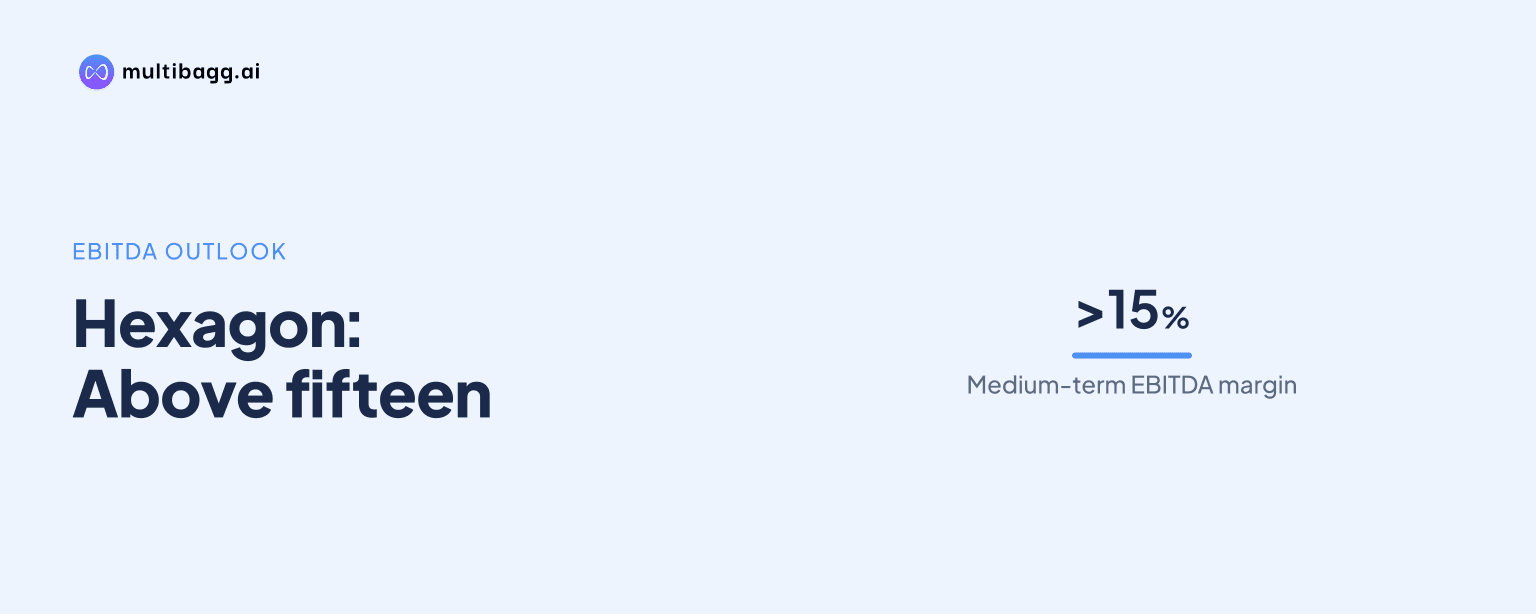
Hexagon Nutrition® targets a medium-term earnings before interest, tax, depreciation and amortisation (EBITDA) margin above 15% by raising capacity utilisation from approximately 30% and moving its business-to-consumer (B2C) revenue mix towards more than 35%. The plan also includes a distributor network beyond 400+, direct-to-consumer (D2C) e-commerce expansion and engagement with more than 25,000 healthcare professionals.
Know Hexagon Nutrition inside out
Results, valuation, peers and who's buying, in one view.
How does Hexagon plan to reach a 15%+ EBITDA margin?
Hexagon targets an EBITDA margin of more than 15% in the medium term through higher manufacturing utilisation, a larger B2C revenue mix and operating leverage on its fixed-cost base. The presentation places these measures in its efficiency and manufacturing-margin pillar, but does not disclose a target year, revenue forecast or profit forecast.
Capacity utilisation is approximately 30%, making increased use of manufacturing capacity a stated route to improving fixed-cost absorption. Hexagon also lists reducing import dependency as an efficiency measure and describes its current position as “85% domestic,” although the presentation does not define the measure behind that percentage or provide a numerical import-reduction target.
The stated margin plan relies on several operating mechanisms rather than one project. Higher utilisation is intended to increase output from the existing fixed-cost base, while B2C mix growth is expected to change the revenue composition; neither the current B2C share nor a specific capacity-utilisation goal is disclosed.
Why is Hexagon targeting B2C revenue above 35%?
Hexagon aims to move B2C revenue towards more than 35% as part of its medium-term 15%+ EBITDA-margin plan. The presentation does not state the current B2C revenue share, so it does not quantify the increase required to reach that level.
The domestic strategy links the B2C objective to brand awareness for Pentasure and Nutrone, wider distribution and a larger D2C channel. D2C e-commerce currently accounts for 6.5%, according to the presentation, but management does not provide a future D2C percentage target or a timetable for scaling the channel.
B2C growth is intended to sit alongside Hexagon’s premium business-to-business-to-consumer (B2B2C) premix strategy. In premixes, management plans to seek more fast-moving consumer goods (FMCG) wallet share, add bakery and snacks applications, offer pharma-grade nutraceutical premixes and increase repeat-client revenue share, without attaching a percentage target to repeat business.
How will Hexagon expand its domestic reach?
Hexagon plans to expand its distributor network beyond 400+ and deepen penetration in tier-2 and tier-3 cities. The slide gives no current distributor total, target completion date or state-by-state distribution plan.
Management also targets engagement with more than 25,000 healthcare professionals (HCPs) as it builds Pentasure and Nutrone awareness. The presentation does not disclose the current number of HCPs engaged, the type of engagement planned or the date by which the 25,000+ objective is to be reached.
D2C e-commerce, at a current 6.5%, is the other specified domestic route alongside physical distribution and HCP engagement. The comparison is clear: Hexagon provides a present D2C share of 6.5% but provides only directional targets for distributor expansion beyond 400+ and HCP engagement above 25,000.
Got a follow-up? Ask IRIS
Which products and capabilities support Hexagon’s growth strategy?
Hexagon identifies functional foods and dietary supplements, plant-based nutritional alternatives, maternal and geriatric nutrition, personalised and immunity products, and condition-specific products for cardiovascular health and obesity as new categories. Management says entry into adjacent segments will be supported by research and development (R&D), without giving revenue targets for individual categories.
The R&D function has 11 professionally qualified and experienced members and participates in client product-development cycles typically lasting six months to two years. Hexagon also cites dedicated R&D facilities, an independent quality-assurance department and references to the Food Safety and Standards Authority of India, the National Accreditation Board for Testing and Calibration Laboratories, and the Department of Scientific and Industrial Research.
A specific product-development milestone was commercial-scale process validation of VIT A+ on 28 September 2026. For PFH-VAP, a stable Vitamin A Palmitate product intended for large-scale food fortification, Hexagon reports 88% Vitamin A retention after 12 months, compared with 28% to 68% for comparative products shown in the presentation.
What export initiatives form part of Hexagon’s plan?
Hexagon plans to grow branded exports beyond 14 countries, pursue market approvals in the Middle East and Africa, and use its South Africa wholly owned subsidiary as an Africa hub. The presentation does not disclose current export revenue, a target export share or a date for expanding beyond 14 countries.
The Uzbekistan facility is identified as a platform for Central Asia and for scaling premix exports. Management also plans to pursue environmental, social and governance and United Nations tenders in additional countries; these are strategic intentions rather than disclosed tender awards or sales contracts.
VIT A+ is positioned as supporting both the fortification and premix offering and the export strategy. Its proposed market brand is HEXA VIT A+, and the 88% retention result after 12 months compares with the 28% to 68% range reported for comparative products, giving Hexagon a disclosed product-performance measure as it pursues food-manufacturer applications.
Conclusion
Hexagon’s plan combines a medium-term EBITDA-margin target above 15% with defined commercial and operating levers: capacity utilisation from approximately 30%, B2C mix towards more than 35%, D2C e-commerce from 6.5%, distribution beyond 400+ and HCP engagement above 25,000. New nutrition categories, premium premixes and exports beyond 14 countries are intended to provide the product and market expansion behind those levers.
What to watch next is management’s disclosure of progress on utilisation, B2C revenue mix, distributor reach and HCP engagement, as the presentation gives no deadlines for these measures. The development of the Uzbekistan and South Africa export platforms, market approvals in the Middle East and Africa, and commercial progress after the 28 September 2026 VIT A+ validation are also relevant to the stated plan.