










Highness plans Goa plant for up to 8,000 displays daily
Key highlights
- Highness plans COG and FOG lines in Goa capable of producing up to 8,000 small and medium-sized displays daily.
- The proposed Goa facility has a disclosed 5,000-square-metre land allotment offer at Tuem’s Electronic Manufacturing Cluster.
- The Goa plan includes an R&D centre, an Endurance and Environmental Testing Lab, a glass-resizing line and a metal shop.
- Highness’s Rabale resizing process uses plus or minus 0.1 millimetre precision cutting and 100% inspection.
powered by IRIS
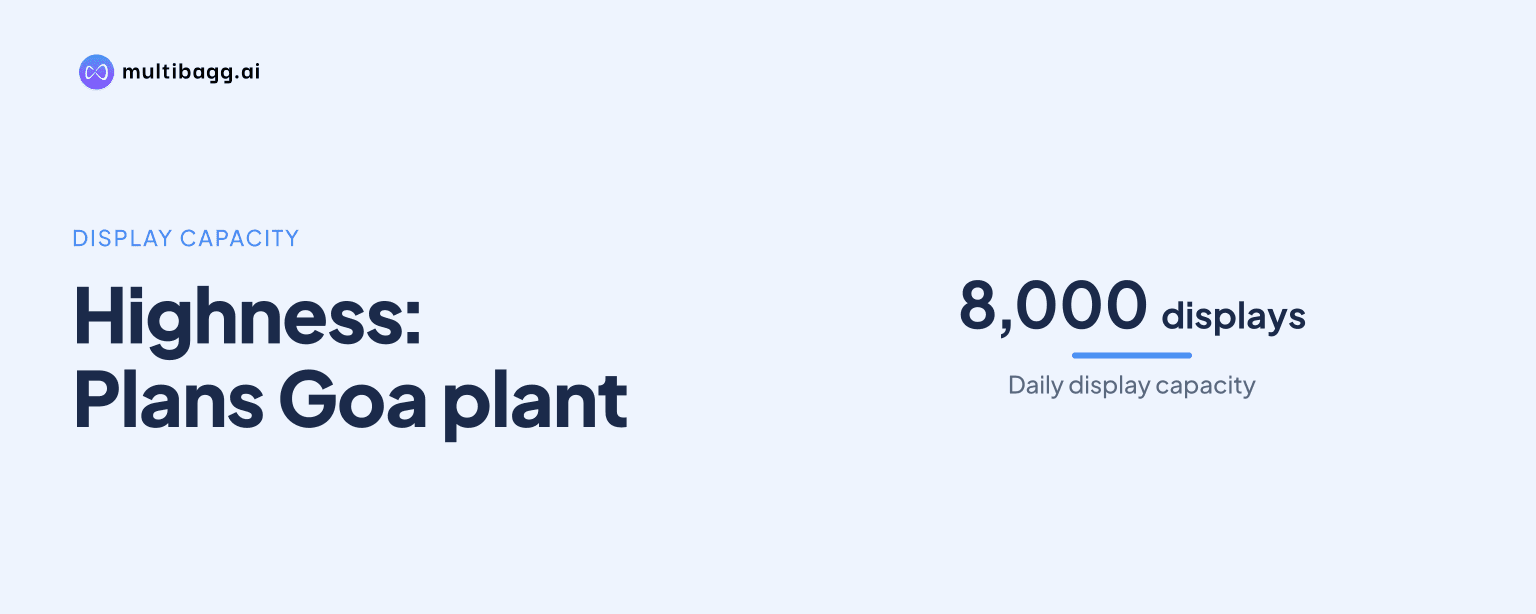
Highness Microelectronics Ltd plans a Goa thin-film-transistor liquid-crystal display (TFT-LCD) module facility with chip-on-glass (COG) and film-on-glass (FOG) lines capable of producing up to 8,000 small and medium-sized displays daily. The proposed 5,000-square-metre Tuem site would also add display resizing, reliability testing, research and development, and enclosure fabrication.
Know Highness Microelectronics inside out
Results, valuation, peers and who's buying, in one view.
What will Highness build at the Goa facility?
Highness plans a TFT-LCD module manufacturing plant at the Electronic Manufacturing Cluster in Tuem, Goa, after receiving an allotment offer for 5,000 square metres of land. The planned facility would contain COG and FOG lines and a glass-cutting and resizing line for display modules.
The Goa plan also includes an in-house research and development (R&D) centre and an Endurance and Environmental Testing Lab. Highness says the R&D centre is intended to support innovation, while the laboratory is designed to assess display reliability through endurance and environmental testing.
An in-house metal shop is another proposed component of the 5,000-square-metre facility. Highness says the shop would enable internal fabrication of display enclosures instead of outsourcing that process, although the presentation does not quantify current outsourced volumes, costs or expected savings.
The company’s business-strategy page describes the Goa site as covering TFT-LCD modules, touch screens and display controllers, in addition to COG, FOG and R&D capabilities. The 8,000-displays-a-day figure, however, is specifically attached to the planned COG and FOG output of small and medium-sized displays.
How much display capacity is Highness targeting in Goa?
Highness is targeting production of up to 8,000 small and medium-sized displays a day through the planned COG and FOG lines. This is a proposed maximum daily capability rather than reported output, sales, utilisation or an annual production forecast.
The stated output is intended to serve industrial automation, white goods, automobiles and select medical devices. Highness does not disclose customer names, purchase commitments, display-size mix, average selling prices or the share of the proposed 8,000-unit daily capacity allocated to each segment.
COG and FOG are the production mechanisms identified for the daily display target. The presentation does not provide a separate capacity figure for touch screens, display controllers, glass resizing or metal enclosures at the Goa location.
The proposed capacity expands the scope of Highness’s display offering beyond a single end-market. The four named application groups range from industrial automation and white goods to automobiles and selected medical devices, but the presentation gives no projected revenue split among them.
Got a follow-up? Ask IRIS
How would Goa change Highness manufacturing operations?
Highness’s existing Rabale, Mumbai facility handles printed circuit board (PCB), backlight, touch-panel and mechanical-housing assembly, supported by internal mechanical-enclosure design. The Goa plan would add COG and FOG module lines, an endurance and environmental testing laboratory, and an in-house metal shop to those disclosed assembly and design activities.
The comparison is between the current Rabale assembly base and the proposed deeper integration at Goa. Rabale has an in-house glass-cutting line that resizes existing display cells, while Goa is planned to include a glass-cutting and resizing line alongside COG and FOG production.
Rabale’s display-resizing process uses precision cutting with accuracy of plus or minus 0.1 millimetres. Its disclosed sequence includes polarizer removal, cutting, cleaning and checking, bonding and sealing, secondary ultraviolet curing, and 100% inspection of dimensions, display performance and reliability.
Highness says the Rabale process allows custom display development without new liquid-crystal display panel tooling. At Goa, the proposed metal shop would address a separate step in the manufacturing chain by bringing enclosure fabrication in-house rather than using external suppliers.
The proposed facility therefore combines several mechanisms: COG and FOG module production, resizing, testing and enclosure work. The presentation does not state whether the Goa site will replace any Rabale activity, how work will be divided between the two locations, or when the planned lines will enter service.
What is the status and execution risk of the Goa plan?
Highness presents Goa as a planned expansion, stating that it has received an allotment offer for 5,000 square metres on the facility page and that it has been allotted a 5,000-square-metre plot on the strategy page. The presentation does not disclose land terms, final regulatory approvals, construction timing or a commissioning date.
Management places the project within its portfolio expansion and backward-integration strategy. It says new machinery and in-house COG and FOG lines are intended to improve quality, reduce dependency and support new product development, but it provides no baseline dependency measure or quantified target.
The Endurance and Environmental Testing Lab is the disclosed mechanism linked to Highness’s quality objective. The company says its quality systems use continuous monitoring and process improvements to support accuracy, efficiency and consistency, without providing test volumes, reliability thresholds or certification targets for Goa.
Highness’s SWOT analysis identifies dependence on third parties for some processes and project gestation periods as weaknesses. It also identifies possible delays in the realisation of government incentives as a threat, while disclosing no incentive amount, application status or incentive condition for the 5,000-square-metre Goa project.
Conclusion
Highness’s proposed Goa facility would add up to 8,000 daily displays of COG and FOG capacity to its existing Rabale assembly, design and resizing activities. The 5,000-square-metre plan combines module production with glass resizing, R&D, reliability testing and internal enclosure fabrication, broadening the manufacturing steps the company intends to manage itself.
The next disclosures to watch are progress from land allotment to site development, installation of COG, FOG and testing equipment, and a commissioning schedule. Management has not disclosed capital expenditure, funding, capacity utilisation, customer demand by the four stated segments or any Goa-linked government incentive amount.