










Himatsingka Seide operating cash flow falls 63% in H1
Key highlights
- Himatsingka Seide generated Rs 67.11 crore of operating cash in the six months ended 30 September 2026, down from Rs 180.65 crore.
- Trade receivables consumed Rs 108.78 crore of cash, while the closing receivables balance rose to Rs 1,271.75 crore.
- Inventories increased to Rs 1,281.15 crore at 30 September 2026 and absorbed Rs 48.90 crore of cash.
- Himatsingka Seide issued Rs 34 crore of non-convertible debentures during the six-month period.
powered by IRIS
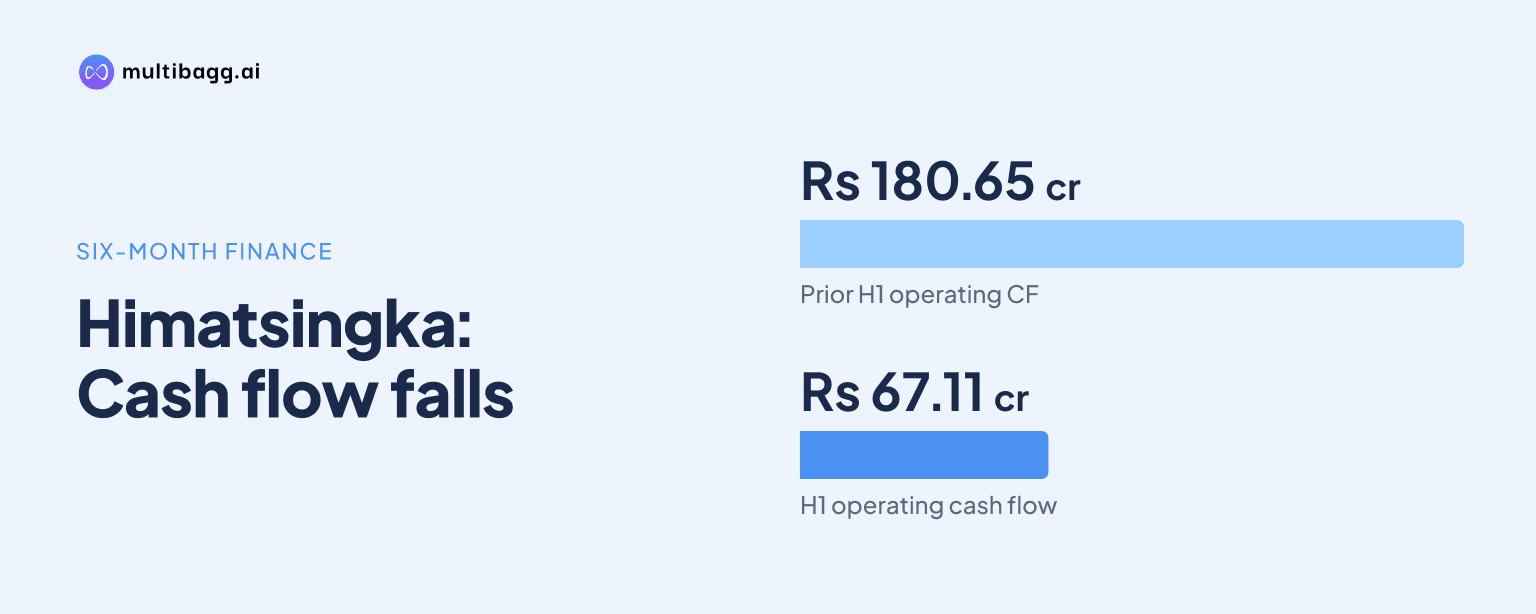
Himatsingka Seide Limited generated Rs 67.11 crore of net operating cash in the six months ended 30 September 2026, 63% below Rs 180.65 crore a year earlier, as trade receivables absorbed Rs 108.78 crore, inventories used Rs 48.90 crore and trade payables reduced cash by Rs 81.17 crore.
Know Himatsingka Seide inside out
Results, valuation, peers and who's buying, in one view.
Why did Himatsingka Seide operating cash flow fall?
Himatsingka Seide’s operating cash flow fell because working-capital movements absorbed substantially more cash than in the previous first half. Cash generated from operations before tax payments declined to Rs 68.19 crore in the six months ended 30 September 2026 from Rs 186.38 crore a year earlier. After net income taxes paid of Rs 1.08 crore, compared with Rs 5.73 crore in the prior-year period, net cash generated from operating activities was Rs 67.11 crore.
Cash flow before working-capital changes was Rs 220.12 crore, down from Rs 241.22 crore in the six months ended 30 September 2025. The pre-working-capital figure included Rs 44.86 crore of loss allowance on financial assets, against Rs 5.99 crore a year earlier, while depreciation and amortisation fell to Rs 55.01 crore from Rs 75.66 crore. Profit before tax was also lower at Rs 13.08 crore, compared with Rs 78.33 crore.
The 63% decline is calculated from the reported operating cash-flow figures of Rs 67.11 crore and Rs 180.65 crore. The fall in cash flow before working-capital changes was Rs 21.10 crore, while receivables, payables and other working-capital accounts accounted for the larger change in cash generation during the half year.
How did Himatsingka Seide’s working capital move?
Himatsingka Seide recorded a Rs 108.78 crore cash outflow from trade receivables in the six months ended 30 September 2026, reversing a Rs 19.65 crore cash inflow in the prior-year period. This was the largest negative working-capital movement reported for the latest half year. Trade receivables rose to Rs 1,271.75 crore at 30 September 2026 from Rs 1,191.69 crore at 31 March 2026.
Inventories absorbed Rs 48.90 crore of cash, compared with an outflow of Rs 54.56 crore a year earlier. Inventories increased to Rs 1,281.15 crore at 30 September 2026 from Rs 1,223.72 crore at 31 March 2026. The cash-flow statement therefore shows a smaller inventory outflow year on year, but a higher inventory balance than at the preceding financial year-end.
Trade payables reduced cash by Rs 81.17 crore, compared with a Rs 8.58 crore outflow in the comparable period. The composition changed within payables: dues to creditors other than micro and small enterprises fell to Rs 582.80 crore at 30 September 2026 from Rs 733.11 crore at 31 March 2026, while dues to micro and small enterprises rose to Rs 193.25 crore from Rs 115.10 crore.
Other movements partly offset those cash demands. Other assets generated Rs 25.33 crore of cash after consuming Rs 17.12 crore a year earlier, and other liabilities generated Rs 59.33 crore against Rs 6.58 crore in the prior-year period. Provisions added Rs 2.26 crore of cash, whereas they used Rs 0.75 crore in the six months ended 30 September 2025.
Got a follow-up? Ask IRIS
What changed in Himatsingka Seide’s borrowings and liquidity?
Himatsingka Seide’s reported borrowings increased by Rs 95.99 crore between 31 March 2026 and 30 September 2026. Non-current borrowings rose to Rs 1,337.02 crore from Rs 1,296.98 crore, while current borrowings increased to Rs 1,378.24 crore from Rs 1,322.29 crore. These balances exclude lease liabilities, which are separately presented in the balance sheet.
During the six months ended 30 September 2026, Himatsingka Seide received Rs 306.03 crore from non-current borrowings and repaid Rs 191.20 crore. Net current borrowings declined by Rs 7.74 crore in the cash-flow statement. Interest paid was Rs 168.88 crore, close to Rs 169.61 crore in the prior-year period, and financing activities used net cash of Rs 65.33 crore, versus Rs 178.47 crore a year earlier.
Himatsingka Seide issued 34,000 senior, unsecured, rated, listed, redeemable, taxable non-convertible debentures during the half year at an issue price of Rs 10,000 each, aggregating Rs 34 crore. The debentures were issued through private placement and listed on BSE Limited. Cash and cash equivalents stood at Rs 24.37 crore at 30 September 2026, down from Rs 46.66 crore at 31 March 2026.
How did Himatsingka Seide’s earnings compare with cash generation?
Himatsingka Seide’s consolidated revenue from operations declined 3% to Rs 1,245.83 crore in the six months ended 30 September 2026 from Rs 1,286.51 crore a year earlier. Profit before tax declined to Rs 13.08 crore from Rs 78.33 crore, while profit for the period fell to Rs 19.19 crore from Rs 52.89 crore. The lower operating cash generation occurred alongside this lower reported profit base.
Finance costs decreased to Rs 134.35 crore from Rs 147.53 crore, and depreciation and amortisation decreased to Rs 55.01 crore from Rs 75.66 crore. Himatsingka Seide reported an operating margin of 11.83% for the six-month period, compared with 17.56% a year earlier, while net profit margin was 1.05%, against 6.09%, according to its Regulation 52 disclosure.
Receivable collection and inventory conversion also changed during the period. Himatsingka Seide reported a debtors’ turnover ratio of 1.98 for the six months ended 30 September 2026, down from 2.16 in the prior-year period. Inventory turnover was 1.25, compared with 1.40 a year earlier, alongside the reported increases in closing receivables and inventories.
Conclusion
Himatsingka Seide’s operating cash flow fell to Rs 67.11 crore from Rs 180.65 crore as higher receivables and inventories, together with lower trade payables, absorbed cash. Revenue, profit before tax and profit for the period also declined year on year, while reported borrowings rose by Rs 95.99 crore from the March 2026 financial year-end.
The unresolved matter for subsequent results is whether the Rs 1,271.75 crore receivables balance and Rs 1,281.15 crore inventory balance convert into cash, and whether trade-payable movements normalise. The next financial disclosures can also show the effect of the Rs 34 crore non-convertible debenture issue on borrowings, interest payments and cash balances.