










Hinduja Leyland Finance merger approved despite loan concerns
Key highlights
- The Official Liquidator flagged overdue loans, repayment obligations and FVTOCI valuations in a report dated 17 September 2026.
- Hinduja Leyland Finance said ECL provisions at 31 March 2026 were adequate and an independent valuer had been engaged.
- The First Petitioner Company’s shareholders approved the Scheme with 100% support by value and number on 30 July 2026.
- The companies must file E-Form INC-28 within 30 days of receiving the NCLT order.
powered by IRIS
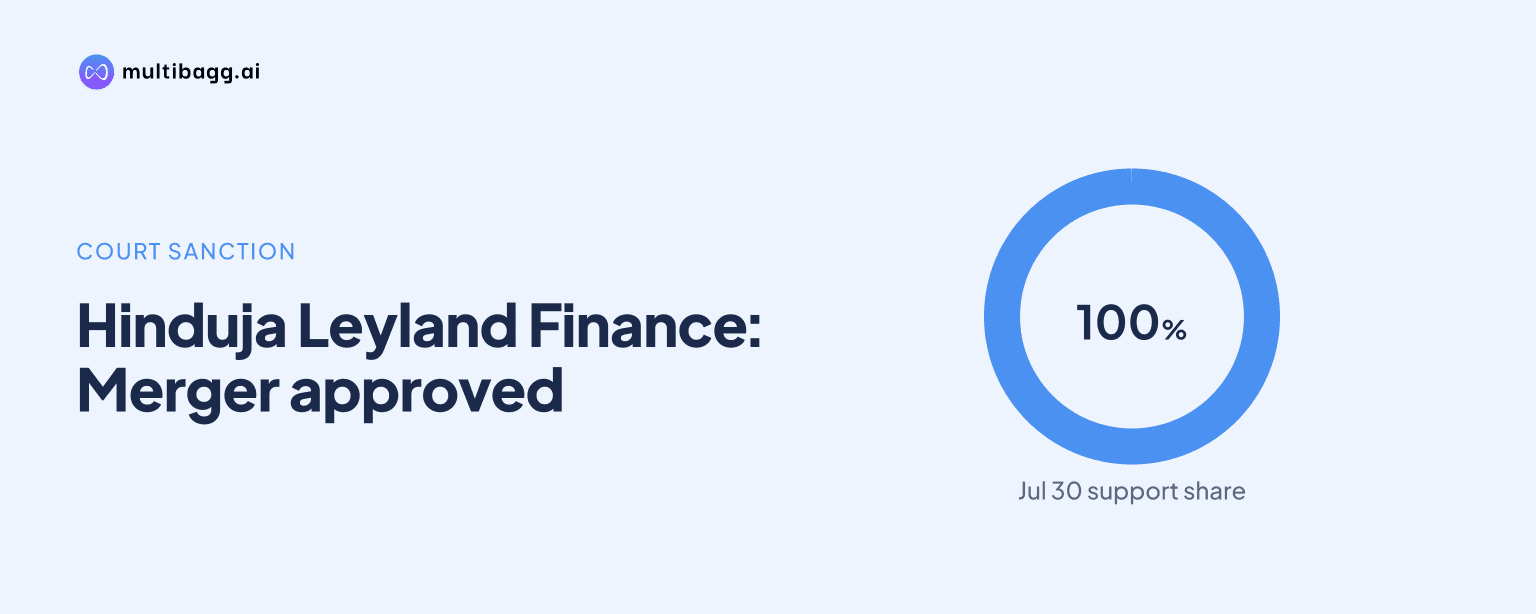
National Company Law Tribunal, Mumbai Bench-I approved Hinduja Leyland Finance’s Scheme after its first petitioner won 100% shareholder support by value and number on 30 July 2026, despite the Official Liquidator’s 17 September 2026 observations on overdue loans, repayment obligations and FVTOCI assets; Hinduja Leyland Finance said its 31 March 2026 ECL provisions were adequate.
Know Ashok Leyland inside out
Results, valuation, peers and who's buying, in one view.
What concerns did the Official Liquidator raise about Hinduja Leyland Finance?
The Official Liquidator raised three specific issues in a report dated 17 September 2026: the Transferor Company’s overdue loan portfolio, its substantial near-term repayment obligations, and the valuation of certain loan assets measured at Fair Value through Other Comprehensive Income, or FVTOCI. The order does not disclose the overdue-loan amount, the value of repayment obligations, the number of affected loans, or the value of the FVTOCI assets.
The scrutiny was part of the review of the proposed Scheme of Arrangement before the National Company Law Tribunal, or NCLT, Mumbai Bench-I. The Tribunal recorded the Official Liquidator’s observations but also recorded the latter’s conclusion, subject to those observations, that the Transferor Company’s affairs had not been conducted in a manner prejudicial to creditors or public interest as of the 17 September 2026 report.
The valuation point concerned loan assets identified as FVTOCI in the Official Liquidator’s report. Hinduja Leyland Finance said its valuation methodology complied with Indian Accounting Standard 113, or Ind AS 113, and that it had engaged an independent valuer to determine the fair value of identified loan assets. The order does not identify the valuer or state when the valuation exercise will be completed.
How did Hinduja Leyland Finance respond to the loan and liquidity observations?
Hinduja Leyland Finance responded in an affidavit dated 17 September 2026 that its Expected Credit Loss, or ECL, provisions at 31 March 2026 were adequate. It also said loan assets, after deducting those provisions, fairly represented their realisable value. The order provides no rupee amount for the provisions or the loan assets covered.
On repayment risk, Hinduja Leyland Finance told the Tribunal that it was well positioned to meet its obligations. That statement addressed the Official Liquidator’s reference to substantial near-term repayments, but the filing gives no maturity schedule, cash balance, committed borrowing facility, liquidity ratio or debt figure against which the assertion can be compared.
The response set out Hinduja Leyland Finance’s position on provisioning, asset valuation and repayments rather than changing the scope of the Official Liquidator’s review. The Tribunal’s order records both sides of the matter: observations were raised on 17 September 2026, and Hinduja Leyland Finance answered on the same date with statements on ECL adequacy, realisable value and repayment capacity.
Got a follow-up? Ask IRIS
Why did the NCLT approve Hinduja Leyland Finance’s merger?
The NCLT approved the Scheme after finding, on the material before it, that it appeared fair and reasonable, did not violate law and was not contrary to public policy. The Tribunal noted that no other statutory or regulatory authority, creditor, member or stakeholder had lodged an objection, and the Regional Director’s authorised representative said on 1 October 2026 that there was no objection to consideration of the Scheme.
The approval followed voting and creditor processes completed before the order. Equity shareholders of the First Petitioner Company approved the Scheme on 30 July 2026 with 100% support by value and number among those present and voting. For the Second Petitioner Company, approval was 99.99% by value and 97.87% by number among those present and voting.
The First Petitioner Company’s unsecured creditors also approved the Scheme on 30 July 2026, with 99.99% of participating creditors supporting it through remote e-voting and e-voting. The Second Petitioner Company’s meeting was dispensed with because its three unsecured creditors, whose aggregate outstanding amount was Rs 8.77159 lakh at 31 March 2026, had been paid in the ordinary course and issued no-dues certificates.
The Tribunal made the company petition absolute after reviewing reports from the Regional Director, Income Tax Department and Official Liquidator, alongside the companies’ undertakings. Approval did not remove the conditions in the order: the companies must protect creditor and employee interests, comply with applicable accounting standards, and follow directions from sectoral regulators where issued.
What must Hinduja Leyland Finance do after merger approval?
The Transferor Company is dissolved without winding up under the approved Scheme, while its liabilities will transfer to the Transferee Company. The order specifies that liabilities for offences committed by officers in default before the merger continue under Section 240 of the Companies Act, 2013, meaning the restructuring does not remove that statutory position.
The petitioner companies must electronically file the order and Scheme with the concerned Registrar of Companies in E-Form INC-28 within 30 days of receiving the order. They must also lodge an authenticated copy of the order and Scheme with the concerned Superintendent of Stamps within 60 days of receipt for adjudication of any stamp duty payable.
Employees of the Transferor Company who are in service immediately before the effective date will become employees of the Transferee Company without a break or interruption in service, on terms no less favourable than those then in force. The order does not state the effective date, the number of employees transferring, or the financial effect of integrating the business.
The Income Tax Department retains the right to examine tax payable from the Scheme and to take action under income-tax law if it finds tax avoidance. This reservation follows the companies’ joint affidavit of 3 September 2026, responding to the Assistant Commissioner of Income Tax’s report dated 12 August 2026, in which they said tax implications would be governed by applicable law.
Conclusion
The NCLT’s approval allows Hinduja Leyland Finance’s Scheme to proceed despite the Official Liquidator’s 17 September 2026 observations on overdue loans, repayment obligations and FVTOCI valuations. The Tribunal relied on the record before it, including Hinduja Leyland Finance’s statements that ECL provisions at 31 March 2026 were adequate, net loan values reflected realisable value and repayment obligations could be met, as well as the absence of further objections and the voting results.
The next disclosed milestones are procedural: E-Form INC-28 must be filed within 30 days of receipt of the order, and stamp-duty papers must be lodged within 60 days. Matters to watch are the independent valuation of identified loan assets, any sectoral regulatory directions, the eventual effective date, and any Income Tax Department examination of tax consequences under the Scheme.