










Hindustan Unilever Limited posts 15% sales growth in Q2
Key highlights
- Hindustan Unilever reported 15% underlying sales growth, its highest rate in 14 quarters.
- September-quarter turnover was ₹18,071 crore, with underlying volume growth of 7%.
- Hindustan Unilever reported a 22.6% EBITDA margin despite about 400 bps gross-margin contraction.
- The earnings-call highlights were released on 28 October 2026, and the transcript disclosure was dated 4 November 2026.
powered by IRIS
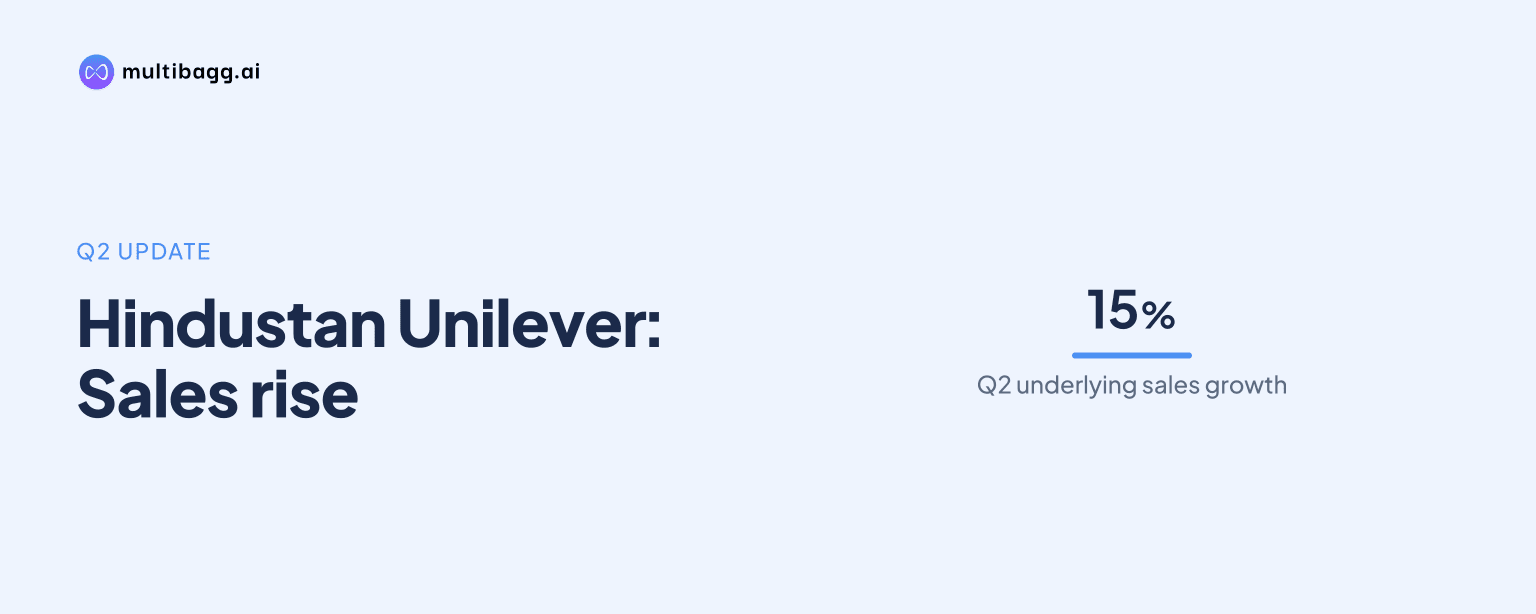
Hindustan Unilever Limited reported 15% underlying sales growth for the quarter ended 30 September 2026, its highest rate in 14 quarters, on turnover of ₹18,071 crore and underlying volume growth of 7%.
Know Hindustan Unilever inside out
Results, valuation, peers and who's buying, in one view.
What did Hindustan Unilever Limited report for the September quarter?
Hindustan Unilever Limited reported turnover of ₹18,071 crore in the September 2026 quarter, corresponding to the second quarter of financial year 2027. The company said underlying sales growth reached 15%, its strongest performance on this measure in the past 14 quarters.
Underlying volume growth was 7%. The company presented the result as being supported by disciplined execution and continuing portfolio transformation. The reported growth figures provide the key operating indicators cited in the September-quarter earnings call.
The company also reported an EBITDA margin of 22.6%. This margin outcome came despite pressure on gross profitability, with gross margin contracting by about 400 basis points due to commodity inflation.
How did the September-quarter earnings call unfold?
The earnings call covered Hindustan Unilever's results for the quarter ended 30 September 2026. Priya Nair, Chief Executive Officer and Managing Director, and Niranjan Gupta, Chief Financial Officer and Executive Director, Finance, participated in the call.
In her prepared remarks, Nair said the company had delivered ₹18,071 crore of turnover and 15% underlying sales growth. She described this as the highest growth rate in the last 14 quarters and said 7% underlying volume growth remained strong.
The earnings-call highlights were released on 28 October 2026. Hindustan Unilever subsequently disclosed the transcript of the call under Regulation 30 of the SEBI Listing Obligations and Disclosure Requirements Regulations, with the disclosure dated 4 November 2026.
The transcript disclosure gives investors access to management's discussion of the quarterly numbers after the financial-results announcement. The supplied information does not provide a share-price movement or additional segment-wise financial figures.
Why did gross margin contract despite sales growth?
Hindustan Unilever said gross margin contracted by about 400 basis points because of commodity inflation. This means input-cost pressure affected gross profitability even as the company recorded its strongest underlying sales-growth rate in 14 quarters.
The reported EBITDA margin was 22.6%, showing the margin measure disclosed for the quarter after the stated gross-margin pressure. The available earnings-call material does not break down commodity costs by category or quantify the individual contribution of pricing, mix, or cost-control actions to EBITDA margin.
The contrast between 15% underlying sales growth and gross-margin contraction is important for investors assessing the quality of quarterly growth. Sales expansion and volume growth indicate operating momentum, while the gross-margin data highlights that raw-material inflation remained a relevant financial factor.
Got a follow-up? Ask IRIS
How does this compare with Hindustan Unilever's earlier growth?
The September-quarter result marks a clear improvement from the company's reported 2% underlying sales growth in the quarter ended 31 December 2024. That earlier quarter had flat volume growth and an EBITDA margin of 23.5%, according to the supplied historical earnings-call information.
For the financial year ended 31 March 2026, Hindustan Unilever reported turnover of ₹63,763 crore, 5% underlying sales growth and 4% underlying volume growth. The September-quarter figures of 15% underlying sales growth and 7% volume growth are therefore higher than the growth rates cited for that full financial year.
What does the result mean for investors and the consumer-goods sector?
For investors, the key reported development is the combination of 15% underlying sales growth and 7% volume growth, alongside a 22.6% EBITDA margin. The figures point to stronger reported demand and execution during the quarter, but also show that commodity inflation reduced gross margin by about 400 basis points.
The result is relevant to the consumer-goods sector because volume growth is a closely watched measure of consumption demand, while commodity costs can influence profitability across packaged consumer products. However, the supplied material does not disclose market-share data, guidance, earnings-per-share figures, or a forecast for future margins.
Hindustan Unilever's management linked the quarter's performance to disciplined execution and portfolio transformation. Investors can use the official transcript to review management's commentary, while distinguishing the disclosed operating data from information not included in the available material.
Conclusion
Hindustan Unilever delivered its highest underlying sales growth in 14 quarters in the September 2026 quarter, with turnover of ₹18,071 crore, 15% underlying sales growth and 7% underlying volume growth. The 22.6% EBITDA margin was achieved despite an approximately 400-basis-point gross-margin contraction linked to commodity inflation.
The next disclosed reference point is the official earnings-call transcript filed on 4 November 2026 for the quarter ended 30 September 2026. Investors will watch subsequent company disclosures for whether volume growth, commodity-cost pressure and reported margins change in later quarters.