










Hindware Limited Proposes 1:1 Share Issue and Stock Listing
Key highlights
- Hindware proposes one Rs 2 equity share for every one Rs 2 Remaining Transferor Company share.
- New shares issued in the 1:1 exchange will remain frozen until listing and trading approval.
- Part III would add 10 crore authorised equity shares of Rs 2 each to Hindware's authorised capital.
- Existing partly paid-up shares would rise from 9 lakh to 15.25 lakh shares.
powered by IRIS
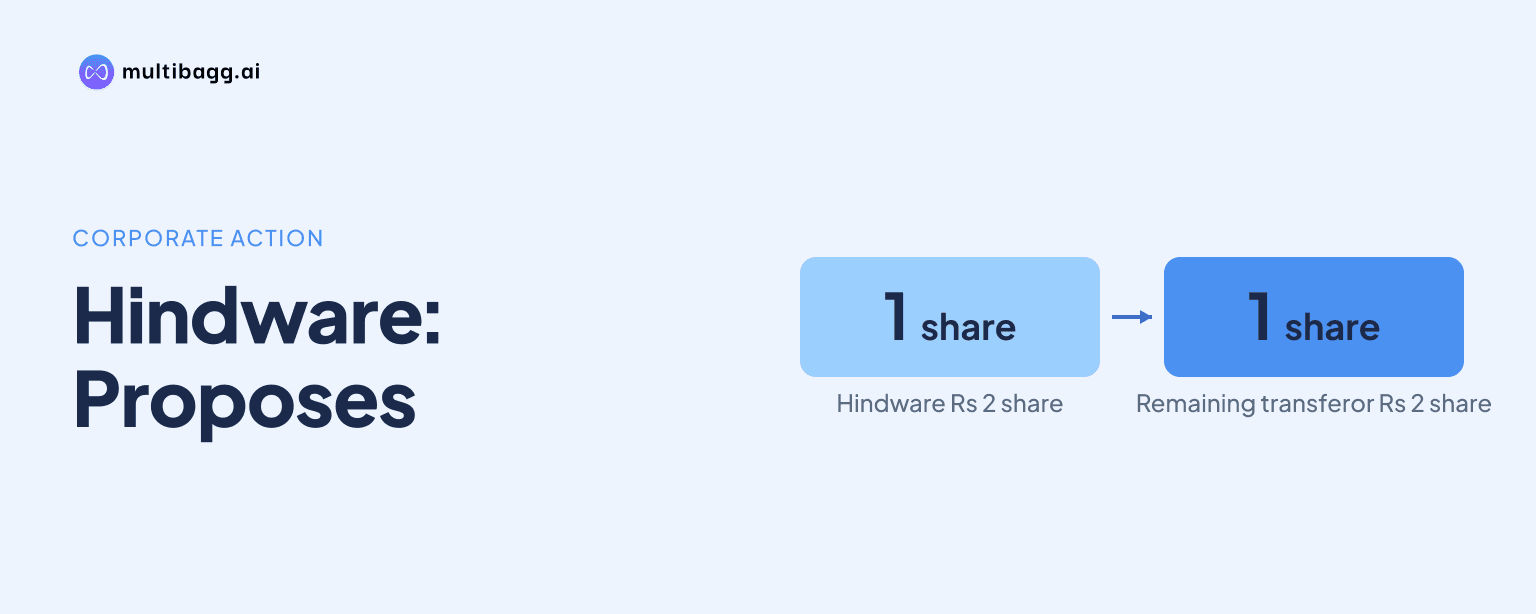
Hindware Limited proposes to issue one fully paid Rs 2 equity share for every fully paid Rs 2 share in the Remaining Transferor Company on the Record Date for Amalgamation, while applying to list all of its equity shares. The scheme requires stock-exchange clearance and Tribunal sanction before it becomes effective.
Know Hindware Home Innovation inside out
Results, valuation, peers and who's buying, in one view.
What does Hindware's 1:1 share exchange mean?
Hindware will allot one new fully paid equity share of Rs 2 for every one fully paid Rs 2 equity share held in the Remaining Transferor Company as of the Record Date for Amalgamation. The allotment is the consideration for Part III of the scheme, which amalgamates the Remaining Transferor Company into Hindware.
Hindware's new shares will rank pari passu with its existing equity shares, meaning they will carry equal rights to dividends, bonus shares, rights shares, voting rights and other corporate benefits after the applicable record date. The scheme says the entitlement was determined using a valuation report, which Corporate Professionals Capital Private Limited described as fair and reasonable in its fairness opinion dated March 27, 2025.
Hindware will not issue fractional shares directly to eligible holders. It will aggregate fractional entitlements, round the total up to the next whole share, and allot those shares to a board-nominated trustee in dematerialised form. The trustee may sell the shares within 90 days of allotment and distribute net proceeds, after expenses and applicable income tax, to holders in proportion to their fractions.
Which assets and liabilities will transfer to Hindware?
Hindware will receive all assets, permits, contracts, liabilities, loans, duties and obligations of the Remaining Transferor Company from the Appointed Date through the operation of law. The transfer covers investments in shares, mutual funds, bonds and other securities, as well as customer claims, advances, bank balances, intellectual property, movable property and immovable property.
The transfer applies to the business left after the Demerged Undertaking was separated under Part II of the scheme. Debts and obligations related to the Remaining Transferor Company will move to Hindware on the same terms, while pre-existing security over transferred assets is intended to remain confined to those assets rather than extend to Hindware's other property.
Hindware may operate the Remaining Transferor Company's bank and demat accounts after the Effective Date until the account names are changed. Cheques and payment instructions made in the former company's name can be accepted and credited to Hindware, while inter-company loans, advances, receivables, payables, contracts and transactions between the two entities will be cancelled from the Effective Date.
How will Hindware's capital and listing process change?
Hindware will apply to list all its equity shares on the stock exchanges in compliance with the applicable Securities and Exchange Board of India, or SEBI, circular and other rules. The new shares issued under the 1:1 exchange will remain frozen in the depository system until listing and trading approval is received.
The scheme says a change in Hindware's shareholding pattern or control between the Record Date for Amalgamation and listing could affect the status of stock-exchange approval. Hindware must also make the applications, filings and undertakings needed to complete the listing formalities.
The 10 crore authorised shares to be combined with Hindware's authorised capital are twice the 5 crore shares transferred to the Resulting Company under Part II. The scheme provides that Hindware's memorandum and articles of association will be amended to reflect the combined authorised capital once the scheme takes effect.
Existing partly paid-up shareholders will have their 9 lakh shares reorganised into 15.25 lakh partly paid-up shares, after fractional adjustments and rounding. If those shares become fully paid before the Record Date for Amalgamation, the same 15.25 lakh figure will apply to fully paid shares. Hindware's board may call for outstanding amounts, and the shares can be included in the listing once fully paid under revised terms.
Got a follow-up? Ask IRIS
What happens to employees, contracts and tax positions?
Hindware will take on employees of the Remaining Transferor Company who are in service on the Effective Date without a break in service. Their employment terms must not be less favourable than those applicable before the merger, and their service for retirement benefits will be treated as continuing from their original joining dates.
Provident fund, gratuity fund, superannuation fund and other employee-fund balances are to move to Hindware's relevant funds or funds nominated by Hindware. Until that transfer is completed, employee dues will continue to be deposited into the existing funds of the Remaining Transferor Company.
Hindware will also succeed to contracts, licences, permits, intellectual-property rights and legal proceedings related to the remaining business from the Appointed Date. It may execute novation agreements or confirmations where required, although the scheme states that a missing formal amendment by a third party will not prevent contractual transfer and vesting.
Taxes paid by the Remaining Transferor Company, including advance tax, tax deducted at source and minimum alternate tax where applicable, are to be treated as paid by Hindware. Subject to applicable law, tax losses, unabsorbed depreciation, refunds, incentives and tax credits may vest in Hindware, which may revise or file tax and statutory returns beyond normal due dates where necessary for the scheme.
What approvals and restrictions apply before completion?
Hindware's amalgamation requires a no-objection or observation letter from the stock exchanges under Regulation 37 of the SEBI Listing Obligations and Disclosure Requirements Regulations, as well as sanction by the Tribunal under Sections 230 to 232 of the Companies Act. The parties may jointly withdraw the scheme before it becomes effective.
If required sanctions and approvals are not obtained by a date agreed by the parties, the scheme will become null and void. In that circumstance, each party is generally to bear its own costs, charges and expenses, subject to the scheme's provisions on rights or obligations that had already arisen.
From the Appointed Date until the Effective Date, the Remaining Transferor Company must carry on the remaining business in trust for Hindware. It cannot alter or diversify the business, enter a new business, or dispose of, mortgage or encumber assets outside the ordinary course without Hindware's prior consent.
The Remaining Transferor Company also cannot use post-Appointed-Date income or profits to declare or pay dividends without Hindware's prior written consent. On the Effective Date, it will be dissolved without winding up, its board and committees will be discharged, and its name will be struck off from the Registrar of Companies records.
Conclusion
Hindware's proposal combines the remaining business into one company through a 1:1 share exchange while transferring assets, liabilities, employees, contracts and tax positions. It also adds 10 crore authorised equity shares of Rs 2 each to Hindware's capital and reorganises 9 lakh partly paid-up shares into 15.25 lakh shares.
The next matters to watch are the stock exchanges' no-objection or observation letter, Tribunal sanction, the Record Date for Amalgamation and listing approval. Until the Effective Date, the remaining business must operate in the ordinary course, and the newly issued shares will remain frozen until listing and trading approval is obtained.