








H.M. Electro Mech reports Rs 6.8 crore H1 operating outflow
MAX Plan at ₹4,999/yr

Find your next multibaggerBe a Pro Investor
Research stocks and track your picks on the go. Download the app.
Key highlights
- H.M. Electro Mech reported a Rs 6.8 crore operating cash outflow in H1 FY27, versus a Rs 1.2 crore operating inflow in FY26.
- Inventories increased by Rs 13 crore to Rs 37.5 crore at H1 FY27.
- Short-term borrowings rose by Rs 11.1 crore to Rs 20.3 crore at H1 FY27.
- H1 FY27 PAT increased 4.8% to Rs 2.5 crore while EBITDA margin rose to 15.3%.
powered by IRIS
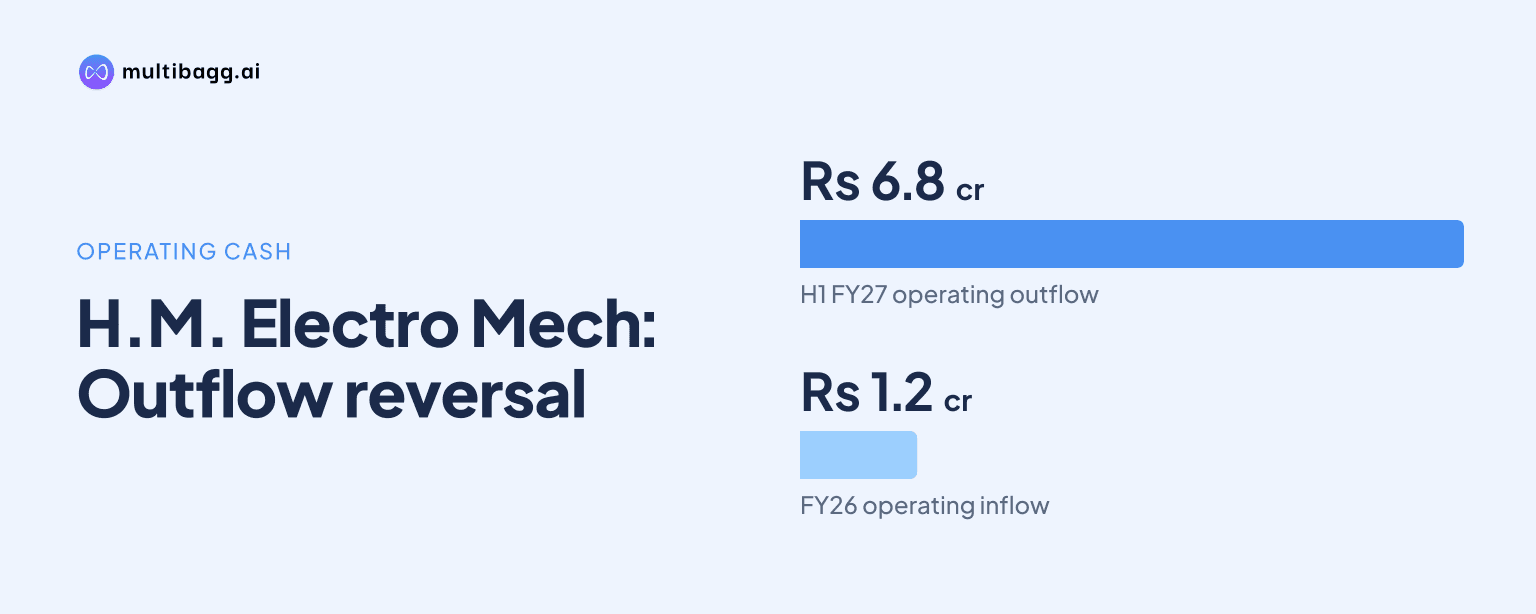
H.M. Electro Mech Limited reported net cash used in operating activities of Rs 6.8 crore in H1 FY27, while inventory increased to Rs 37.5 crore and short-term borrowings rose to Rs 20.3 crore. H.M. Electro Mech nevertheless reported Rs 2.5 crore in profit after tax for the half year, up 4.8% year on year.
Know H.M. Electro Mech inside out
Results, valuation, peers and who's buying, in one view.
Why did H.M. Electro Mech report negative operating cash flow in H1 FY27?
H.M. Electro Mech reported a Rs 6.8 crore operating cash outflow in H1 FY27, compared with a Rs 1.2 crore operating cash inflow reported for FY26. The presentation does not provide a line-by-line reconciliation of operating cash flow, so it does not assign the half-year outflow to specific working-capital movements.
The balance sheet records inventory of Rs 37.5 crore at H1 FY27, up Rs 13 crore from Rs 24.5 crore at FY26 end. Other current assets rose by Rs 5.4 crore to Rs 11.9 crore, while trade receivables declined by Rs 23.3 crore to Rs 42 crore and trade payables declined by Rs 20 crore to Rs 11.6 crore.
The cash result differed from the reported earnings outcome. H.M. Electro Mech recorded Rs 2.5 crore in profit after tax, or PAT, in H1 FY27, against Rs 2.4 crore in H1 FY26, even as revenue from operations declined 6.1% to Rs 31.7 crore from Rs 33.8 crore.
Gross profit increased 57.9% to Rs 15.8 crore in H1 FY27 from Rs 10 crore a year earlier. This followed a 33% decline in cost of materials consumed, including changes in work in progress and finished goods, to Rs 15.9 crore from Rs 23.8 crore.
How did H.M. Electro Mech’s working-capital balances change?
H.M. Electro Mech’s inventory increased by Rs 13 crore at H1 FY27, while receivables and trade payables were both lower than their FY26 closing balances. Among these reported lines, inventory was the largest increase, rising 53.1% to Rs 37.5 crore from Rs 24.5 crore.
The inventory turnover ratio was 3.5 times in H1 FY27, compared with 5.4 times in FY26 and 5.9 times in FY25. H1 FY27 is a partial-year period and FY25 and FY26 are full-year periods, so those disclosed ratios are not directly like-for-like measures of a full-year operating cycle.
Debtor turnover was 0.6 times in H1 FY27, down from 2.5 times in FY26 and 3.5 times in FY25. The H1 FY27 receivables balance was lower at Rs 42 crore versus Rs 65.3 crore at FY26 end, but the presentation does not explain the relationship between that balance movement and the reported turnover ratio.
How was H.M. Electro Mech’s H1 FY27 cash shortfall funded?
H.M. Electro Mech reported Rs 8.5 crore of net cash from financing activities in H1 FY27, which exceeded the Rs 6.8 crore used in operations. Net cash from investing activities was Rs 1.2 crore, compared with Rs 2.1 crore used in investing activities for FY26.
The reported cash flows produced a Rs 2.9 crore increase in cash and cash equivalents during H1 FY27. Cash and cash equivalents closed the period at Rs 10.4 crore, compared with Rs 7.6 crore at the beginning of the year, while FY26 closed with Rs 7.6 crore.
Short-term borrowings more than doubled to Rs 20.3 crore at H1 FY27 from Rs 9.2 crore at FY26 end, an increase of Rs 11.1 crore. Long-term borrowings declined by Rs 1.3 crore to Rs 4.6 crore, leaving combined reported short- and long-term borrowings at Rs 24.9 crore, compared with Rs 15.1 crore at FY26 end.
The cash-flow statement does not identify the individual sources of the Rs 8.5 crore financing inflow. It therefore does not specify how much came from borrowings, equity transactions, repayment changes or other financing activity during H1 FY27.
Got a follow-up? Ask IRIS
What do H.M. Electro Mech’s earnings and debt measures show?
H.M. Electro Mech increased earnings before interest, tax, depreciation and amortisation, or EBITDA, by 27.4% to Rs 4.9 crore in H1 FY27 from Rs 3.8 crore in H1 FY26. EBITDA margin increased to 15.3% from 11.3%, while PAT margin rose to 7.8% from 7%.
Employee benefit expenses increased 89.3% to Rs 9.1 crore and other expenses rose 33.2% to Rs 1.9 crore. Finance costs increased 182.3% to Rs 1.4 crore from Rs 0.5 crore, limiting the increase in profit before tax and exceptional items to 1.3%, or Rs 3.4 crore.
The debt-equity ratio was 0.3 times in H1 FY27, compared with 0.2 times in FY26 and 0.1 times in FY25. Return on capital employed, or RoCE, was 16.5% in H1 FY27, below 18.3% in FY26 and 22.4% in FY25, while interest coverage increased to 11.3 times from 9.2 times.
The current ratio was 2.3 times in H1 FY27, compared with 2.2 times in FY26 and 2.5 times in FY25. Shareholders’ funds rose to Rs 77.7 crore from Rs 75.2 crore, while total assets declined to Rs 133.8 crore from Rs 137.1 crore.
What should readers monitor in H.M. Electro Mech’s next results?
Readers should monitor whether H.M. Electro Mech’s inventory changes from Rs 37.5 crore and whether operating cash flow improves after the Rs 6.8 crore H1 FY27 outflow. The presentation gives no target for inventory, operating cash flow or working-capital levels.
Short-term borrowings of Rs 20.3 crore and finance costs of Rs 1.4 crore are also relevant items for the next reported period. The presentation does not disclose the maturity profile, interest rates or specific composition of short-term borrowings.
Readers can also track whether the 15.3% H1 FY27 EBITDA margin is sustained as revenue develops from Rs 31.7 crore in the half year. For context, H.M. Electro Mech reported Rs 132.2 crore of revenue and Rs 14.5 crore of EBITDA for FY26.
Conclusion
H.M. Electro Mech combined a Rs 2.5 crore H1 FY27 PAT with a Rs 6.8 crore operating cash outflow. Inventory increased by Rs 13 crore, short-term borrowings increased by Rs 11.1 crore, and Rs 8.5 crore in financing inflow helped lift closing cash to Rs 10.4 crore.
The presentation leaves unresolved the detailed drivers of the operating outflow and the composition of financing inflows. The next results should show whether inventory moves from Rs 37.5 crore, short-term borrowings remain near Rs 20.3 crore and operating cash flow changes after the H1 FY27 outflow.

