










Hyundai Motor India Q2 FY27 Results: Key Numbers
Key highlights
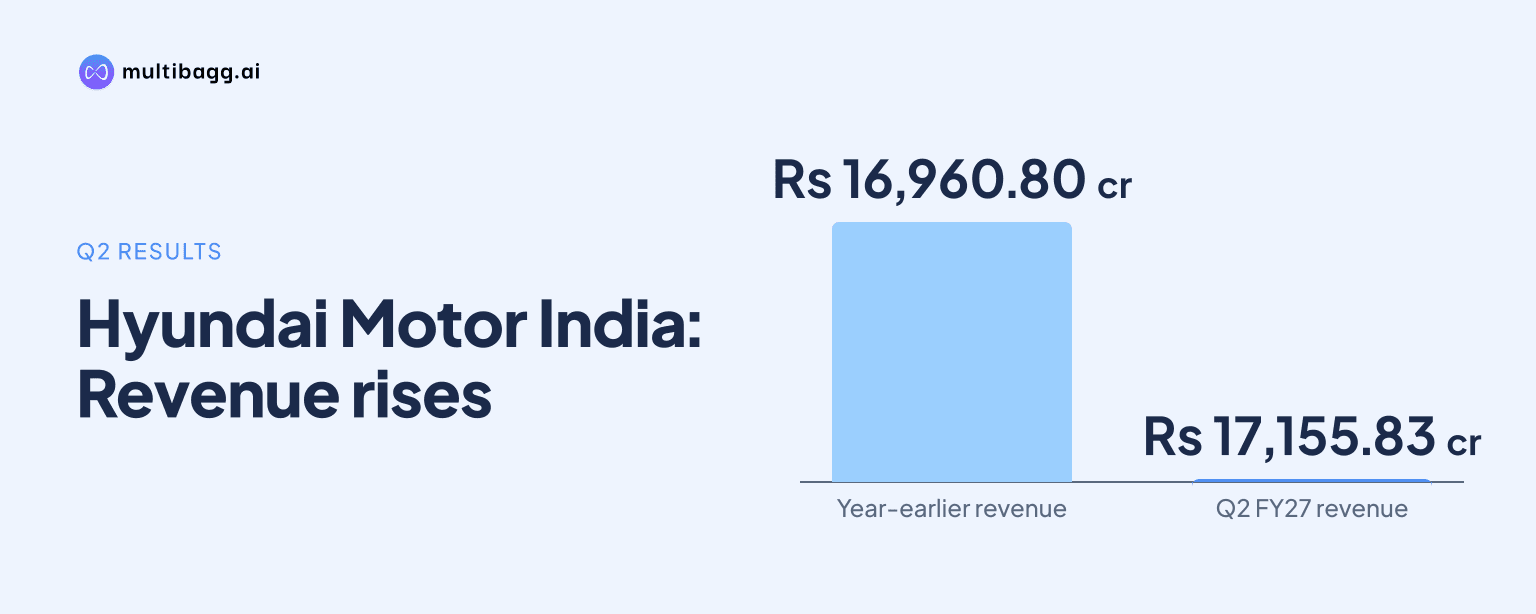
- Hyundai Motor India reported standalone Q2 FY27 revenue of ₹17,155.83 crore, compared with ₹16,960.80 crore a year earlier.
- Q2 FY27 profit after tax rose to ₹1,570.25 crore from ₹1,337.79 crore in the year-earlier quarter.
- Total July-September sales increased 14.7% year on year to 219,072 vehicles.
- Hyundai plans ₹7,500 crore of capital expenditure by FY27 and has commenced production at the Talegaon facility, which has annual capacity of 170,000 units.
powered by IRIS
Hyundai Motor India’s board was scheduled to consider its unaudited standalone and consolidated financial results for the quarter and half year ended September 30, 2026, on October 28. The company had informed the NSE about the board meeting on October 21. Its Q2 FY27 earnings call was also scheduled for 4:30 PM IST on the same day. The quarterly update was closely watched because sales volumes rose strongly, while brokerages expected higher commodity costs and start-up expenses to pressure profitability.
Know Hyundai Motor India inside out
Results, valuation, peers and who's buying, in one view.
Board meeting and results schedule
The October 28 meeting was set to approve Hyundai Motor India’s September-quarter results. The company’s filing covered both standalone and consolidated financial statements for Q2 FY27 and the first half of FY27. Hyundai had generally published results between 28 and 46 days after the end of a quarter over the eight quarters cited in the available record. The Q2 FY27 result date fell 28 days after September 30, 2026.
Reported Q2 FY27 financial figures
The provided results information shows standalone revenue of ₹17,155.83 crore for the September quarter, compared with ₹16,960.80 crore a year earlier. Profit after tax stood at ₹1,570.25 crore, against ₹1,337.79 crore in the corresponding prior-year period. The figures indicate that profit after tax increased from the year-earlier base, while revenue also moved higher. The company’s reported figures should be assessed alongside the detailed financial statements and management commentary released with the results.
Key Q2 FY27 data
Sales volumes supported the topline
Hyundai Motor India’s monthly releases showed total July-September sales of 219,072 vehicles, including domestic sales and exports. This represented a 14.7% increase from 1.91 lakh units a year earlier. Volumes were also 23% higher sequentially than the 1.78 lakh units reported in Q1 FY27. July contributed 75,360 units, August accounted for 65,796 units, and September added 77,916 units. Higher volumes, price increases and product mix were identified by brokerages as the main factors supporting revenue growth expectations.
Broker expectations before the announcement
A 12-broker average compiled by Informist had projected consolidated revenue of ₹20,465 crore, up 17% year on year. The same set of estimates put EBITDA at ₹1,996 crore, down 18%, and net profit at ₹1,241 crore, down 21%. These were pre-result estimates rather than reported financial results. The survey suggested that revenue could record its first double-digit rise in nine quarters, while profit could decline for a third consecutive quarter. The gap between forecasts and reported figures can also reflect differences in standalone and consolidated reporting bases.
Got a follow-up? Ask IRIS
Margin pressure remained a key issue
Brokerages expected commodity inflation to offset some of the operating leverage generated by higher volumes. Kotak Securities estimated an EBITDA margin of 9.7%, implying a 4.2 percentage-point year-on-year decline. Nirmal Bang also expected a margin contraction of about 420 basis points to 9.7%, alongside revenue growth of around 17%. The cited cost pressures included commodity expenses, discounts and expenses related to the start-up of Hyundai’s Pune plant. The extent of any pressure on earnings depended on operating costs, other income and the pace of margin recovery.
Previous quarterly performance provides context
For Q1 FY27, Hyundai Motor India reported revenue of about ₹16,334 crore and net profit of ₹888 crore in the available data. Revenue was down 13.65% sequentially and 0.48% year on year in that quarter. Gross profit was reported at ₹954 crore, while net profit was down 29.23% sequentially and 35.10% year on year. Operating profit margin was 9.12%, down 1.26 percentage points sequentially and 4.20 percentage points year on year. This made the September-quarter sales recovery especially relevant for investors tracking the company’s operating performance.
Capital expenditure and capacity expansion
Hyundai Motor India has outlined capital expenditure of ₹7,500 crore by FY27 as it seeks to strengthen its position in the domestic passenger vehicle market. The company has said it plans to introduce two new models during the year, including a mass-market electric SUV. It also commenced production at the Talegaon facility in Maharashtra, which has annual capacity of 170,000 units. These expansion plans bring additional capacity and product options, but plant start-up costs were among the items cited in pre-result margin estimates.
Management outlook and investor focus
Managing Director and Chief Executive Officer Tarun Garg said Hyundai expected to outperform the industry in the second half of FY27. He projected domestic car-sales growth of 8% to 10% for the full year. The company sold 294,262 units in the first half of FY27, a 10% year-on-year increase, according to the provided information. Hyundai attributed the first-half momentum in part to a reduction in Goods and Services Tax. Investors were expected to focus on management’s comments on demand, commodity costs, discounts, exports and the ramp-up at Talegaon during the scheduled earnings call.
What the Q2 update means
Hyundai Motor India entered the September quarter with higher sales volumes and expectations of revenue growth, but also with pressure on costs and margins. The reported standalone figures show revenue of ₹17,155.83 crore and profit after tax of ₹1,570.25 crore for the quarter. The board’s October 28 approval and subsequent investor call provided the formal forum for the company to discuss the financial performance and outlook. The next investor focus will remain on management commentary about demand trends, planned launches, capital expenditure and the progress of margin recovery through the rest of FY27.