










IDBI Bank Starts Fraud Review of Ushdev International Account
Key highlights
- IDBI Bank has started proceedings to classify Ushdev International's account as fraud, with no final outcome stated in the available material.
- Ushdev International entered liquidation on 16 October 2025 after its approved resolution plan failed.
- Nine liquidation asset blocks carried an aggregate reserve price of ₹132.38 crore in the September 2026 auction notice.
- The 31 March 2026 Statement of Affairs reported ₹219.76 crore of assets and ₹12,489.70 crore of current liabilities.
powered by IRIS
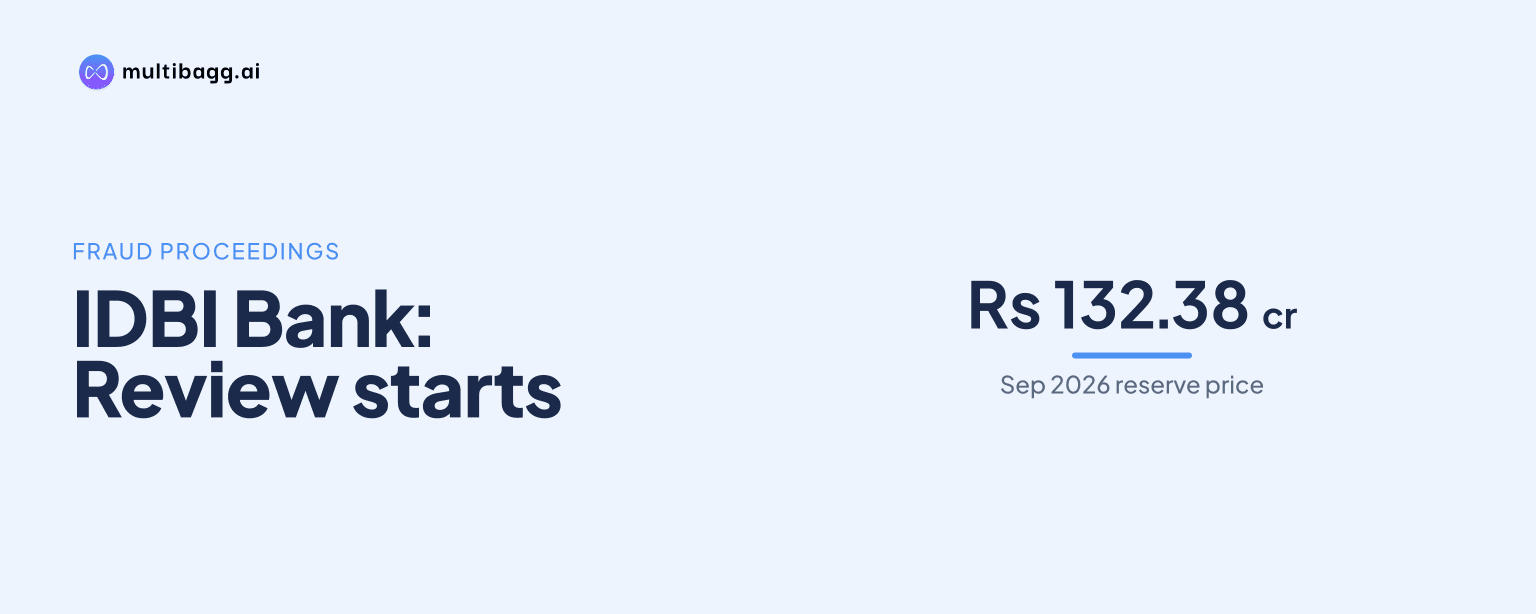
IDBI Bank has started proceedings to classify Ushdev International Limited's account as fraud while the company remains in liquidation, with nine asset blocks offered at an aggregate reserve price of ₹132.38 crore in September 2026. The development adds a banking review to an insolvency process already marked by a failed resolution plan and substantial creditor claims.
Know Ushdev International inside out
Results, valuation, peers and who's buying, in one view.
Why has IDBI Bank begun a fraud-classification review of Ushdev International?
IDBI Bank has initiated proceedings to classify Ushdev International's account as fraud, according to the information provided. The available material does not state the stage of the bank's process, the grounds for the proposed classification, or whether a final classification decision has been made.
This distinction matters because the initiation of proceedings is not the same as a completed fraud classification. Public reports concerning a Central Bureau of Investigation case do not list IDBI Bank as a member of the State Bank of India-led consortium. The supplied information also does not link the bank's review to any particular allegation, investigation finding, or recovery claim.
Ushdev International, a metals trader with wind-power assets, has been in liquidation since 16 October 2025. The Mumbai bench of the National Company Law Tribunal ordered liquidation after the approved resolution plan of successful applicant M/s Taguda Pte. Ltd. failed. Secured financial creditors then encashed the bid bond and performance security worth ₹18.13 crore, including interest of ₹1.61 crore.
The appellate process did not reverse the liquidation order. In July 2026, the National Company Law Appellate Tribunal dismissed Taguda's challenge, imposed costs of ₹0.05 crore, and rejected its offer to pay ₹227 crore in one instalment. The tribunal described the offer as a delaying tactic, according to the supplied account.
What do Ushdev International's financial statements show?
Ushdev International's reported financial position indicates a large gap between assets and liabilities, although the auditor said it could not obtain sufficient evidence regarding asset realisability or claim settlement. The auditor issued a disclaimer of opinion for the position as at 15 October 2025.
At that date, the company reported a net loss of ₹15.73 crore, negative net worth of ₹3,223.33 crore, and net current liabilities of ₹3,281.33 crore. These figures underline the financial stress that preceded liquidation, but they should be read alongside the auditor's inability to verify key balances.
The Statement of Affairs as at 31 March 2026 showed total assets of ₹219.76 crore against total current liabilities of ₹12,489.70 crore. That resulted in reported negative net worth of ₹12,269.94 crore. The difference between the liquidation estate's auction reserve values and total reported liabilities is important for creditors assessing possible recoveries.
Got a follow-up? Ask IRIS
Which Ushdev International assets were put up for auction?
Liquidator Trupalkumar J. Patel issued a fresh e-auction notice dated 3 September 2026 for nine blocks of Ushdev International's liquidation estate with an aggregate reserve price of ₹132.38 crore. The auction was scheduled for 21 September on the BAANKNET platform, with expressions of interest, eligibility documents and earnest money deposits due by 18 September.
The September sale notice covered assets in Maharashtra and Karnataka. It included land and building assets, while the broader liquidation estate has also included windmills, equity shares and advance receivables. Earnest money for each lot was set at 10% of that lot's reserve price. The sale terms were on an "as is where is", "as is what is", "whatever there is", "without recourse" and "without any warranties" basis.
An earlier notice dated 20 July 2026 had offered 14 lots with a combined reserve price of ₹149.05 crore for sale on 6 August. That offering covered assets in Maharashtra, Tamil Nadu, Karnataka, Rajasthan and Gujarat, including offices at New Harileela House, wind turbines in four states and a stake in Uttam Galva Ferrous Ltd.
On the face of the two notices, about ₹16.67 crore of reserve value and wind assets in three states were no longer part of the September offering. The filings provide aggregate reserve prices, so reserve prices for individual assets that appeared in both notices cannot be directly compared from the available information.
How does the liquidation process affect creditors and investors?
The liquidation converts Ushdev International's remaining estate into assets available for sale, with proceeds intended to be distributed under the Insolvency and Bankruptcy Code framework. Actual creditor recovery will depend on completed sales, realised values, admitted claims, liquidation costs and the applicable distribution waterfall. No auction outcome or creditor recovery rate is provided in the material.
For prospective bidders, the sale conditions place the due-diligence burden on the buyer. Inspection periods were provided before the scheduled auctions, but the assets were offered without warranties. Participation was restricted to persons eligible under Section 29A of the Insolvency and Bankruptcy Code, and ineligible bidders could forfeit their earnest money deposits.
The failed Taguda plan is central to the present process. A resolution plan would have sought to revive the corporate debtor, whereas liquidation focuses on monetising the estate. The NCLAT's dismissal of the challenge allowed the liquidation process to continue, while the proposed fraud classification review introduces a separate bank-led proceeding concerning the account.
The source also refers to the 66th consolidated committee of creditors meeting on 3 November 2026. Since the company is already in liquidation, disclosures around any residual resolution-plan matters, asset-sale progress and creditor recoveries remain relevant for stakeholders monitoring the case.
Conclusion
IDBI Bank's initiation of fraud-classification proceedings comes while Ushdev International remains in liquidation following the failure of its approved resolution plan. The company's reported liabilities substantially exceed the assets listed in its Statement of Affairs, and the ₹132.38 crore September auction reserve price illustrates the limited scale of the identified sale pool relative to reported current liabilities.
The next disclosures to watch are asset-sale announcements, realised auction values and recovery rates for creditors. Stakeholders may also monitor any updates arising from the 66th consolidated committee of creditors meeting held on 3 November 2026 and any further developments in IDBI Bank's account-classification process.