










Ushdev enters liquidation after Taguda plan implementation fails
Key highlights
- Ushdev entered liquidation on 16 October 2025 after Taguda Pte Ltd failed to implement its tribunal-approved resolution plan.
- Ushdev had Rs 12,275.8238 crore of admitted claims as at 9 June 2026, including Rs 9,532.6373 crore owed to secured financial creditors.
- Secured lenders forfeited Rs 18.1346 crore in Taguda-linked bid-bond and performance-security funds on 9 February 2024.
- Ushdev’s auditor issued a disclaimer on internal financial controls for the year ended 31 March 2026 because sufficient documentation was unavailable.
powered by IRIS
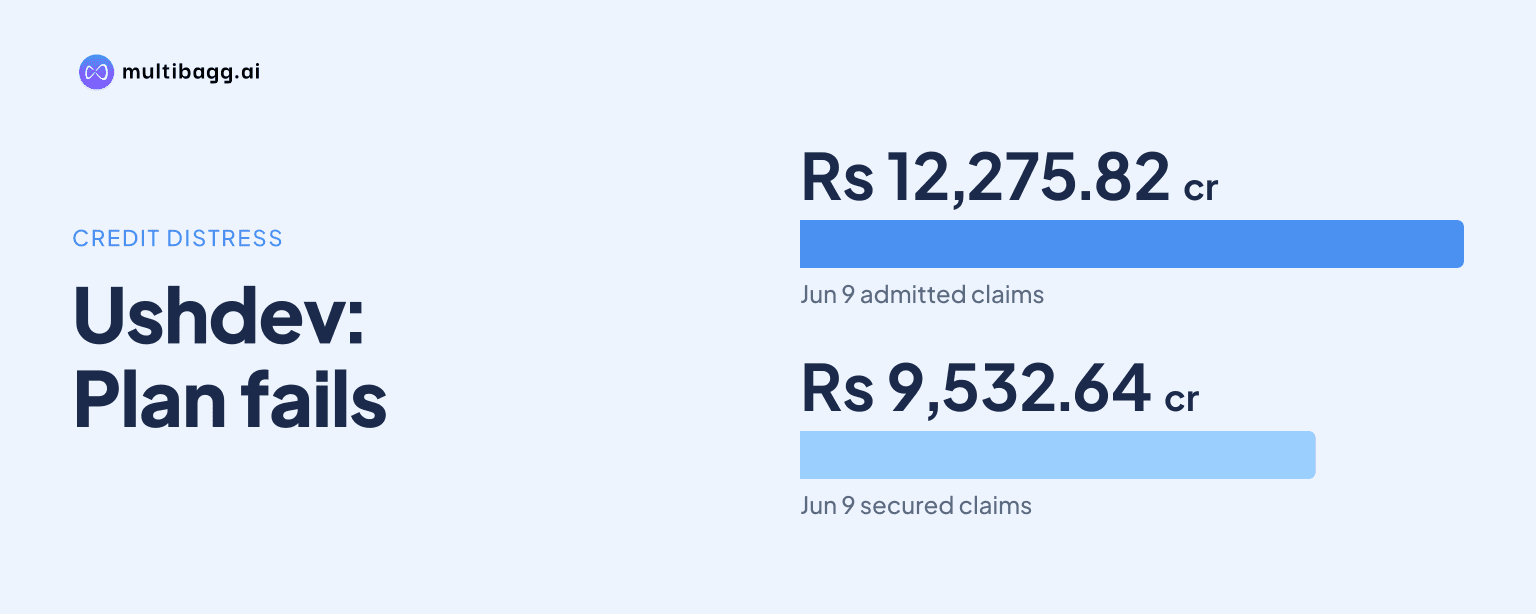
Ushdev International Limited (in Liquidation) entered liquidation on 16 October 2025 because Taguda Pte Ltd did not implement the tribunal-approved resolution plan. The move ended Ushdev’s going-concern status, transferred management powers to a liquidator and placed Rs 12,275.8238 crore of claims admitted as at 9 June 2026 into the Insolvency and Bankruptcy Code process.
Know Ushdev International inside out
Results, valuation, peers and who's buying, in one view.
When did Ushdev enter liquidation?
Ushdev entered liquidation on 16 October 2025 under an order of the Mumbai bench of the National Company Law Tribunal (NCLT). Financial creditors led by State Bank of India had petitioned for liquidation after the successful resolution applicant failed to implement its plan, and the NCLT appointed Trupalkumar Patel as liquidator.
The liquidation order followed a Corporate Insolvency Resolution Process (CIRP) that began on 14 May 2018. At that point, the NCLT suspended the board’s powers and transferred them to Subodh Kumar Agrawal, first as interim resolution professional and later as resolution professional confirmed by the Committee of Creditors (CoC).
Ushdev operates in metal trading and wind-power generation. Its power-generation business remained in operation throughout the 2025-26 financial year, while accounting for the period from 16 October 2025 moved to a non-going-concern basis after the liquidation order.
Why did Ushdev's approved resolution plan fail?
Ushdev’s approved resolution plan failed because Taguda Pte Ltd did not make the payment required to implement it. The CoC voted in favour of the plan, the NCLT approved it on 3 February 2022, and the National Company Law Appellate Tribunal order dated 11 March 2022 was read with that approval.
An Interim Monitoring Agency (IMA) was formed on 15 March 2022 to implement the plan. The filing says no payment was received from Taguda, after which secured financial lenders led by State Bank of India invoked the bid-bond and performance-security funds on 9 February 2024.
The invoked funds totalled Rs 18.1346 crore, including Rs 1.6074 crore of interest on bid-bond money held in a fixed deposit, and were forfeited. The liquidation order dissolved the IMA, while Ushdev says management powers are now exercised by the liquidator under the Insolvency and Bankruptcy Code (IBC).
How much are Ushdev's admitted stakeholder claims?
Ushdev had total claims of Rs 12,275.8238 crore admitted by the Stakeholders’ Consultation Committee (SCC) and CoC as at 9 June 2026. The filing classifies Rs 91.1895 crore as secured and Rs 12,184.6343 crore as unsecured, but cautions that its classification by borrowing facility may differ from classification under the IBC.
Secured financial creditors were the largest creditor category, with admitted claims of Rs 9,532.6373 crore. This was higher than the combined Rs 1,449.5449 crore of government operational claims and Rs 999.8120 crore of other operational claims, while unsecured financial creditors had Rs 293.3843 crore of admitted claims.
State Bank of India had the largest listed secured-financial-creditor claim at Rs 2,541.1486 crore. IDBI’s admitted claim was Rs 1,706.2875 crore and Bank of Baroda’s was Rs 1,149.4416 crore, together accounting for Rs 5,396.8777 crore of the secured-financial-creditor category.
Among government operational claims, the Maharashtra VAT Department had Rs 981.5471 crore and the Income Tax Department’s tax-demand claim was Rs 467.7069 crore. Other operational creditors had Rs 999.8120 crore of admitted claims, while employee operational creditors had Rs 44.53 lakh.
Got a follow-up? Ask IRIS
Which Ushdev assets are outside the liquidation estate?
Two sets of wind assets are outside Ushdev’s liquidation estate because the relevant secured lenders did not relinquish their security interests. The filing identifies Canara Bank’s 0.90 megawatt windmill and related land at Theni, Tamil Nadu, and State Bank of India’s 8.00 megawatt windmills and related land at Satara, Maharashtra.
The claims shown beside those assets are Rs 136.02 crore for Canara Bank and Rs 60.9711 crore for State Bank of India. Under Section 52 of the IBC, a secured creditor that does not relinquish its interest may enforce that security independently, so the secured asset remains outside the liquidator’s control.
If a lender’s realisation from independently enforced security exceeds its debt, the surplus must be handed to the liquidator. If proceeds fall short, the unpaid debt may be considered in the Section 53 distribution order if the creditor files its claim accordingly.
How has liquidation changed Ushdev's accounting?
Ushdev changed to a non-going-concern, or liquidation, basis of accounting from 16 October 2025. Its assets were restated to net realisable values stated in valuation reports, while liabilities were restated to claim values accepted by the liquidator and resulting differences recorded as adjustment surplus or deficit.
The filing says no depreciation on fixed assets was provided after liquidation began, because assets and liabilities were restated at 31 March 2026. Trade receivables from the continuing power operations remained at carrying amount, but other trade receivables mainly linked to the metal business were restated to nil based on valuation reports.
Prepaid expenses were also restated to nil after liquidation began. Ushdev says power operations continued because the liquidator considered their continuation relevant to achieving a better valuation on sale, while revenue from those operations after 16 October 2025 is considered on realisation of sales proceeds in the liquidator’s accounts.
What did Ushdev's auditor report on the liquidation accounts?
Ushdev’s auditor, SGN & CO., issued a disclaimer of opinion on internal financial controls over financial reporting as at 31 March 2026. The auditor said it could not obtain sufficient appropriate audit evidence because adequate documentation covering the design, implementation and operating effectiveness of those controls was unavailable.
The missing evidence included controls over the move from going-concern to liquidation accounting, asset valuation and realisation, claims and liability settlement, accounting records, transaction authorisation and liquidation-period reporting. SGN & CO. said the internal-controls disclaimer affected its audit opinion on Ushdev’s financial statements for the year ended 31 March 2026.
Conclusion
Ushdev’s liquidation followed the failure of an approved resolution plan at the implementation stage, rather than a failed creditor vote or a refusal of tribunal approval. The forfeiture of Rs 18.1346 crore in Taguda-linked bid-bond and performance-security funds preceded the 16 October 2025 liquidation order, while admitted claims of Rs 12,275.8238 crore show the scale of liabilities subject to the IBC process.
The filing expects liquidation to be completed in 12 to 15 months. The next developments will depend on sales of movable and immovable assets and actionable claims through public auction or private contract, continued power operations where they support sale value, and realisations by lenders enforcing security outside the liquidation estate.