










IEX says market coupling may take 1.5-2 years after rules
Key highlights
- IEX management estimates market coupling could take another 1.5 to 2 years after final regulations are notified.
- CERC's April 2026 draft proposed Grid India as market coupling operator; comments and the public hearing concluded in June 2026.
- CERC has proposed reducing RTM bidding from 15 minutes to 5 minutes and gate closure from 75 minutes to 50 minutes.
- RTM accounted for nearly 42% of IEX electricity volume in Q2 FY27, with volume of nearly 16.5 billion units.
powered by IRIS
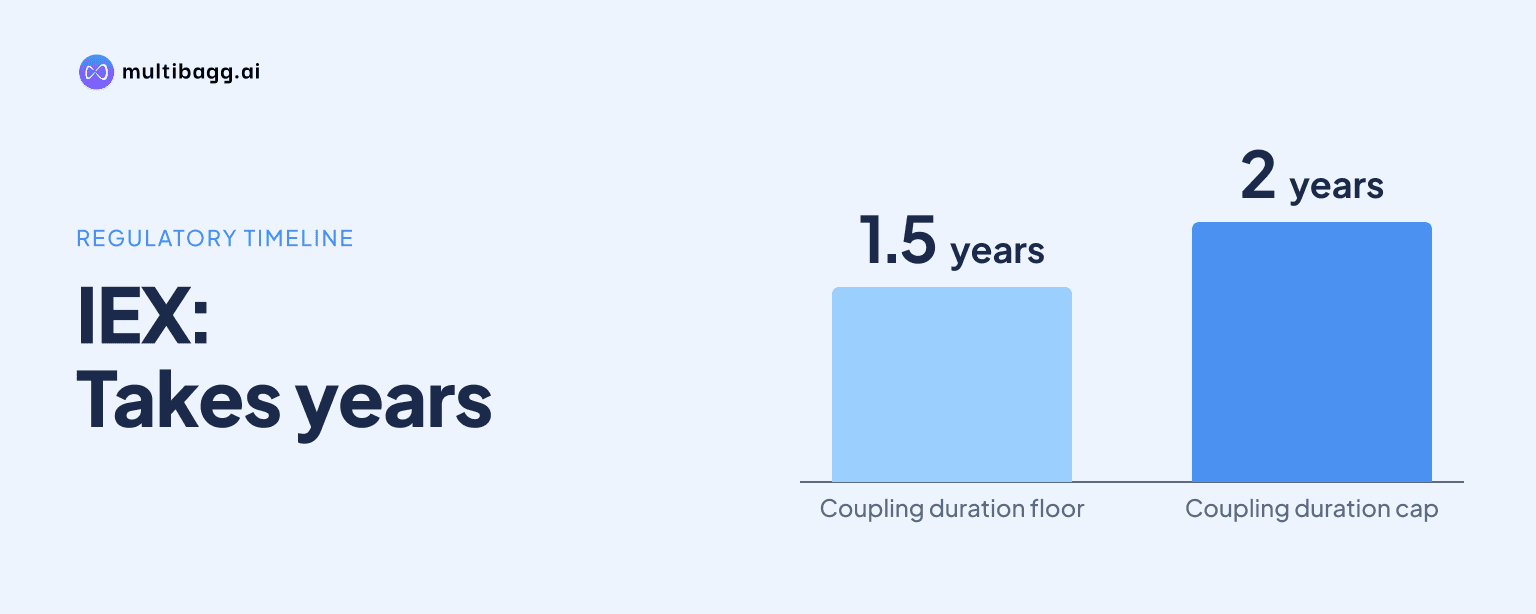
Indian Energy Exchange Limited said on October 30, 2026 that market coupling could take another 1.5 to 2 years after final regulations are notified, because common software and hardware, a settlement system and mock trials would still need to be completed across all three exchanges.
Know Indian Energy Exchange inside out
Results, valuation, peers and who's buying, in one view.
When could IEX market coupling actually begin?
IEX said market coupling would not begin in calendar 2026 and could take a further 1.5 to 2 years after regulations are notified. Chairman and Managing Director Satyanarayan Goel described this as his own estimate, not a fixed regulatory timetable, and said the duration would depend on the final regulations and the implementation approach they prescribe.
The Central Electricity Regulatory Commission, or CERC, issued draft market-coupling regulations in April 2026 and proposed Grid India as the market coupling operator. Stakeholder comments and the public hearing were completed in June 2026, but IEX said there was no further development during Q2 FY27. Management therefore gave no date for notification of the final regulations.
IEX distinguished the regulatory notification from the operational launch. Management said necessary preparations would start after the regulations are notified, because the final rules would determine the technology, settlement and operating requirements for the proposed implementation model.
Why does IEX say implementing market coupling takes time?
IEX said implementation would take time because it requires common software, hardware, uniformity across all three exchanges, a settlement system and mock trials. Goel listed these requirements on the October 30 call when asked whether Grid India would be ready to act as the sole market coupling operator proposed in the April draft regulations.
The company said the work would extend beyond developing software because exchange systems would need to operate uniformly and settlement arrangements would need to be developed before mock trials. IEX did not quantify the cost, identify a technology vendor or say Grid India was unprepared. It said readiness and the implementation period would depend on what is notified in the regulations.
The assessment follows CERC's July 2025 order proposing market coupling in the day-ahead market, or DAM. IEX said it had spent the previous 3 years strengthening customer relationships and technology capabilities through customer feedback, application programming interface-based bidding tools, back-office integrations, data analytics, an enhanced web portal and cybersecurity safeguards.
Why would RTM coupling be harder for IEX?
IEX said coupling the real-time market, or RTM, is likely to become more challenging if CERC shortens the RTM process as proposed. CERC's discussion paper proposes cutting the auction window from 15 minutes to 5 minutes and reducing gate closure from 75 minutes to 50 minutes, leaving less time for bidding and auction processing.
CERC's July 2025 order had said RTM coupling would be considered subsequently because bidding and auction timelines are very tight. IEX linked that observation to the newer scheduling proposal, arguing that a 5-minute bidding window would make coordination for coupling more difficult than under the existing 15-minute window. Public comments on the proposed Indian Electricity Grid Code changes closed in the week before the October 30 call.
RTM has become a larger part of IEX's volume mix. RTM accounted for nearly 42% of IEX electricity volume in Q2 FY27, exceeding DAM's share for the second consecutive quarter. RTM volume was nearly 16.5 billion units, up 10.5% year on year, and the segment recorded its highest single-day volume of 315 million units in September 2026.
Q2 FY27 market conditions also showed the short-interval volatility cited by IEX. Weak monsoon conditions lifted DAM buy bids by nearly 120% year on year, while average DAM prices rose 46% to Rs 5.72 per unit and average RTM prices rose 49% to Rs 5.24 per unit. Later cyclones and unseasonal rain created ample supply liquidity, and RTM prices fell near zero in multiple time blocks on a few days.
Got a follow-up? Ask IRIS
What has CERC decided and what can IEX challenge?
IEX said CERC has proposed market coupling, but final regulations remain necessary before it can be implemented. The company appealed CERC's July 2025 order before the Appellate Tribunal for Electricity, or APTEL, and subsequently the Supreme Court. IEX said both forums found that it was not yet an aggrieved party because coupling could only be implemented after regulations are issued.
According to IEX, the two forums declined to interfere at that stage while leaving open the company's ability to approach the appropriate forum if it is aggrieved by the final regulations. Management said IEX could raise the grounds included in its earlier appeal at that point. Its stated legal position is therefore tied to the final rules rather than the July 2025 order alone.
The regulatory record described by management has three dated steps: CERC's July 2025 order, the April 2026 draft regulations and the June 2026 completion of comments and the public hearing. IEX said Q2 FY27 brought no additional development, so neither a final notification date nor a prescribed go-live schedule was disclosed on the call.
How do IEX's volumes affect the market-coupling debate?
IEX's reported trading growth increases the relevance of how coupling is designed, particularly for short-duration products. Electricity trading volume was 39.7 billion units in Q2 FY27, up 12.7% year on year, and reached 77 billion units in H1 FY27, up 14.2%. RTM's nearly 42% share meant it exceeded DAM's share for a second successive quarter.
Management also cited regulatory measures that could support exchange liquidity from energy storage. CERC amended the Sharing of Inter-State Transmission Charges and Losses Regulations, 2020, to provide a waiver for up to 25 years for battery energy storage systems integrated with renewable or hybrid generating stations. IEX said the measure should reduce power-trading costs for battery energy storage system players and increase exchange liquidity.
Separately, the Central Electricity Authority's draft standards propose that solar and onshore wind projects commissioned after July 1, 2027 install co-located energy storage of at least 2 hours, with capacity equal to at least 10% of installed plant capacity. For specified projects commissioned after July 1, 2029 and up to July 30, 2031, the draft proposes at least 4 hours of storage at the same 10% capacity threshold.
IEX did not say these storage policies determine coupling's timing. Its stated case was that coupling needs common operational infrastructure, while cutting RTM bidding from 15 minutes to 5 minutes makes real-time coupling more difficult. Management said its customer and technology initiatives over the past 3 years should help IEX retain and strengthen its market position after coupling.
Conclusion
IEX's central message is that a market-coupling regulation would not itself create an immediate operational switch. Management estimates that common technology, settlement arrangements and mock trials could require another 1.5 to 2 years after notification, while RTM's nearly 42% share of Q2 FY27 electricity volume raises the importance of auction-processing timelines.
The next item to watch is CERC's final market-coupling regulation after the April 2026 draft and June public hearing. Its provisions will determine the implementation model, including Grid India's proposed role, and will establish whether IEX has grounds to pursue the challenge management said remains available after final regulations are issued.