










Indian Energy Exchange Limited real-time volume overtakes day-ahead
Key highlights
- IEX said RTM accounted for 41% of total volume in the first seven months, compared with 35% for DAM.
- Management described RTM growth at about 30% to 35% CAGR since June 2020, versus roughly 2% to 5% for DAM.
- IEX said DAM and RTM charge the same transaction fee, limiting the per-unit revenue effect of volume migration.
- Management cited a possible April 1, 2027 move to five-minute RTM bidding and 10-minute market clearing.
powered by IRIS
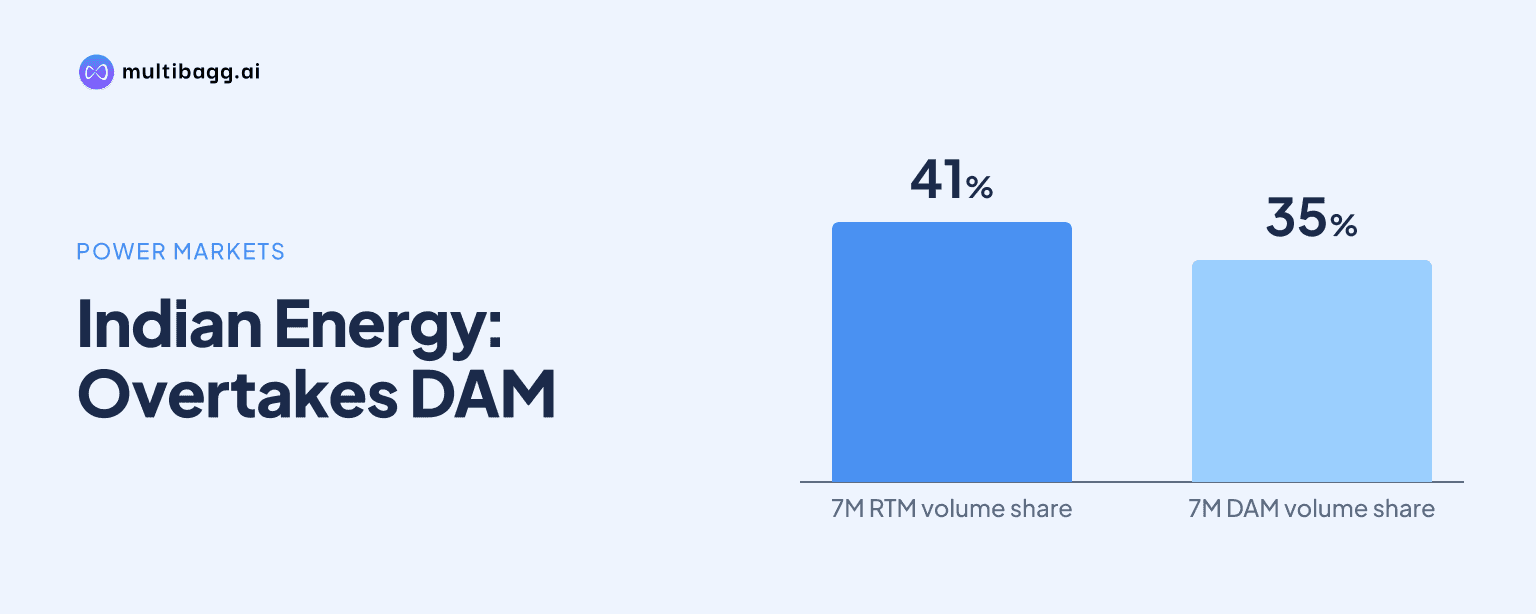
Indian Energy Exchange Limited said its Real-Time Market accounted for 41% of total volume in the first seven months of the year, surpassing the Day-Ahead Market at 35%, as buyers sought lower prices and more current demand estimates. IEX said the transaction fee is the same in both markets.
Know Indian Energy Exchange inside out
Results, valuation, peers and who's buying, in one view.
Has IEX real-time trading overtaken day-ahead trading?
Yes. IEX said Real-Time Market, or RTM, volume was far higher than Day-Ahead Market, or DAM, volume in the first seven months of the year, with RTM representing 41% of total volume and DAM representing 35%. The comparison marks a change in product mix, as the market that allows transactions closer to delivery has moved ahead of the day-ahead product by 6 percentage points.
Management placed the current mix in the context of RTM's expansion since its June 2020 introduction. It described DAM compound annual growth rate, or CAGR, at roughly 2% to 5%, compared with RTM CAGR of about 30% to 35%. This difference indicates that RTM has expanded substantially faster than DAM over the period rather than simply tracking overall exchange-volume growth.
The change includes an element of substitution between markets. Management said that, before 2020, volume growth was concentrated in DAM, while current growth is occurring in RTM. It explicitly said some shifting from DAM to RTM is taking place, even as both products remain central to IEX's trading platform.
Why are buyers moving from day-ahead to real-time trading?
Management said buyers are moving to RTM because RTM prices are lower than DAM prices and because purchasing closer to delivery allows a better estimate of demand. It said RTM sellers can be desperate to sell available power, which results in lower prices than in the day-ahead market.
The mechanism matters for distribution utilities and other buyers managing changing requirements over the day. A buyer using RTM can make its purchase after obtaining a more current estimate of its deficit, rather than committing the previous day through DAM. Management described price and power availability, rather than possible DAM market coupling, as the drivers of movement between the two products.
IEX also linked RTM growth to variable renewable generation. Management said a good part of RTM volume growth comes from renewable generators, though it could not segregate volumes from firm and dispatchable renewable energy, solar and wind contracts. Variable output can create surpluses or deficits nearer to delivery, creating a use case for an exchange market that clears in real time.
Management said some firm and dispatchable renewable energy contracts require developers to create capacity four to five times the energy to be delivered under the contracted profile. That can leave volatile excess generation that cannot readily be committed through another power purchase agreement. Developers can instead bring surplus output to an exchange, while buyers can use RTM to cover changing demand.
Got a follow-up? Ask IRIS
Does the DAM-to-RTM shift change IEX revenue per unit traded?
No, according to management, because IEX charges the same transaction fee in DAM and RTM. In response to a question on the revenue implications of product migration, management said both are flagship IEX products and that a shift from one to the other does not matter to the company on a per-unit fee basis.
That conclusion depends on trading activity remaining on IEX rather than moving to another power exchange. Management said IEX has a large market share in both DAM and RTM, although it did not provide a market-share percentage for either product during this discussion. A DAM buyer moving to IEX's RTM would retain the same transaction-fee mechanism, whereas a move to another exchange would not.
Management said it does not apprehend a shift of buyers from IEX to other exchanges if DAM market coupling is introduced. It cited two to three years of technology development, customer interactions, product development and application programming interface, or API, integration as efforts aimed at retaining customers. This is management's assessment, not a disclosed customer-retention measure.
The company also described the depth of its customer integrations. Management said it has completed back-office integration with major customers and has front-end as well as back-office interfaces for bidding, reconciliation and reporting. These integrations connect customer systems, including SAP and other internal systems, with IEX processes.
What other conditions are shaping IEX product volumes?
Renewable variability and battery-based arbitrage are central to management's RTM outlook. It said the gap between daytime and evening prices is large and that shortages during the current year have been high, leaving room for battery energy storage system, or BESS, plants to arbitrage across trading periods. Management also said about 4 gigawatts of commissioned BESS capacity in India has largely been created through the merchant route.
The second quarter lifted activity in other products for a different reason. Management said the monsoon was weak during the quarter, creating uncertainty that led participants to secure power through Day-Ahead Contingency, or DAC, and intra-day contracts, or ITD. This differs from RTM's longer-running pattern: DAC and ITD demand was described as a second-quarter response to uncertainty, while RTM has grown rapidly since June 2020.
Management expects RTM volume to continue increasing as renewable penetration rises. It said exchanges become more important when power generation is variable, and pointed to surplus renewable capacity and merchant BESS projects as potential sources of exchange trading. The company did not provide a numerical RTM volume target for the rest of the year.
RTM may also face tighter operating timelines from April 1, 2027. Management referred to an indication from Central Electricity Regulatory Commission, or CERC, staff that RTM bidding time could be reduced to five minutes and market-clearing time to 10 minutes. It said market coupling in RTM would be challenging under such timelines, while not stating that a final RTM coupling regulation had been issued.
Conclusion
IEX's reported 41% RTM share versus 35% for DAM confirms that real-time trading became its larger volume market in the first seven months of the year. The mix change includes some DAM cannibalisation, but management's stated revenue rationale is that both products charge the same transaction fee and are core IEX markets.
The next issue is whether RTM maintains its roughly 30% to 35% CAGR as renewable output and merchant BESS capacity expand, while DAM growth remains near the roughly 2% to 5% range cited by management. Investors will also watch the April 1, 2027 timetable discussed for five-minute RTM bidding and 10-minute clearing, along with any final regulations on market coupling.