










IFB Q2 revenue rises 14% but PBDIT falls 11% on costs
Key highlights
- IFB reported Q2 FY 26-27 revenue of Rs 1,512.54 crore, up 14.02% year on year.
- Q2 PBDIT fell 11.30% to Rs 90.92 crore and margin declined to 6.01% from 7.73%.
- Q2 PAT declined 20.48% to Rs 39.56 crore, while annualised ROCE fell to 17.55% from 24.73%.
- IFB ended 30 September 2026 with Rs 342.66 crore of net cash and Rs 8.22 crore of long-term debt.
powered by IRIS
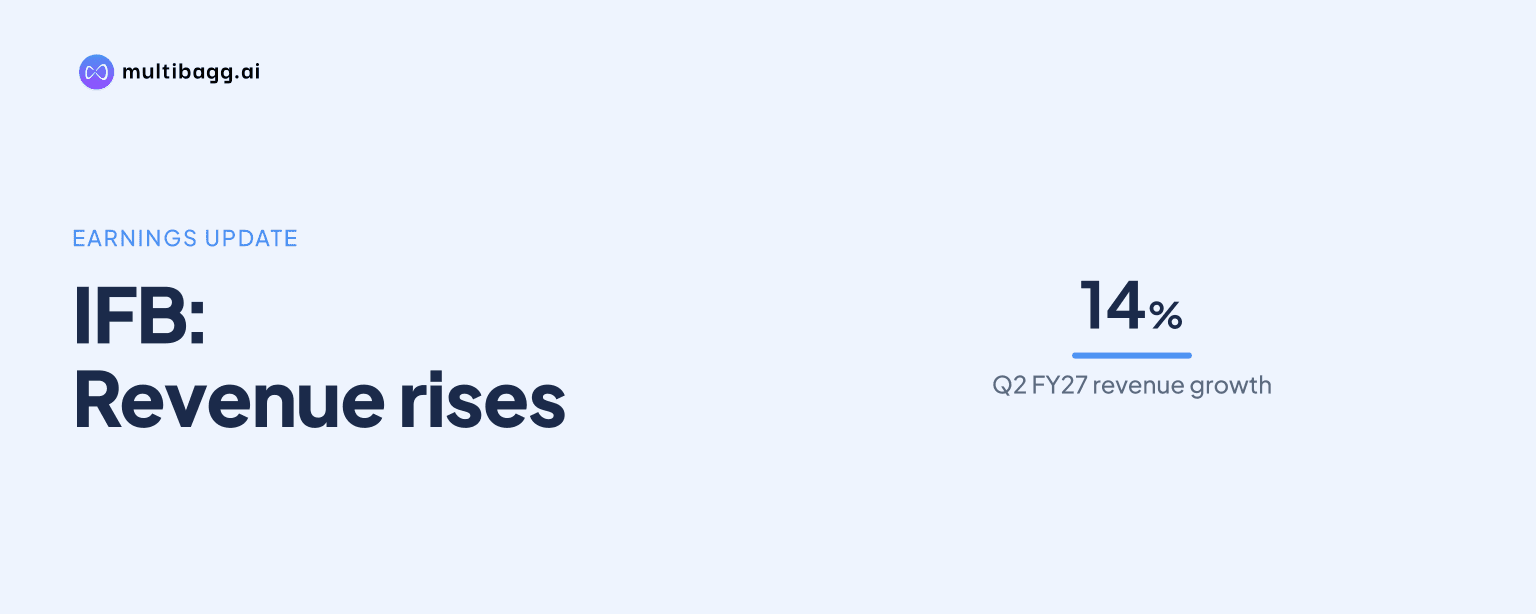
IFB Industries Limited reported Q2 FY 26-27 revenue of Rs 1,512.54 crore, up 14.02% year on year, but PBDIT fell 11.30% to Rs 90.92 crore as high material costs reduced the margin to 6.01% from 7.73%. PBDIT means profit before depreciation, interest and tax.
Know IFB Industries inside out
Results, valuation, peers and who's buying, in one view.
Why did IFB's Q2 profit fall despite revenue growth?
IFB's Q2 profit fell because high material costs affected PBDIT, according to management, despite a Rs 185.93 crore increase in revenue. Revenue rose to Rs 1,512.54 crore in Q2 FY 26-27 from Rs 1,326.61 crore in Q2 FY 25-26, while PBDIT declined to Rs 90.92 crore from Rs 102.50 crore.
The decline continued below PBDIT in Q2 FY 26-27. Profit before tax, or PBT, fell 21.17% to Rs 53.86 crore from Rs 68.32 crore, while profit after tax, or PAT, declined 20.48% to Rs 39.56 crore from Rs 49.75 crore. PBT margin decreased to 3.56% from 5.15%, and PAT margin fell to 2.62% from 3.75%.
IFB's Q2 trend also shows revenue outpacing operating profit over several years. Q2 revenue rose from Rs 1,189 crore in FY 24-25 and Rs 1,327 crore in FY 25-26 to Rs 1,513 crore in FY 26-27, while PBDIT was Rs 79 crore, Rs 103 crore and Rs 91 crore, respectively. PAT moved from Rs 33.30 crore to Rs 49.75 crore and then Rs 39.56 crore across those three Q2 periods.
Which divisions drove IFB's Q2 revenue growth?
IFB said the Home Appliances Division, or HAD, grew Q2 revenue by 11%, while Engineering revenue increased 24%, supporting total revenue growth of 14.02% in Q2 FY 26-27. The presentation does not provide divisional revenue, PBDIT or PAT amounts for either HAD or Engineering.
Management described the consumer durables market as challenging in Q2 FY 26-27 because part of festive demand shifted to November. It also cited rising commodity costs and adverse foreign-exchange movement as margin pressures, while identifying demand for higher-capacity and feature-rich appliances as an opportunity to improve average selling prices.
IFB said HAD is pursuing cost and portfolio optimisation to partly offset commodity and foreign-exchange effects reflected in the 172-basis-point fall in Q2 PBDIT margin to 6.01%. The measures include stock-keeping unit rationalisation and portfolio optimisation to reduce complexity and concentrate on identified key products, but the presentation does not disclose savings or a timetable.
How did IFB perform in YTD FY 26-27?
IFB reported YTD FY 26-27 revenue growth of 15.33%, while PBDIT rose 4.02%, meaning operating-profit growth trailed sales growth in the period ended September 2026. Revenue reached Rs 3,041.63 crore from Rs 2,637.43 crore, and PBDIT increased to Rs 179.38 crore from Rs 172.45 crore.
YTD margins narrowed despite the increase in absolute profit. PBDIT margin fell to 5.90% from 6.54%, while PAT margin declined to 2.55% from 2.85%. Management attributed the YTD margin effect to increased commodity prices and adverse foreign-exchange movement, as it did for Q2.
YTD PBT increased 3.08% to Rs 105.40 crore and PAT rose 3.34% to Rs 77.62 crore, in contrast with the Q2 declines of 21.17% and 20.48%, respectively. The presentation reports the cumulative YTD figures but does not provide a separate first-quarter PBT or PAT bridge.
Got a follow-up? Ask IRIS
What do IFB's cash flow and working-capital figures show?
IFB reported Q2 FY 26-27 operating cash flow of negative Rs 40.13 crore, compared with the corresponding prior-year quarter, for which the presentation shows a 181.66% decline. This occurred alongside 14.02% revenue growth to Rs 1,512.54 crore and a 20.48% decline in PAT to Rs 39.56 crore.
At 30 September 2026, inventories were Rs 777 crore, up 12.15% year on year, while receivables were Rs 401 crore, down 6.27%. Accounts payable were Rs 1,086 crore, up 6.70%, according to the Q2 parameter table.
YTD operating cash flow remained positive at Rs 108.60 crore but was 31.62% lower than the corresponding prior-year period. The presentation does not disclose a Q2 cash-flow bridge, inventory categories or a breakdown of the movement between the negative Q2 operating cash flow and the positive YTD figure.
How did IFB's returns and debt position change?
IFB's annualised return on capital employed, or ROCE, decreased to 17.55% in Q2 FY 26-27 from 24.73% a year earlier. Annualised return on net worth, or RONW, was 16.50%, down 768 basis points, alongside the decline in Q2 PAT to Rs 39.56 crore.
For YTD FY 26-27, annualised ROCE was 17.21%, compared with 19.09% in the prior-year period, and annualised RONW was 16.19%, down 206 basis points. These changes accompanied PAT growth of 3.34% to Rs 77.62 crore, compared with revenue growth of 15.33% to Rs 3,041.63 crore.
IFB reported Rs 8.22 crore of long-term debt at 30 September 2026, comprising Rs 3.50 crore in Stamping borrowings and Rs 4.72 crore in Steel borrowings. Cash and cash equivalents, including mutual-fund investments, were Rs 350.88 crore, resulting in net cash of Rs 342.66 crore; fund-based working-capital utilisation was zero.
Conclusion
IFB delivered higher Q2 and YTD revenue in FY 26-27, but commodity costs and adverse foreign-exchange movement coincided with lower margins. The Q2 comparison was sharper: revenue rose 14.02%, whereas PBDIT fell 11.30%, PAT fell 20.48%, and annualised ROCE declined to 17.55% from 24.73%.
The next disclosed event is IFB's investor and analyst conference call on 5 November 2026 at 4:00 p.m. Indian Standard Time. Management's discussion may address the festive-demand shift to November, cost and portfolio measures, and repayment plans for the Rs 3.50 crore Stamping loan by February 2027 and the Rs 4.72 crore Steel loan by October 2028.