










IFGL net debt reached Rs 73.7 crore as working capital rose
Key highlights
- IFGL's net debt moved from negative Rs 175.6 crore in FY22 to Rs 73.7 crore in FY26.
- Working capital increased from Rs 465.7 crore in FY23 to Rs 604.4 crore in FY26.
- Cash and equivalents declined from Rs 262.7 crore in FY22 to Rs 121.9 crore in FY26.
- Receivables reached Rs 463.8 crore and inventories reached Rs 438.6 crore in H1FY27.
powered by IRIS
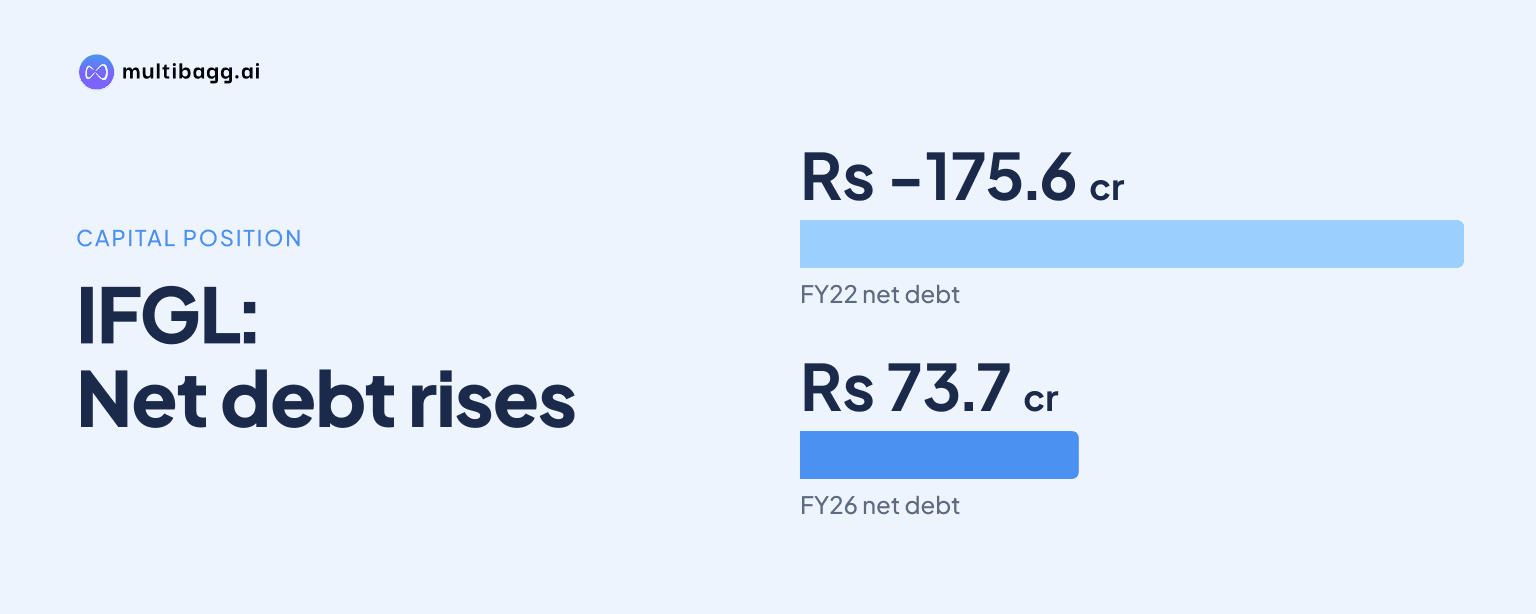
IFGL Refractories reported net debt of Rs 73.7 crore at March 2026, compared with net cash of Rs 175.6 crore at March 2022, alongside working capital of Rs 604.4 crore in FY26 and cash and equivalents of Rs 121.9 crore. Total debt stood at Rs 195.6 crore in FY26.
Know IFGL Refractories inside out
Results, valuation, peers and who's buying, in one view.
How did IFGL move from net cash to net debt?
IFGL moved from a net-cash position in FY22 to net debt in FY25 and FY26. The presentation records net debt of negative Rs 175.6 crore in FY22, negative Rs 45.9 crore in FY23 and negative Rs 39.1 crore in FY24, before the measure turned positive at Rs 33.0 crore in FY25 and reached Rs 73.7 crore in FY26.
The shift reflects both a higher debt balance and a lower cash-and-equivalents balance over the period. Total debt rose from Rs 87.1 crore in FY22 to Rs 195.6 crore in FY26, while cash and equivalents declined from Rs 262.7 crore to Rs 121.9 crore. The presentation describes the FY26 net-debt position as of 31 March 2026.
What happened to IFGL's debt and liquidity in FY26?
IFGL's total debt declined by Rs 6.8 crore in FY26, but cash and equivalents fell by Rs 47.5 crore, resulting in a Rs 40.7 crore increase in net debt from FY25. Total debt was Rs 202.4 crore in FY25 and Rs 195.6 crore in FY26, whereas cash and equivalents moved from Rs 169.4 crore to Rs 121.9 crore.
The balance sheet separates borrowings into current and non-current portions. Current borrowings were Rs 163.0 crore at March 2026, up from Rs 155.4 crore at March 2025, while non-current borrowings were Rs 32.6 crore, down from Rs 46.9 crore. These two borrowing lines sum to the presentation's FY26 total-debt figure of Rs 195.6 crore.
IFGL's net-debt-to-equity ratio was 0.06 times in FY26, compared with 0.03 times in FY25 and negative 0.19 times in FY22. Net debt to earnings before interest, tax, depreciation and amortisation, or EBITDA, was 0.51 times in FY26, compared with 0.23 times in FY25 and negative 1.11 times in FY22. The ratios changed as net debt became positive and EBITDA before exceptional items was Rs 145.8 crore in FY26.
How much did IFGL's working capital increase?
IFGL's working capital increased to Rs 604.4 crore in FY26 from Rs 465.7 crore in FY23, a rise of Rs 138.7 crore over three financial years. It first declined to Rs 446.5 crore in FY24, then increased to Rs 528.3 crore in FY25 before reaching the FY26 level.
The upward movement continued into the first half of FY27, when working capital was Rs 609.7 crore. That was Rs 5.3 crore above the FY26 figure, although H1FY27 is a partial-year reporting period and the presentation does not provide a full-year FY27 working-capital target.
Got a follow-up? Ask IRIS
Which working-capital items increased at IFGL?
IFGL's receivables increased by Rs 100.1 crore between FY23 and FY26, rising from Rs 325.0 crore to Rs 425.1 crore. Inventories increased by Rs 109.4 crore over the same period, from Rs 302.0 crore to Rs 411.4 crore, while payables rose by Rs 52.7 crore from Rs 179.3 crore to Rs 232.0 crore.
In H1FY27, each of the three disclosed components was above its FY26 level. Inventories reached Rs 438.6 crore, receivables were Rs 463.8 crore and payables were Rs 292.7 crore. Compared with FY26, payables increased by Rs 60.7 crore, receivables by Rs 38.7 crore and inventories by Rs 27.2 crore.
The March 2026 consolidated balance sheet also shows the scale of these items within current assets and liabilities. Current assets were Rs 988.7 crore, including Rs 411.4 crore of inventories and Rs 425.1 crore of trade receivables; current liabilities were Rs 422.7 crore, including Rs 232.0 crore of trade payables. Current assets increased from Rs 951.1 crore at March 2025, while current liabilities increased from Rs 416.4 crore.
How did IFGL's equity, returns and earnings change?
IFGL's equity increased to Rs 1,174.9 crore at March 2026 from Rs 934.0 crore at March 2022, an increase of Rs 240.9 crore. Over the same interval, total assets increased from Rs 1,286.1 crore to Rs 1,673.0 crore, while non-current assets rose from Rs 480.9 crore to Rs 684.3 crore.
Return on equity, defined by IFGL as net profit divided by net worth, was 3.0% in FY26, down from 7.6% in FY24 and 7.9% in FY23. Return on capital employed, defined as earnings before interest and tax divided by total capital employed, was 5.4% in FY26, compared with 9.4% in FY24 and 10.4% in FY23. The presentation reports H1FY27 annualised figures of 7.0% for return on equity and 10.1% for return on capital employed.
Profitability measures also changed during the balance-sheet evolution. Revenue increased to Rs 1,904.0 crore in FY26 from Rs 1,275.4 crore in FY22, but EBITDA before exceptional items was Rs 145.8 crore in FY26 versus Rs 158.5 crore in FY22. The corresponding EBITDA margin was 7.7% in FY26, compared with 12.4% in FY22, and finance cost rose to Rs 15.8 crore from Rs 3.4 crore.
Conclusion
IFGL's FY26 balance sheet shows a transition from surplus cash to positive net debt as total debt rose from Rs 87.1 crore in FY22, cash and equivalents declined, and working capital increased. The rise in inventories and receivables from FY23 through H1FY27 occurred alongside a higher equity base, while net debt ratios reached 0.06 times equity and 0.51 times EBITDA in FY26.
The next disclosed item to watch is whether the H1FY27 working-capital level of Rs 609.7 crore persists through the year, particularly after receivables reached Rs 463.8 crore and inventories Rs 438.6 crore. IFGL also states that legacy goodwill from the 2017 amalgamation was fully amortised, so reported earnings from FY27 onwards will no longer include the approximately Rs 26.7 crore annual non-cash amortisation charge.