










IGL Spirits demerger separates 71% of former group EBITDA
Key highlights
- IGL Spirits reported FY26 EBITDA of ₹492 crore, equal to 71% of the pre-demerger group’s ₹690 crore total.
- IGL Spirits generated FY26 revenue of ₹2,801 crore, compared with ₹1,164 crore for chemicals and ₹246 crore for Ennature.
- IGL Spirits has annual ethyl-alcohol distillation capacity of 379 million litres across Kashipur and Gorakhpur.
- Potable-spirits gross margin rose to 45.9% in FY26 from 36.0% in FY24.
powered by IRIS
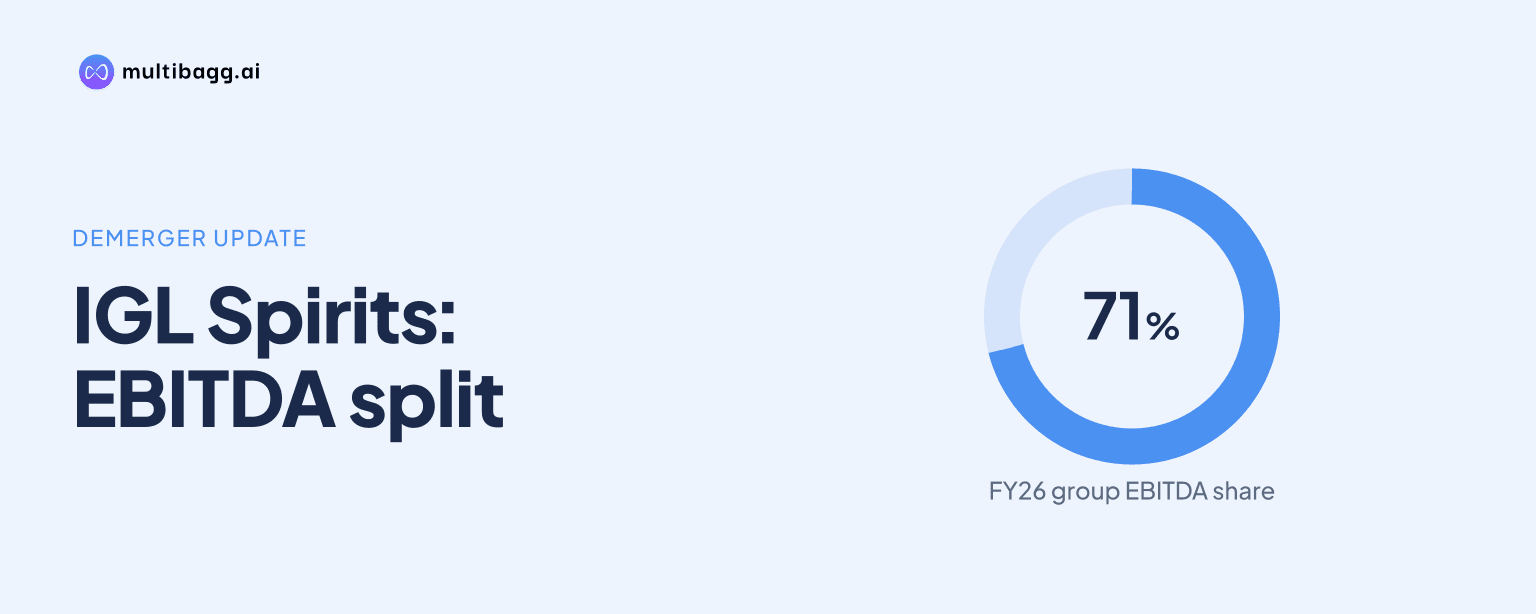
IGL Spirits Limited was separated as a standalone spirits and bio-fuels company with ₹492 crore of FY26 earnings before interest, tax, depreciation and amortisation (EBITDA), representing 71% of the former group’s ₹690 crore EBITDA. IGL Spirits reported FY26 revenue of ₹2,801 crore and will operate with its own profit and loss account, investor base and capital-allocation framework.
Know IGL Spirits inside out
Results, valuation, peers and who's buying, in one view.
What does the IGL Spirits demerger separate?
The IGL Spirits demerger separates the group’s spirits and bio-fuels operations from chemicals and nutraceuticals, creating a focused alco-beverage and bio-fuels entity. IGL Spirits generated ₹2,801 crore of FY26 revenue and ₹492 crore of EBITDA, compared with ₹1,164 crore of revenue and ₹169 crore of EBITDA for the continuing chemicals business.
The pre-demerger group reported FY26 revenue of ₹4,211 crore and EBITDA of ₹690 crore across its three businesses. IGL Spirits represented 71% of group EBITDA, while the chemicals business accounted for 25% and Ennature Biopharma Limited accounted for 4%; Ennature reported FY26 revenue of ₹246 crore and EBITDA of ₹29 crore.
Under the scheme of arrangement, shareholders receive one IGL Spirits share for every one India Glycols Limited share. India Glycols Limited continues as the chemicals business, while the scheme provides one Ennature Biopharma Limited share for every three India Glycols Limited shares.
How does IGL Spirits compare with the other demerged businesses?
IGL Spirits was the largest of the three businesses in FY26, with a 17.6% EBITDA margin versus 14.5% for chemicals and 11.9% for Ennature. Its ₹492 crore EBITDA was also higher than the combined ₹198 crore reported by the chemicals and Ennature businesses.
Within IGL Spirits, bio-fuels generated 52% of FY26 net revenue while spirits generated 48%. Spirits accounted for 71% of EBITDA and bio-fuels 29%, while the presentation gives spirits net revenue of ₹1,311 crore, showing that the higher-revenue bio-fuels activity produced the smaller EBITDA share.
The presentation says cash flows will stay within IGL Spirits for capacity fill and premium-brand development instead of chemicals or pharmaceutical capital expenditure. Ethanol supply and shared services at Kashipur will be governed by commercial, arm’s-length arrangements.
What manufacturing platform does IGL Spirits retain?
IGL Spirits retains two integrated manufacturing hubs with annual ethyl-alcohol distillation capacity of 379 million litres, allowing routing among spirits, Extra Neutral Alcohol (ENA) and bio-fuels. Kashipur in Uttarakhand has 600 kilolitres per day of ethanol capacity on a 300-acre integrated complex, while Gorakhpur in Uttar Pradesh has 500 kilolitres per day on a 56-acre distillation complex.
The platform uses grain-based plants at both Kashipur and Gorakhpur and can also use molasses from the sugarcane-to-sugar-plant chain. The presentation identifies dual feedstock as a mechanism for sourcing continuity, while captive ENA supports supply visibility and availability for the spirits segment.
Of the 379 million litres of annual capacity, 136 million litres are dedicated to potable alcohol for branded spirits. The three product routes are own-brand spirits, captive or merchant ENA, and bio-ethanol or power alcohol for oil marketing companies (OMCs), enabling output to be allocated across demand and realisation conditions.
IGL Spirits had a 220 million-litre ethanol allocation for Ethanol Supply Year 2025-26, with an estimated value of about ₹1,450 crore. The presentation describes limited near-term growth capital expenditure requirements, with efficiencies and resource allocation identified as the nearer-term levers.
Got a follow-up? Ask IRIS
How are spirits and bio-fuels expected to drive growth?
IGL Spirits identifies Indian-made foreign liquor (IMFL) as its premiumisation and margin-growth engine, non-IMFL as its cash and scale engine, and ethanol as its utilisation and cash engine. The IMFL plan includes about eight launches, entry into eight new states, and expansion through nationwide Canteen Stores Department and paramilitary channels.
IGL Spirits plans to premiumise its whisky, vodka and rum portfolio through in-house brands and partnerships with Amrut and Bacardi. Management says white spirits and Amrut products can lift margins, but these initiatives are commercial plans rather than reported future financial outcomes.
Non-IMFL is supported by IGL Spirits’ number-one position in Uttar Pradesh and Uttarakhand. The presentation cites its cash-and-carry model, lower working-capital needs, and lower brand-building and packaging intensity than premium IMFL, alongside regulated demand and distribution scale.
Ethanol is positioned to absorb spare distillation capacity and has a short receivable cycle, according to the presentation. Management links demand to a transition from E20, or 20% ethanol blending, toward E25 and flex-fuel vehicles, while describing IGL Spirits as a top-10 bio-fuel supplier in India.
What do IGL Spirits’ operating metrics show?
IGL Spirits’ FY26 operating data show higher realisation per case and gross margin despite case volume being broadly unchanged from FY25. Cases sold rose from 25.0 million in FY24 to 30.1 million in FY25, then moved to 30.0 million in FY26, leaving FY26 volume 20% above FY24.
Realisation per case, calculated as potable-spirits net revenue divided by cases sold, rose by ₹65 between FY24 and FY26. Potable-spirits gross margin increased by 990 basis points, or 9.9 percentage points, to 45.9%, indicating that the reported improvement was associated with price and margin movement rather than higher FY26 case volume alone.
IGL Spirits reported a 20.5% FY26 return on capital employed and approximately 30 million cases sold. The presentation reports compound annual growth rates between FY24 and FY26 of 39% for revenue and 48% for EBITDA.
Conclusion
The demerger puts the former group’s largest EBITDA contributor into a separately reported business with ₹492 crore of FY26 EBITDA and ₹2,801 crore of revenue. It also separates a platform where bio-fuels generated 52% of net revenue but spirits generated 71% of EBITDA, supported by 379 million litres of annual distillation capacity and multiple alcohol product routes.
What to watch next is management’s stated pathway to ₹550 crore of EBITDA in FY27, supported by new launches and approximately two times IMFL volume, and its FY28 debt-free balance-sheet objective. Over three to four years, management targets about ₹1,000 crore of EBITDA through core-market penetration, portfolio expansion, strategic partnerships and ethanol demand linked to E25.