










IGL Spirits lifts EBITDA margin to 17.6% in FY26 as profit rises
Key highlights
- IGL Spirits reported FY26 net revenue of Rs 2,801 crore, up from Rs 1,459 crore in FY24.
- IGL Spirits’ EBITDA margin increased to 17.6% in FY26 from 15.4% in FY24.
- IGL Spirits reported FY26 PAT of Rs 244 crore, compared with Rs 88 crore in FY24.
- Bio-fuels revenue reached Rs 1,470 crore in FY26, versus Rs 512 crore in FY24.
powered by IRIS
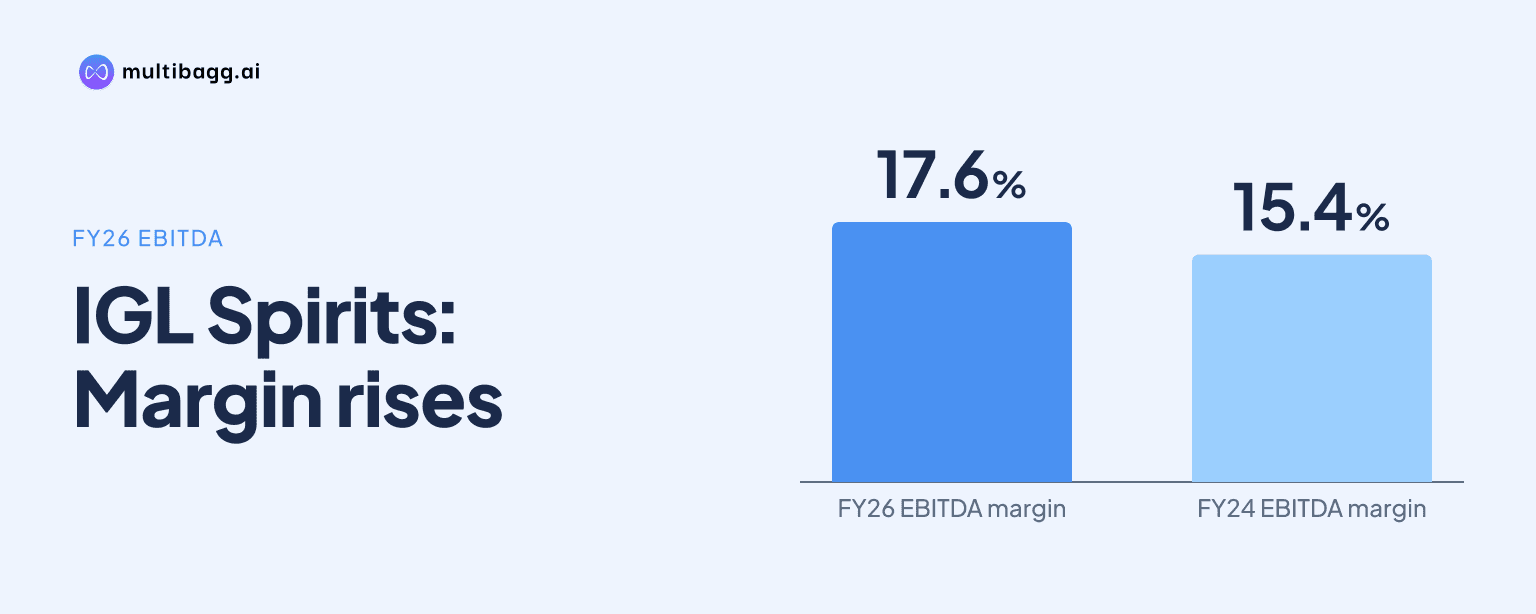
IGL Spirits Limited lifted its earnings before interest, tax, depreciation and amortisation (EBITDA) margin to 17.6% in FY26 from 15.4% in FY24, while net revenue reached Rs 2,801 crore and profit after tax (PAT) rose to Rs 244 crore. The reported improvement came with growth in both potable spirits and bio-fuels.
Know IGL Spirits inside out
Results, valuation, peers and who's buying, in one view.
How did IGL Spirits’ revenue and profit change from FY24 to FY26?
IGL Spirits increased net revenue to Rs 2,801 crore in FY26 from Rs 1,459 crore in FY24, an increase of Rs 1,342 crore over two years. The presentation states that net revenue grew at a compound annual growth rate (CAGR) of about 39% between FY24 and FY26, after reaching Rs 2,219 crore in FY25.
EBITDA rose from Rs 224 crore in FY24 to Rs 350 crore in FY25 and Rs 492 crore in FY26. The increase was Rs 126 crore in FY25 and Rs 142 crore in FY26, meaning the rupee increase in EBITDA accelerated in the latest year even as the increase in net revenue slowed to Rs 582 crore from Rs 760 crore a year earlier.
PAT increased from Rs 88 crore in FY24 to Rs 151 crore in FY25 and Rs 244 crore in FY26. FY26 PAT was Rs 156 crore above the FY24 level, while the presentation does not provide a bridge for interest, depreciation, taxes or other items between EBITDA of Rs 492 crore and PAT of Rs 244 crore.
How much did IGL Spirits’ profitability margin improve in FY26?
IGL Spirits’ EBITDA margin improved by 2.2 percentage points to 17.6% in FY26 from 15.4% in FY24. Margin was 15.8% in FY25, so the FY26 result was also 1.8 percentage points above the preceding year while EBITDA rose by Rs 142 crore to Rs 492 crore.
PAT margin rose in each reported year, from 6.0% in FY24 to 6.8% in FY25 and 8.7% in FY26. The FY26 PAT margin was 2.7 percentage points above FY24, with PAT increasing from Rs 88 crore on Rs 1,459 crore of revenue to Rs 244 crore on Rs 2,801 crore of revenue.
The presentation attributes the profitability trend to growth across potable spirits and bio-fuels supported by operating leverage. It also links stable volumes and premium portfolio expansion to margin enhancement, but does not disclose a numerical FY26 margin bridge by brand, product category, input cost or manufacturing site.
Which segment supplied most of IGL Spirits’ revenue growth?
Bio-fuels supplied most of IGL Spirits’ Rs 1,342 crore net-revenue increase between FY24 and FY26. Bio-fuels revenue rose by Rs 958 crore, from Rs 512 crore to Rs 1,470 crore, compared with a Rs 384 crore increase in potable spirits revenue from Rs 947 crore to Rs 1,331 crore.
Bio-fuels also delivered the larger increment in FY26, adding Rs 426 crore from Rs 1,044 crore in FY25. Potable spirits revenue increased by Rs 155 crore from Rs 1,176 crore in FY25, while the presentation states CAGR of about 69% for bio-fuels and about 19% for potable spirits across FY24 to FY26.
Potable spirits remained a growing business in FY26 despite its lower growth rate than bio-fuels, producing Rs 1,331 crore of revenue. The supplied material does not split that revenue between Indian-made foreign liquor, non-Indian-made foreign liquor or extra-neutral alcohol, and it does not provide separate segment margins.
Got a follow-up? Ask IRIS
Did IGL Spirits increase volumes, cash profit and capital returns together?
IGL Spirits reported 30.0 million cases in FY26, broadly unchanged from 30.1 million cases in FY25, after increasing from 25.0 million in FY24. Net revenue nevertheless increased by Rs 582 crore in FY26, a comparison that matches management’s description of stable volumes alongside premium portfolio expansion.
Cash profit rose from Rs 159 crore in FY24 to Rs 248 crore in FY25 and Rs 395 crore in FY26. IGL Spirits defines cash profit as PAT adjusted for non-cash expenses and taxes, making it distinct from EBITDA of Rs 492 crore and PAT of Rs 244 crore in FY26.
Return on capital employed (RoCE) increased from 13.0% in FY24 to 17.9% in FY25 and 20.5% in FY26. IGL Spirits defines RoCE as earnings before interest and tax divided by average capital employed, with capital employed defined as net worth plus term loan; the presentation does not disclose the underlying FY26 earnings before interest and tax or average capital employed.
What happened to IGL Spirits’ net debt in FY26?
IGL Spirits’ net debt fell to Rs 767 crore in FY26 from Rs 900 crore in FY25, a year-on-year reduction of Rs 133 crore. The company defines net debt as term loan plus fund-based working capital minus cash and cash equivalents, while FY26 cash profit rose by Rs 147 crore to Rs 395 crore.
FY26 net debt remained Rs 39 crore above the Rs 728 crore reported in FY24 because debt had increased by Rs 172 crore in FY25. The three-year pattern therefore differs from revenue, EBITDA, PAT, cash profit and RoCE, all of which rose in each reported year.
Conclusion
IGL Spirits’ FY26 record combines higher revenue, profitability and capital returns: net revenue reached Rs 2,801 crore, EBITDA reached Rs 492 crore, PAT reached Rs 244 crore and RoCE reached 20.5%. Bio-fuels delivered Rs 958 crore of the Rs 1,342 crore revenue increase since FY24, while 30.0 million reported cases in FY26 were broadly level with FY25.
The next measure to watch is whether the FY26 mix and margin pattern continues as management pursues its stated aim to double Indian-made foreign liquor volumes by FY27. The presentation also identifies premium portfolio expansion and white-spirits scaling to eight states, while the absence of product-level margins leaves the contribution of each spirits category unresolved.