










IKS Health outlines two routes for AI-enabled EHR delivery
Key highlights
- IKS Health plans to create an AI training format from more than 5 million longitudinal records.
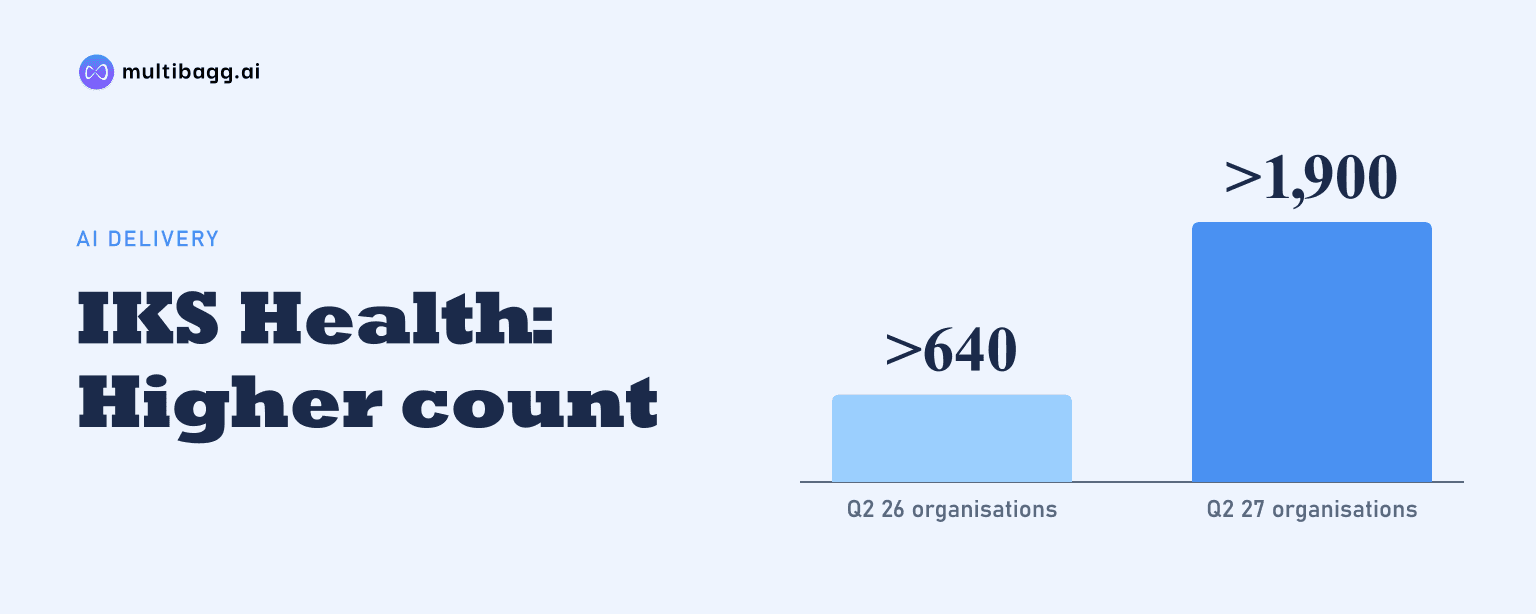
- IKS Health reported more than 1,900 healthcare organisations in Q2 27, compared with more than 640 in Q2 26.
- More than 90% of IKS Health revenue came from repeat customers.
- IKS Health’s initial TruBridge priorities are claims denials, coding and clinical efficiency.
powered by IRIS
Inventurus Knowledge Solutions Limited says its IKS Health strategy offers two AI delivery routes: an action layer over existing electronic health records or a unified platform where it owns the EHR, supported by more than 5 million longitudinal records used to create a structured training format for proprietary models.
Know Inventurus Knowledge Solutions inside out
Results, valuation, peers and who's buying, in one view.
What are IKS Health’s two paths to AI transformation?
IKS Health’s two paths are to add a System of Action and System of Intelligence above an existing EHR, or to combine the record, intelligence and action layers in an AI-native platform where it owns the EHR. The first route is designed for organisations seeking to protect established EHR investments, while the second is presented for new segments including rural health.
In the overlay model, the EHR remains the System of Record, meaning the data repository and single source of truth. The System of Intelligence provides artificial intelligence and machine learning, predictive insights, semantic interoperability and cognitive computing, while the IKS platform acts as the System of Action through workflow optimisation, automation and real-time operational impact.
The integrated route is described as an AI-native substrate built from the ground up. IKS Health says this structure has zero-latency data flows without middle interfaces and supports end-to-end clinical and financial automation, whereas the existing-architecture route is intended to work with a customer’s current EHR infrastructure.
How will IKS Health integrate AI with existing EHRs?
IKS Health plans to integrate with existing EHRs through application programming interfaces, or APIs, and by embedding agentic System of Action workflows in native EHR workflows. For the large medical group market, its stated strategy is to build API-powered integrations with relevant EHRs rather than require a core system replacement.
The company plans to translate trained agentic workflows between rural or community settings and large-group or ambulatory settings. In the existing-EHR route, both the IKS platform and individual solutions are intended to use longitudinal data and context for automated execution, with the System of Intelligence connecting data and decisions around the underlying record system.
IKS Health identifies explainability, human-in-the-loop, or HITL, review and rules-based AI as operating controls. Its plan is to use rules-based AI for deterministic outcomes and explainable AI with HITL where applicable for non-deterministic work. The System of Intelligence framework also identifies human oversight for safety, complex transactions and workflow exceptions.
Got a follow-up? Ask IRIS
What data and models support IKS Health’s AI strategy?
IKS Health plans to create a structured unified data format from more than 5 million longitudinal records to enable its proprietary small language models, or SLMs. The company says those models will power interconnected workflows for rural and community health systems, forming what it calls an AI training moat.
The data-and-model plan is linked to a combined System of Action and System of Record strategy for the rural and community market. IKS Health intends to cross-sell its System of Action into the TruBridge installed base, while using the trained workflows across large-group and ambulatory settings through its API integration approach.
The company’s commercial priorities differ by segment. It plans land-and-expand cross-selling in its installed base of large health systems, System of Action cross-selling in the rural and community TruBridge base, and platform sales to mid-size health systems and medical groups. IKS Health reported more than 1,900 healthcare organisations in Q2 27, compared with more than 640 in Q2 26.
Which workflows and clients are the first focus?
IKS Health’s initial TruBridge focus areas are claims denials, coding and clinical efficiency. The claims-denial offering uses a data model engine to identify denial risk before claims are submitted, with the stated aim of helping teams prioritise high-risk claims, reduce preventable denials and rework, and improve clean-claim rates and cash flow.
For coding, IKS Health lists an end-to-end suite that combines AI assistance, human validation and pre-bill compliance reviews. The company says the intended outcomes are faster coding, improved accuracy, lower denial risk from coding quality and higher coding capacity without adding full-time employees. This workflow retains human validation rather than describing coding as fully autonomous.
The clinical-efficiency offering combines a virtual care assistant with IKS Scribble to automate document management and clinical documentation. Across the broader patient journey, IKS Health lists optimised scheduling and financial clearance before a visit, autonomous coding and referral-order management during a visit, and billing, denial prevention and payment-posting work after a visit.
MISH Hospital and Clinics in Lenexa, Kansas, is a disclosed example of the unified-EHR proposition. TruBridge has partnered with MISH to implement a unified EHR platform in which patient information and clinical workflows will operate in one integrated EHR; IKS Health says the planned platform is intended to streamline operations, improve access and reduce technology complexity.
Conclusion
IKS Health’s strategy separates customers by their starting technology position. Organisations with established EHRs can use API-connected intelligence and action workflows without a core replacement, while settings where IKS Health owns the EHR can use a single platform that combines the record, intelligence and action layers. The more than 5 million longitudinal records, proprietary SLMs and HITL controls are the mechanisms the company identifies behind these two routes.
What to watch next is execution of the stated cross-selling and platform-sales plan, especially in the TruBridge rural and community installed base and among mid-size health systems and medical groups. Management also plans an operating-model transformation in TruBridge revenue-cycle-management and coding businesses, moving from technology-led HITL work toward explainable-AI autonomy for non-deterministic outcomes.