










IMFA starts Kalinganagar furnace, cites 534,000-tonne capacity
Key highlights
- IMFA’s first KNR-1 furnace achieved hot-metal tapping on 25 August 2026.
- IMFA produced 86,652 tonnes of ferro chrome in Q2 FY27, up from 65,671 tonnes in Q2 FY26.
- IMFA reported Q2 FY27 revenue of Rs 968.17 crore and PAT of Rs 148.77 crore.
- IMFA has approvals for 1.2 million tonnes per annum of ore capacity backed by a Rs 1,000 crore investment plan.
powered by IRIS
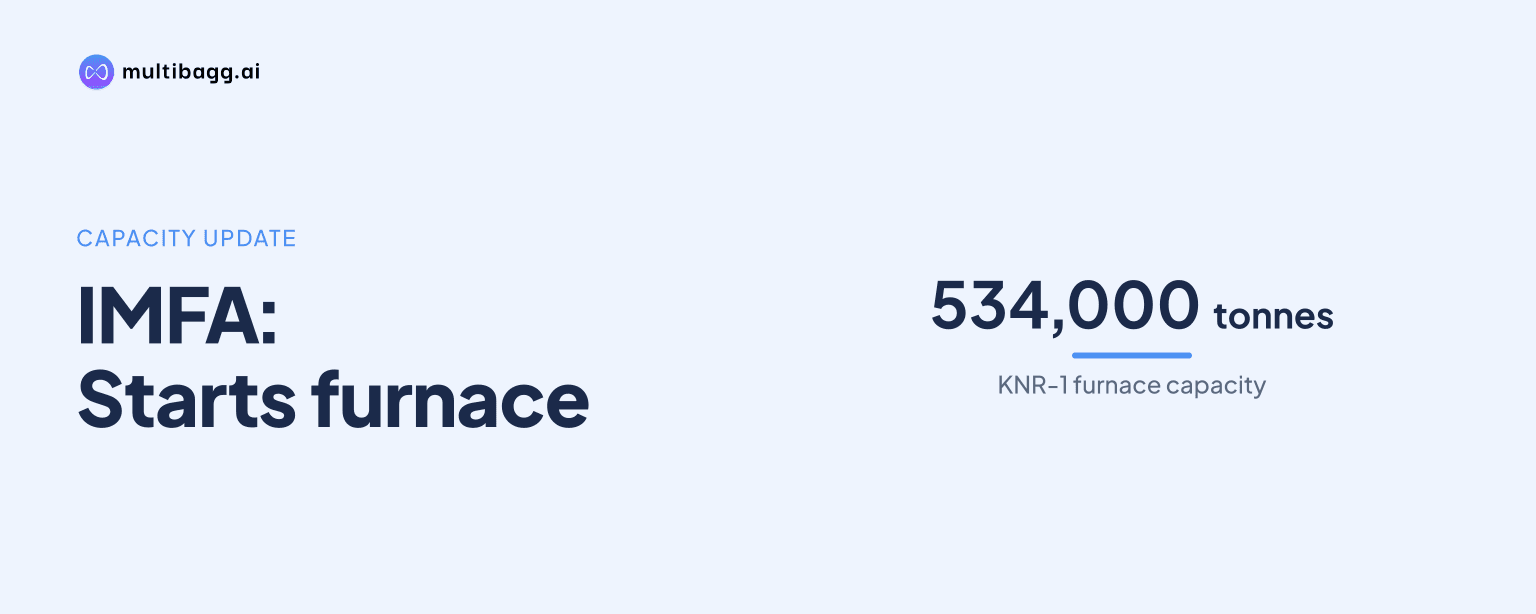
Indian Metals & Ferro Alloys Limited said its first KNR-1 furnace at Kalinganagar began hot-metal production on 25 August 2026, supporting the company’s stated 534,000-tonne-per-annum ferro-chrome capacity. IMFA produced a record 86,652 tonnes in Q2 FY27, compared with 65,671 tonnes in Q2 FY26, as capacity increased.
Know Indian Metals & Ferro Alloys inside out
Results, valuation, peers and who's buying, in one view.
What does IMFA disclose about Kalinganagar capacity?
IMFA is developing KNR-1, a 100,000-tonne-per-annum greenfield ferro-chrome project at Kalinganagar. Furnace-1 achieved its first hot-metal tapping on 25 August 2026, and the project was formally inaugurated on 14 October 2026. IMFA said production volumes from the first furnace were being progressively ramped up during Q2 FY27.
The second KNR-1 furnace was in commissioning as of the 4 November 2026 earnings release, with hot-metal tapping expected soon. The accompanying November 2026 investor presentation said the furnace was scheduled for commissioning by November 2026. IMFA linked completion of the project with total installed ferro-chrome capacity of 534,000 tonnes per annum.
IMFA’s presentation sets out a different progression by financial year: 384,000 tonnes per annum in FY26, 484,000 tonnes per annum in FY27 and 534,000 tonnes per annum in FY28. The earnings release, meanwhile, describes the company as having an installed capacity of 355 megavolt-amperes capable of 534,000 tonnes per annum. The disclosures establish 534,000 tonnes as the stated capacity endpoint, while showing FY28 as the presentation’s timing for that level.
How did IMFA’s production and sales change in Q2 FY27?
IMFA produced 86,652 tonnes of ferro chrome in Q2 FY27, up 20,981 tonnes from 65,671 tonnes in Q2 FY26. The Q2 figure also exceeded Q1 FY27 production of 80,690 tonnes by 5,962 tonnes. IMFA described the 86,652-tonne result as its highest ever quarterly production.
Ferro-chrome sales reached 81,998 tonnes in Q2 FY27, compared with 69,765 tonnes a year earlier, an increase of 12,233 tonnes. In H1 FY27, production was 167,342 tonnes against 131,600 tonnes in H1 FY26, while sales rose to 161,265 tonnes from 136,345 tonnes. The release attributed higher volumes to increased capacity.
Chrome ore raising did not follow the same quarterly pattern. IMFA raised 144,697 tonnes in Q2 FY27, below 169,615 tonnes in Q2 FY26, but H1 FY27 ore raising rose to 417,253 tonnes from 273,395 tonnes because Q1 FY27 raising was 272,555 tonnes. IMFA operates captive chrome ore mines at Sukinda and Mahagiri and says they will meet the enhanced smelting capacity’s ore requirement.
How are mining and power plans intended to support IMFA’s expansion?
IMFA disclosed approvals for 1.2 million tonnes per annum of ore capacity, backed by a Rs 1,000 crore investment to expand mining in line with future ferro-chrome production targets. Its Sukinda underground mining expansion was progressing toward completion by FY31. The filing does not quantify the planned underground mine output or give an interim completion date before FY31.
IMFA increased contracted renewable energy capacity from 70 megawatts to 135 megawatts in Q1 FY27. The increase included a 29-year agreement with EG Urja Strot Pvt. Ltd. for 65 megawatts of additional hybrid power capacity. Management said hybrid renewable energy would support its expansion alongside captive ore supply and the company’s integrated operating model.
The company’s existing captive power base comprises 200 megawatts of coal-based capacity and 4.55 megawatt-peak of solar capacity. Power generation was 301 million units in Q2 FY27, compared with 309 million units in Q2 FY26, while H1 generation was 589 million units versus 588 million units. The 135-megawatt figure is contracted renewable capacity, rather than power generated in the reported quarter.
Got a follow-up? Ask IRIS
What financial results accompanied IMFA’s higher volumes?
IMFA reported Q2 FY27 revenue of Rs 968.17 crore, up 34.72% from Rs 718.65 crore in Q2 FY26. Earnings before interest, tax, depreciation and amortisation, or EBITDA, rose to Rs 235.04 crore from Rs 138.34 crore, while profit after tax, or PAT, increased to Rs 148.77 crore from Rs 98.77 crore. IMFA cited higher volumes, energy diversification and operational efficiency in discussing the quarter.
The Q2 FY27 EBITDA margin was 24.28%, compared with 19.25% in Q2 FY26, and the PAT margin was 15.26%, compared with 13.42%. IMFA said the EBITDA margin movement was primarily due to higher sales volume and price realisation. Exports increased to Rs 817.54 crore from Rs 603.96 crore over the same two quarters.
For H1 FY27, IMFA reported revenue growth of 41.79% and EBITDA growth of 95.71% from the corresponding prior-year period. The EBITDA margin increased to 26.77% from 19.40%, while the PAT margin increased to 17.47% from 13.60%. The board recommended an interim dividend of Rs 5 per equity share with a face value of Rs 10, and non-annualised earnings per share rose to Rs 63.06 from Rs 35.26.
What other projects has IMFA disclosed?
IMFA said its KNR-2 acquisition had been fully integrated, with all four furnaces operational and about 35,000 tonnes of material produced in H1 FY27. KNR-2 is separate from KNR-1, where furnace-1 started production in August 2026 and furnace-2 remained under commissioning in early November 2026. This distinction matters because both projects form part of IMFA’s disclosed capacity expansion activity.
The board approved Rs 375 crore of capital expenditure for increasing chrome ore raising and producing low-carbon ferro chrome. IMFA did not disclose the division of that amount between mining and low-carbon ferro chrome, nor did it specify a capacity or commissioning date for the proposed product. Managing Director Subhrakant Panda said the planned shift to hybrid renewable energy, niche grades and low-carbon ferro chrome would broaden the product range.
IMFA is also setting up a 120-kilolitres-per-day grain-based ethanol plant at Therubali, Odisha. Mechanical erection was in its final stage, though the company cited geopolitical and monsoon-related disruptions for the delay. IMFA scheduled trial runs from mid-November 2026 and expected integrated commissioning in January 2027.
Conclusion
IMFA’s first KNR-1 furnace moved into production on 25 August 2026 as Q2 FY27 ferro-chrome output rose to 86,652 tonnes from 65,671 tonnes a year earlier. The expansion is paired with 1.2 million tonnes per annum of approved ore capacity, a Rs 1,000 crore mining investment plan and renewable contracts reaching 135 megawatts, alongside the already integrated KNR-2 furnaces.
The next disclosed event is the planned November 2026 commissioning of KNR-1’s second furnace. Investors can also monitor the mid-November 2026 ethanol trial run, expected January 2027 ethanol commissioning, the FY31 Sukinda underground mining completion plan, and whether IMFA’s future reporting clarifies the presentation’s FY28 534,000-tonne capacity milestone against the earnings release’s stated installed capacity.