










India Consumer Price Index Inflation at 6.09% Caps Nifty Gains
Key highlights
- India CPI inflation rose from 5.54% in September to 6.09% in October 2026.
- The Nifty gained 0.6% for the week to close at 25,144.3 after touching 25,424 intraday.
- FIIs invested ₹33,340 crore during the week, extending a three-week buying streak.
- The Sensex closed at 81,592.45, up 0.70% for the week.
powered by IRIS
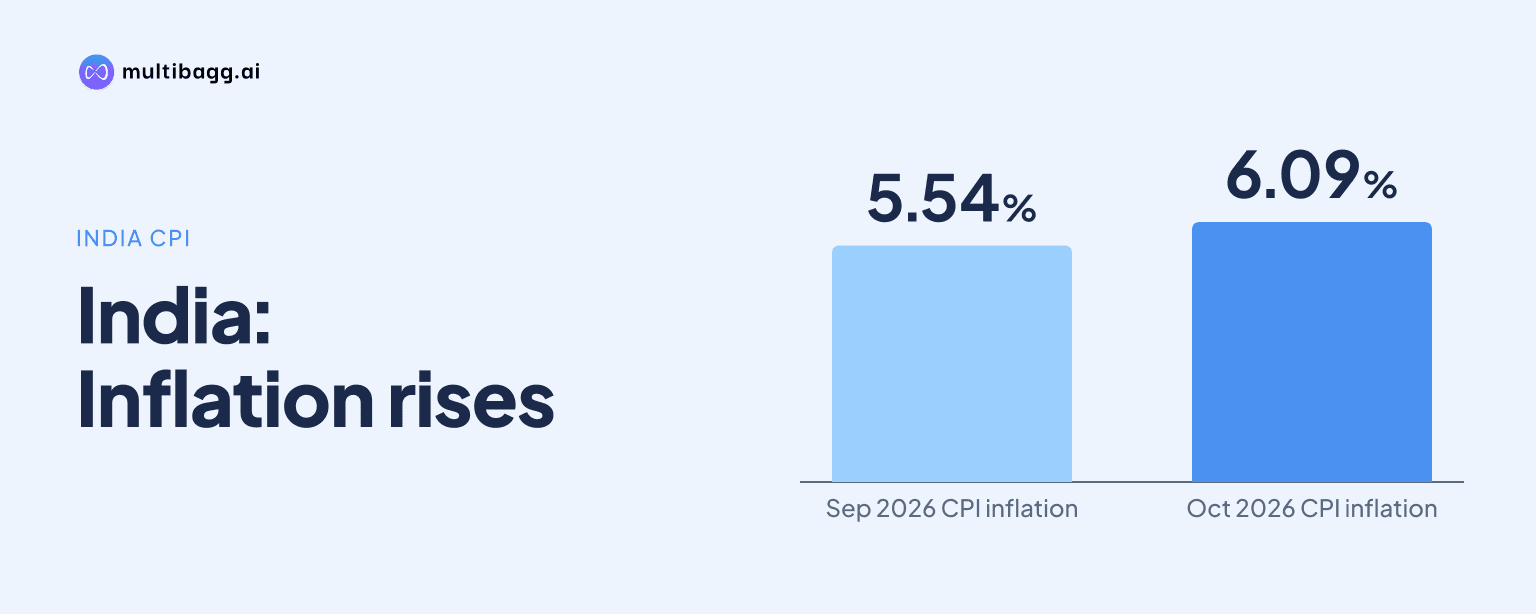
India Consumer Price Index (CPI) inflation reached 6.09% in October 2026, above the Reserve Bank of India’s 6% upper tolerance limit, but ₹33,340 crore of weekly foreign institutional investor (FII) inflows helped the Nifty close 0.6% higher at 25,144.3 and secure a third successive weekly gain.
Why did the Nifty rise despite CPI inflation crossing 6%?
The Nifty rose because sustained FII buying provided enough liquidity to outweigh immediate concerns around inflation and crude oil. The index closed at 25,144.3 after gaining 0.6% for the week, while the Sensex ended at 81,592.45, up 0.70%. This marked a third consecutive weekly advance after a period in which foreign investors had been persistent sellers.
FIIs put ₹33,340 crore into Indian equities during the week, according to the reported flow data. The buying followed a 10-week selling phase and extended a three-week buying streak. Reports also cited nearly ₹84,000 crore of FII buying during November, while an NSE provisional-data tally put November buying at about ₹73,566 crore across eight sessions. The differing figures reflect the separate flow measures cited in the reports, but both point to substantial foreign buying.
What does CPI inflation at 6.09% mean for markets?
CPI inflation at 6.09% means the October reading moved above the Reserve Bank of India’s 6% upper tolerance limit. It increased from 5.54% in September and was the first breach of that ceiling under the new CPI series, according to Ministry of Statistics and Programme Implementation data released on 12 November.
The reading has increased market attention on the monetary-policy outlook, particularly the December policy meeting. The source material referred to expectations of a 25-basis-point increase in December and another in February, but these were expectations rather than confirmed decisions. Higher-than-expected inflation in India and the United States capped the market’s upside even as the benchmarks finished the week higher.
Got a follow-up? Ask IRIS
How did foreign flows shape the week’s market move?
Foreign flows shaped the week by absorbing selling pressure and supporting benchmark indices at a time of elevated macro concerns. NSE provisional data cited FII purchases of ₹12,563.33 crore on 11 November and ₹7,830.60 crore on 12 November. The same tally said domestic institutional investors sold about ₹46,135 crore during November’s first eight sessions.
The Nifty’s trajectory also showed that foreign inflows did not remove all caution. It touched 25,424 on Wednesday before profit booking emerged at higher levels, leaving the index below its intra-week peak. The reported market commentary identified the durability of foreign buying as the key variable for the coming weeks, rather than treating the three-week recovery as settled.
Which risks could limit the Nifty rally from here?
Crude oil, inflation and global interest-rate signals could limit the Nifty rally if they weaken risk appetite or change expectations for policy rates. Crude was reported near $96 a barrel, while US-Iran geopolitical developments were identified as a factor that could affect oil prices. Easing Brent prices offered some support during the week, but the rebound in crude remained a concern.
Investors are also watching the US Federal Open Market Committee minutes and India’s wholesale price index inflation data for further policy cues. A reported 5.12% US 10-year yield and a 19-month high in the dollar were cited as factors that could slow FII buying. Nvidia CEO Jensen Huang’s reported resignation also unsettled global technology sentiment, with the Nifty IT index falling 3.2% over the week.
Conclusion
The week showed a clear tension in Indian equities: strong FII demand pushed the Nifty to a third weekly gain, even as CPI inflation moved beyond the RBI’s stated upper tolerance limit. The 0.6% Nifty advance and ₹33,340 crore of weekly foreign inflows demonstrate that capital flows remained the immediate support for benchmark valuations, but profit booking near 25,424 showed that the advance was not broad or uninterrupted.
The next test is whether foreign buying continues after the reversal from the prior 10-week selling stretch. Investors will watch crude oil movements linked to US-Iran developments, India’s WPI data, the FOMC minutes and the RBI’s December policy meeting, where inflation expectations have become more important after the 6.09% October print.