










Nifty 50 Breakout Tests 25,500 After 9.55% Seven-Day Rally
Key highlights
- Nifty gained 9.55% in seven trading sessions, rising from 23,053.10 on October 30 to 25,255.05 on November 11.
- Nifty closed 210.40 points, or 0.84%, higher at 25,255.05 on November 11.
- The key resistance range cited for Nifty is 25,200-25,300, followed by 25,500.
- More than half of Nifty stocks were reported above their 200-day moving averages.
powered by IRIS
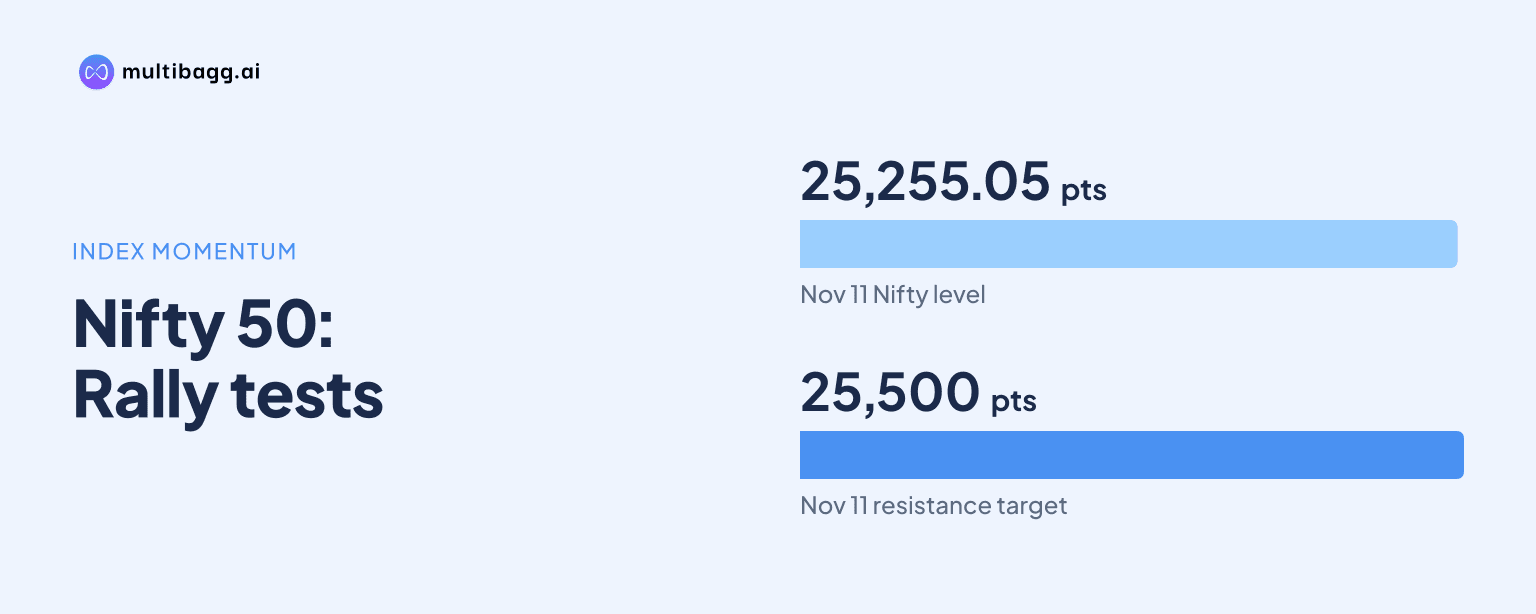
Nifty 50's November breakout carried the index 9.55% higher in seven trading sessions, from 23,053.10 on October 30 to a nine-month-high close of 25,255.05 on November 11, putting the 25,500 hurdle at the centre of the next technical test.
Why did Nifty break out in November 2026?
Nifty broke out after a rapid recovery from its October level, with the index gaining about 2,201.95 points between October 30 and November 11. The move took it above 25,000 and through an earlier resistance area of 24,444-24,600. Commentary also described the index as having broken an eight-month falling trendline and recovered its entire 12-week decline in two weeks.
The rally was linked to several positive market inputs cited by analysts: foreign institutional investors turning aggressive buyers, lower crude oil prices, lower US bond yields, fair valuations and improving corporate earnings reflected in September-quarter results. Market breadth also improved, with more than half of Nifty stocks reported above their 200-day moving averages. PSU bank stocks were among the visible gainers, with Union Bank, Punjab National Bank, Bank of India, Bank of Baroda and Indian Bank each rising 4% to 5% in the cited period.
Which Nifty levels matter after the 25,255.05 close?
Nifty's immediate upside area is variously placed at 25,200-25,300 and 25,350, while 25,500 is the repeatedly identified major hurdle. The index closed at 25,255.05 on November 11, placing it within the immediate resistance band cited in the market discussion and below the more important 25,500 level.
Support views differ because the analysis spans immediate trading levels and broader pullback zones. A fall below 25,100-25,150 was flagged as a risk for profit-taking, while 24,750-24,800 was identified as the key near-term support range by another analyst. The wider 24,600-24,300 area was presented as a possible retracement zone following the sharp rise.
Got a follow-up? Ask IRIS
Can Nifty extend beyond 25,500?
Nifty can extend its advance if it clears and sustains above 25,500, according to the technical views cited in the discussion. One view said a monthly close above 25,500 by the end of November could constitute a significant long-term buy signal. Another projection placed 26,300 as an immediate upside target after such strength.
The higher targets are not uniform. Some analysts saw 25,300-25,600 as the next upside zone, while another medium-term view pointed to 26,500. The context also noted that a decisive move above 25,500 could open the way for a retest of record highs. These are technical projections, not confirmed outcomes, and depend on the index holding above recently crossed support areas.
What could interrupt Nifty's advance?
Nifty's sharp pace of ascent has pushed momentum indicators closer to overbought territory, raising the possibility of a brief consolidation or profit-booking phase. Analysts nevertheless described the underlying trend as bullish, noting that the index held recent gains after its run-up rather than giving them up quickly.
The near-term watch list included the November 12 inflation release, global inflation data, pending September-quarter earnings, crude oil prices and foreign institutional investor activity. The market discussion also linked improving sentiment to falling oil prices after Donald Trump signalled that the war in Iran was over. Any change in those inputs, or a failure to hold the cited support zones, could test the durability of the breakout.
Conclusion
Nifty's move to 25,255.05 represented a fast technical recovery, supported by improved breadth, buying interest and a favourable combination of foreign flows, oil prices, yields and earnings commentary. The index has crossed important earlier resistance, but the clustering of resistance between 25,200 and 25,500 means the next phase requires confirmation rather than simply another rise in momentum.
The key marker to watch is whether Nifty can sustain above 25,500, particularly through a November monthly close. Investors will also monitor the disclosed inflation data, September-quarter earnings, crude oil and foreign institutional investor activity, while 25,100-25,150 and 24,750-24,800 remain the principal near-term support areas identified in the discussion.