










SEBI IPO Rules Set New Paths for Shareholder Quota Bids
Key highlights
- SEBI permits an optional shareholder reservation of up to 10% of an IPO issue.
- Eligible shareholder-category applications can be made for up to ₹2 lakh.
- Investors may apply in both shareholder and retail categories under the stated framework.
- Large issuers may receive up to 10 years to meet the 25% public-shareholding requirement.
powered by IRIS
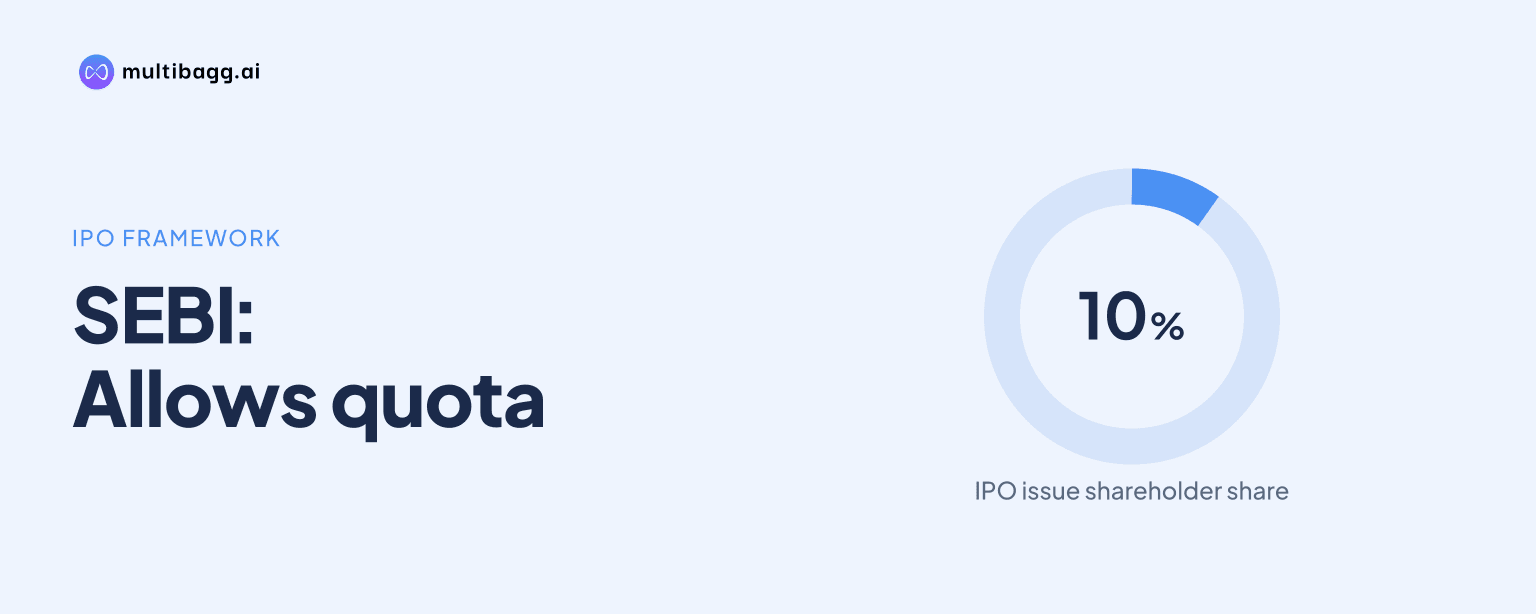
Securities and Exchange Board of India rules allow an IPO to reserve up to 10% of an issue for eligible shareholders of a listed parent or promoter, while the final red herring prospectus determines the qualifying date, reservation size and application terms for each offer.
What is the shareholder quota in an IPO?
A shareholder quota is a separately reserved part of an IPO for eligible equity shareholders of the listed parent or promoter entity when a subsidiary or group company seeks a listing. Securities and Exchange Board of India permits this reservation as an optional mechanism, rather than a compulsory feature of every IPO.
The reservation can be up to 10% of the issue under the framework cited in the discussions. The issuer must disclose whether such a reservation is being offered and the applicable conditions in its offer documents. Investors should therefore not assume that ownership of a parent company's shares will automatically create eligibility for every group-company IPO.
Social-media discussions have focused on three filed offers linked to Coal India, JSW Cement and JSW Steel. These references indicate possible eligibility paths through ownership of the relevant listed shares, but they do not establish final shareholder reservations or their terms. Those details remain dependent on each offer's final prospectus.
How do investors qualify for a shareholder IPO category?
Investors generally qualify by holding the relevant listed parent or promoter share in the demat account linked to the Permanent Account Number used for the IPO application. Discussions around the filed offers suggest that even one share may be sufficient where the offer document permits it, but the final prospectus is the binding source for the required holding and date.
The crucial point is timing. The applicable red herring prospectus sets out the relevant record-date or cut-off terms, and missing that date can prevent an investor from using the shareholder category. Some market commentary refers to the date connected with the red herring prospectus filing, while the broader guidance in the offer framework is to rely on the specific date disclosed by the issuer.
Investors also need to ensure that their application details align with the demat holding and PAN used for the bid. A mismatch in these details could affect whether the shareholder-category application is treated as eligible under the terms of the offer.
Can eligible shareholders apply in both shareholder and retail categories?
Yes, the stated application framework allows an eligible shareholder to apply under the shareholder category and separately as a retail investor using the same PAN. These are separate application opportunities, not a single enlarged retail application or a guarantee that either application will receive shares.
The individual application cap in the shareholder category is up to ₹2 lakh, according to the context provided. Investors can also make an application through the retail or non-institutional investor route where the IPO rules permit it. Each offer can prescribe limits on application numbers, bid values and categories, so the offer document remains necessary reading before applying.
Separate categories can matter when an IPO receives uneven demand across investor pools. However, an investor's potential allotment still depends on subscription levels and the allotment process within the relevant category. A shareholder reservation improves access to a dedicated pool only when an issuer has created that pool and the applicant satisfies its conditions.
Got a follow-up? Ask IRIS
How are broader IPO public-float rules changing?
Securities and Exchange Board of India and the notified Securities Contracts framework provide greater flexibility for large issuers on initial public float and the time available to reach 25% public shareholding. The changes do not generally remove the 25% public-shareholding objective for domestic listings; instead, they create a graded route for meeting it over time.
The March 2026 amendment introduced six tiers based on post-issue capital calculated at the offer price. The thresholds cover companies valued up to ₹1,600 crore, ₹1,600 crore to ₹4,000 crore, ₹4,000 crore to ₹50,000 crore, ₹50,000 crore to ₹1 lakh crore, ₹1 lakh crore to ₹5 lakh crore, and above ₹5 lakh crore.
For large companies, the context says issuers above ₹50,000 crore in market capitalisation can use a smaller initial float of ₹1,000 crore plus at least 8% of post-issue market capitalisation, with up to 10 years to meet the 25% minimum public-shareholding requirement. Earlier proposals discussed separate milestones, including 10% public shareholding within two years and 25% within five years for companies above ₹1 lakh crore. The notified framework and the applicable listing terms will determine the final position for individual issuers.
What other IPO allocation rules should applicants track?
Applicants should track non-institutional investor allocation rules, anchor investor terms and promoter lock-ins alongside shareholder eligibility. These provisions operate independently from a shareholder reservation and can shape the supply of shares available across different IPO categories.
For non-institutional investors, 33% of the allocation is reserved for applications from ₹2 lakh to less than ₹10 lakh, while the remaining two-thirds is earmarked for applications above ₹10 lakh. For anchor investors, half of allotted shares retain a 30-day lock-in, while the other half carries a 90-day lock-in under the cited rules.
The promoter lock-in framework also requires promoters of an unlisted company seeking listing to lock in at least 20% of post-issue equity capital. That core holding is subject to an 18-month lock-in, or three years where proceeds fund major unappraised projects, while promoter holdings beyond 20% have a six-month lock-in. These rules concern issuer ownership and market structure, rather than a retail applicant's shareholder-category eligibility.
Conclusion
The current discussion around shareholder quotas highlights a simple distinction: owning a listed parent share may create a route to a reserved IPO category, but it does not create an automatic right to allotment. Securities and Exchange Board of India rules permit a reservation of up to 10%, while demand in that category and the issuer's disclosed allotment process determine the outcome.
Investors should watch for the final red herring prospectuses of the Coal India, JSW Cement and JSW Steel-linked offers. Those documents will disclose whether a reservation is available, the qualifying shareholding date, the exact reserved portion and the application conditions that apply to each IPO.