










Indian Options Market Sees Volume Dip and Sharp Put Premiums
Key highlights
- Indian options trading volumes dropped 51% in FY26 after tighter derivatives rules.
- Combined daily NSE and BSE options premium turnover rose 43% to ₹1,061 billion in a reported October period.
- The Nifty 23,650 put premium jumped from ₹11 to ₹95 within minutes during a closing auction.
- Nifty aggregate put-call ratio open interest reached 1.52, above the 1.46 level recorded on 5 January.
powered by IRIS
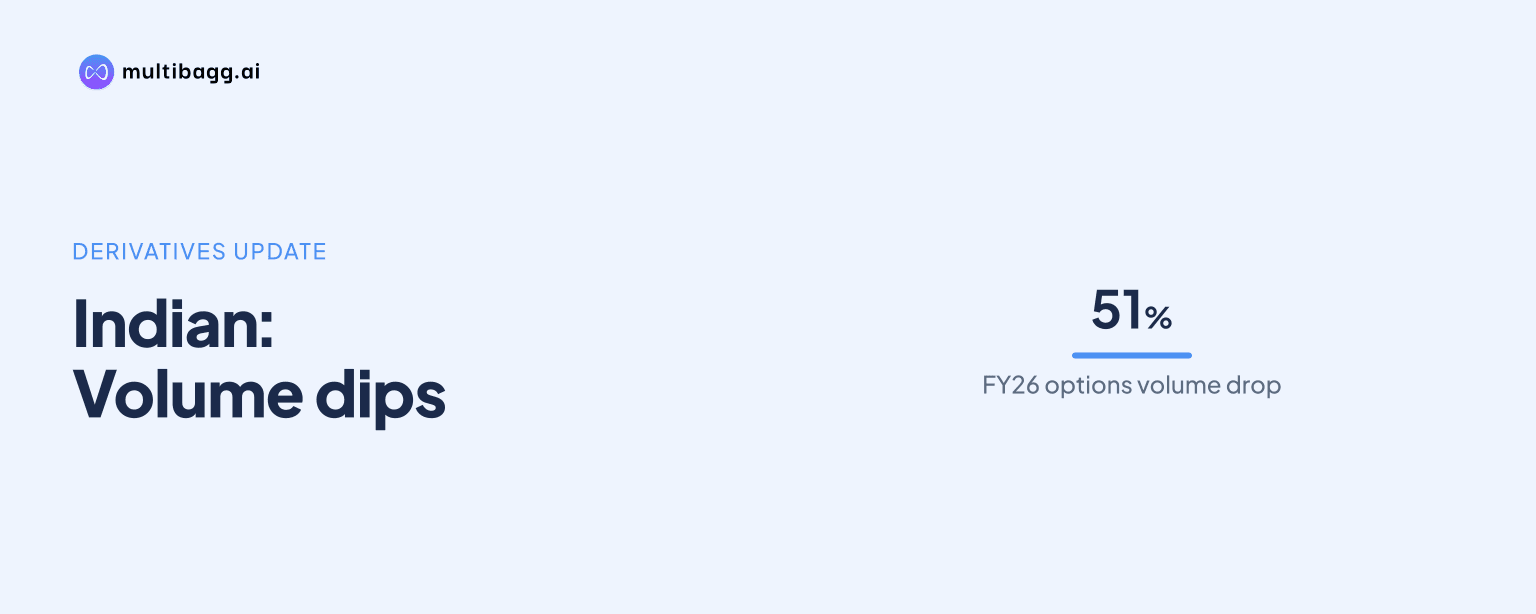
Indian options market activity fell 51% in FY26 after tighter derivatives rules, while a late Nifty closing auction lifted the 23,650 put premium from ₹11 to ₹95 within minutes, showing how lower routine volumes can coexist with abrupt and concentrated price swings.
Why did options market activity fall?
Options market activity fell as regulatory changes reduced expiry-day trading and as the ban on Jane Street squeezed participation in index options. Higher contract sizes, uniform expiries, upfront premium collection and higher transaction taxes were cited as factors that reduced speculative retail activity in FY26. The market also saw traders reassess risk appetite amid uncertainty following the order against the Wall Street trading firm.
Index options premium turnover on the National Stock Exchange of India and BSE declined week on week in four of five sessions after the order. Although premium turnover rose on one Friday, it then fell in every session in the following week. Rajesh Baheti of Crosseas Capital Services said the effects could linger in the near term as participants reassess regulatory clarity and market transparency.
What do the turnover figures show about the slowdown and rebound?
The turnover data show a sharp FY26 decline, but also a later October rebound as volatility returned. Options trading volumes across Indian exchanges dropped 51% in FY26 after the derivatives-rule changes. In a separate reported October period, combined daily options premium turnover on NSE and BSE rose 43% from September to ₹1,061 billion, while average daily contracts increased 39% to 360 million.
The figures also show that the recovery was not even across venues. BSE recorded faster percentage growth in the reported October period, while MCX options premiums held up better during the preceding quarterly slowdown. These are snapshots from different market periods, rather than evidence of a continuous rise in activity.
Why did put premiums surge despite a low India VIX?
Put premiums surged because late-session liquidity conditions and rapid Nifty price changes created concentrated demand for downside protection, even though India VIX barely moved. During a tumultuous closing auction, the Nifty's indicative equilibrium price fell as low as 23,377, around 1.7% lower. The 23,650 put option price jumped from ₹11 to ₹95 within minutes.
India VIX closed at 11.23, up only 0.65%, on that session. This contrast suggests that the stress was concentrated in particular strikes and a short time window rather than reflected as a broad, sustained increase in the volatility gauge. Traders who treated 23,600 as a key support faced sharp reversals when the index fell toward 23,300 and then moved back toward 23,600.
Got a follow-up? Ask IRIS
What does Nifty options positioning indicate?
Nifty options positioning indicates both low hedging demand in one period and caution over potentially crowded put selling in another. Foreign institutional investors' net options protection, measured as net put options minus net call options, fell into negative territory and reached its lowest level since January 2012, according to Ambit Capital's Gaurav Mehta. India VIX was also reported near an all-time low of 12.36%, reducing option premiums and the perceived need to hedge cash portfolios.
At the same time, the aggregate Nifty put-call ratio of open interest reached 1.52, above 1.46 recorded on 5 January. A ratio of 1.52 means traders had sold 152 puts for every 100 calls sold, a position that benefits if markets remain firm and put premiums decay. Rohit Srivastava of IndiaCharts said this could signal an overbought zone and the possibility of a short-term pullback, while noting the reading was not near its historical high.
How have support levels changed in Nifty options data?
Nifty support levels changed as put open interest shifted to lower strikes during a falling session. The largest put open interest was initially seen at 23,000 in the morning, but later significant additions appeared at 22,800, 22,850 and 22,900. Total put open interest was highest at 22,900, making it the immediate support level in that data set.
Other reported positioning showed the highest Nifty put open interest at the 8,000 strike, with 86.62 lakh shares, while another snapshot placed significant put open interest around 21,500 and call open interest around 23,000. These figures relate to different observations and should not be treated as one current support map. They instead illustrate that option-based support can move quickly as the underlying index changes.
Conclusion
The combined evidence points to an options market adjusting to tighter rules, a reduction in some forms of participation and uneven liquidity. Lower broad volatility has compressed premiums and reduced hedging demand in some periods, but the closing-auction episode showed that individual put contracts can still reprice sharply when liquidity thins and key technical levels break.
The next issue to watch is whether proprietary trading firms regain confidence in market transparency and regulatory clarity. Baheti said activity could rebound meaningfully within four to six weeks if that confidence returns, while Nifty put-call ratios, put open-interest shifts and India VIX will remain relevant indicators of whether downside risk is being priced more broadly.