










BSE Limited 4,000 call faces heavy resistance near expiry
Key highlights
- BSE Ltd's 4,000 strike carried 10.28 lakh call open interest for the 23 November 2026 expiry.
- The 4,000 call strike recorded 36.61 lakh in call volume, the highest reported call volume in the option chain.
- Options implied a plus or minus 180.60-point move in BSE Ltd, or 4.62%, over the remaining 11 days.
- BSE Ltd's at-the-money implied volatility was 33.17% at the 3,900 strike.
powered by IRIS
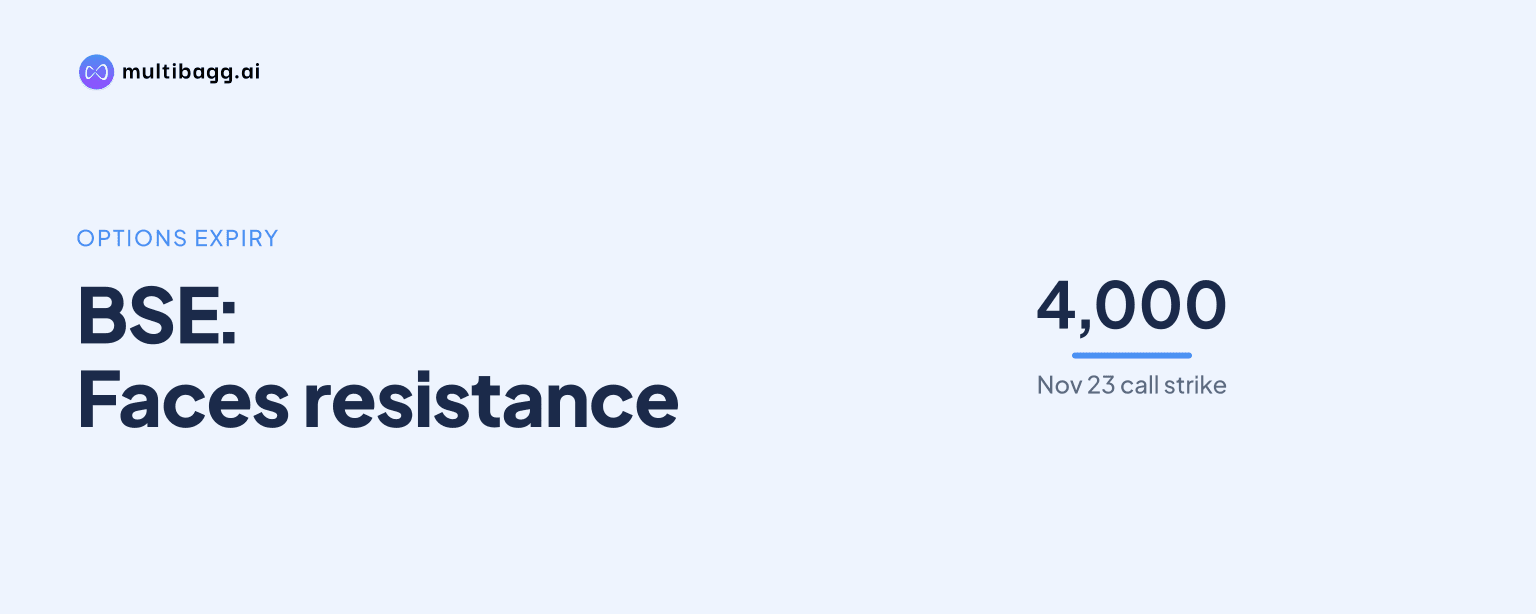
BSE Limited's 4,000 call faces a significant near-term options barrier, with 10.28 lakh call open interest at that strike for the 23 November 2026 expiry, even as the implied range from a 3,904.90 spot price extends to 4,085.50. The setup points to active upside interest, but not a clear breakout signal.
Why is BSE Ltd's 4,000 call important?
BSE Ltd's 4,000 strike is important because it is both the largest call open-interest resistance level and the highest-volume call strike in the 23 November expiry option chain. At a spot price of 3,904.90, the strike was just out of the money, requiring the share price to rise before the call gains intrinsic value at expiry.
The proximity of the strike makes the contract sensitive to daily moves in the underlying share. The option-chain data showed call volume of 36.61 lakh at 4,000, while put volume of 13.67 lakh at 3,900 marked the largest volume-based support level. This places BSE Ltd in a narrow zone where a move through 4,000 would be closely watched, while failure to sustain higher prices could keep the calls exposed to time decay.
What does BSE Ltd's open interest show?
BSE Ltd's open interest shows that 4,000 is a crowded strike, but open interest alone does not establish whether every position reflects outright bullish buying. Large call open interest can represent buyers anticipating an advance, sellers expecting the level to hold, or spread and hedging positions.
Separate active-contract data also showed substantial trading in the 4,000 call. One reading recorded 6,599 contracts traded and turnover of about ₹955.14 lakh, with 5,657 contracts of open interest and a contracts-to-OI ratio of roughly 1.17:1. Another snapshot listed the contract at ₹56.30, down 0.35%, alongside the November futures contract at 3,908.00, up 0.21%.
The social-media discussion characterised the activity as fresh upside positioning because trading volume exceeded the listed open interest in that reading. That interpretation should be treated carefully. The option-chain resistance at 4,000 and the high call volume indicate that this is the central level for near-term positioning, but the data does not by itself confirm the net direction of all traders at the strike.
Got a follow-up? Ask IRIS
Does BSE Ltd's share trend support call interest?
BSE Ltd's trend provides support for constructive sentiment because the share was reported above its 5-day, 20-day, 50-day, 100-day and 200-day moving averages. The company was also described as having broken out from an inverse head and shoulders pattern, a technical observation that traders may use to frame an upside view.
The cash-market picture has not been uniform across the supplied updates. In one session, BSE Ltd rose 0.69%, outperforming the Sensex's 0.38% gain but underperforming its sector by 0.85 percentage points. An earlier update described a 3.96% gain, ahead of the Capital Markets sector's 3.39% rise and the Sensex's 1.75% advance, supported by delivery volumes of 21.13 lakh shares, up 52.81% over the five-day average.
Other commentary noted a nearly 2% decline after a 5% rally, illustrating why a moving-average trend should not be treated as a straight-line forecast. The reported fall in delivery volumes in a later update also introduced caution around whether cash-market participation was matching the derivatives activity.
What move are BSE Ltd options pricing before expiry?
BSE Ltd options were pricing an expected move of plus or minus 180.60 points, or 4.62%, from the 3,904.90 spot price for the 23 November expiry. This implied a range of 3,724.30 to 4,085.50 with 11 days remaining, based on the combined premium of the at-the-money 3,900 call and put.
The upper end of that implied range is above the 4,000 call resistance, meaning the market-implied move leaves room for a move through the level. It is not a prediction that BSE Ltd will reach that point. The 3,900 at-the-money implied volatility was 33.17%, reflecting the premium traders were paying for near-term movement in either direction.
The 3,700 max-pain reading sits below the stated spot price and below the 3,800 OI support. Max pain is a settlement-oriented calculation based on outstanding options, rather than a reliable price target. For retail participants, the more practical levels from the available data are 3,800 and 3,900 on the downside and 4,000 on the upside.
Conclusion
BSE Ltd's 4,000 call is attracting attention because it combines heavy call open interest, the largest reported call volume and a strike close to the prevailing share price. The broader technical trend and prior strong cash-market performance support positive sentiment, but the concentration of calls at 4,000 also makes it a visible resistance level rather than evidence of an assured rally.
The next focus is whether BSE Ltd can hold the 3,900 volume-support area and absorb call positioning at 4,000 before the 23 November expiry. Investors should also watch participation in the cash market, the evolution of open interest and any movement in implied volatility, as those factors can clarify whether the derivatives activity is being confirmed by the underlying share.