










FIIs Buy ₹45,960 Crore in Week as DIIs Turn Net Sellers
Key highlights
- FIIs bought a net ₹45,960 crore of Indian equities during a five-session week.
- DIIs sold a net ₹24,197 crore in the same week, ending an 11-week buying streak.
- FIIs bought a net ₹28,724 crore across Thursday and Friday of the reported week.
- FIIs withdrew ₹45,162 crore in October before the reported November reversal.
powered by IRIS
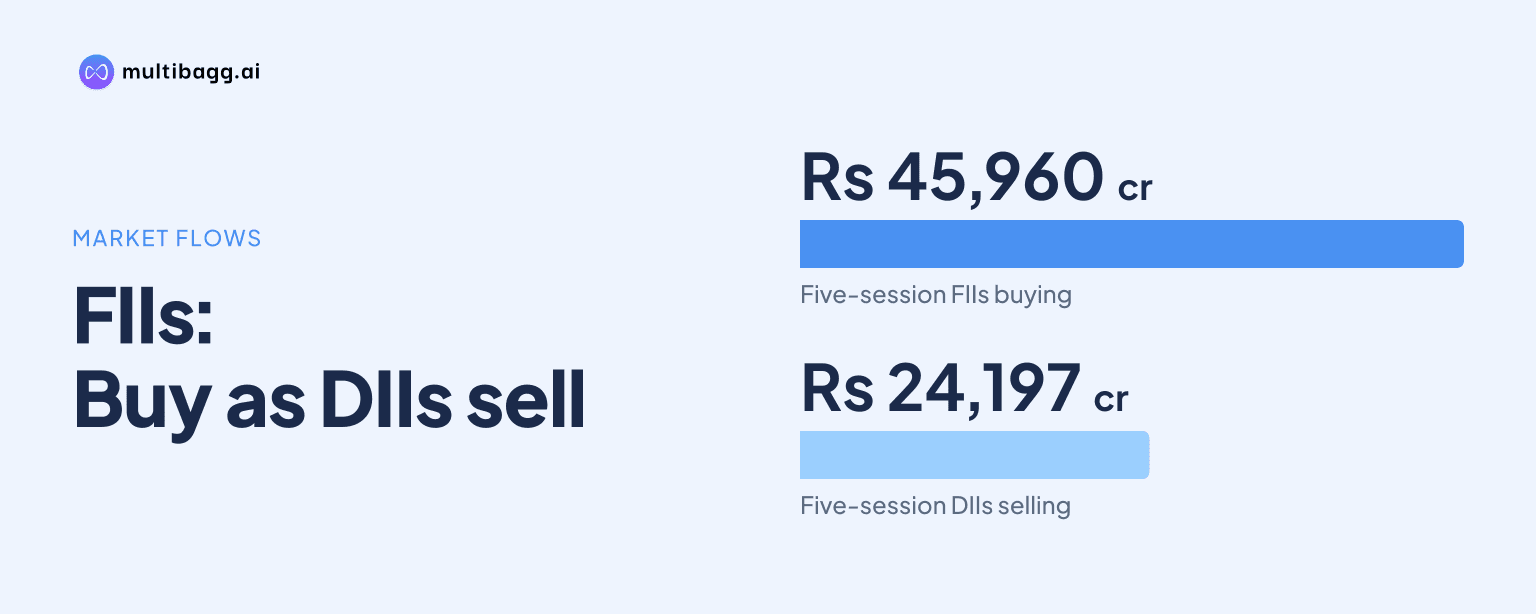
Foreign institutional investors (FIIs) bought a net ₹45,960 crore of Indian equities during a five-session week, while domestic institutional investors (DIIs) sold ₹24,197 crore, marking a reversal after DIIs had bought for 11 consecutive weeks. The flow shift followed October FII outflows of ₹45,162 crore and a sharp market recovery.
Why are FIIs buying Indian equities now?
FIIs turned net buyers in all five sessions of the reported week, putting ₹45,960 crore into Indian equities after a 10-week selling spell. The buying represented a sharp reversal from October, when FIIs withdrew ₹45,162 crore. Social-media discussion around the data has focused on the scale and speed of the change rather than on a single stock or sector.
The reported buying was concentrated toward the end of the week. FIIs purchased a net ₹28,724 crore across Thursday and Friday alone. On November 6, FIIs bought a net ₹13,750 crore, extending their stated buying streak to 14 sessions and taking cumulative inflows to ₹53,154 crore.
The context also notes that FIIs remained net sellers for 2026 despite the November rebound. Earlier in the year, from January to early June, FIIs reportedly sold close to ₹2.7 lakh crore of Indian equities. This makes the current inflow trend important, but it does not by itself establish a full-year reversal.
Why are DIIs selling after weeks of buying?
DIIs turned net sellers as they booked profits following the market recovery, selling a net ₹24,197 crore during the same week that FIIs bought ₹45,960 crore. This ended an 11-week DII buying streak and was their first week of net selling in 12 weeks.
The late-week selling was particularly large. DIIs sold a net ₹16,413 crore across Thursday and Friday, including ₹10,445 crore on the prior session and ₹5,969 crore on Friday. The figures show domestic institutions reducing exposure while foreign institutions added it.
That change contrasts with the broader pattern earlier in 2026. Between January and early June, DIIs reportedly bought roughly ₹4.16 lakh crore of Indian equities while FIIs sold close to ₹2.7 lakh crore. The domestic buying was linked in the supplied discussion to SIP discipline and insurance flows, which had helped absorb foreign selling pressure.
What do the latest FII and DII numbers show?
The latest reported figures show a strong directional divergence: FIIs were net buyers and DIIs were net sellers. Available reports for November 9 and November 11 differ in their precise provisional values, but they consistently show foreign inflows offsetting nearly equivalent domestic sales.
The differences between reports underline the need to treat daily institutional figures as provisional when comparing sources. For investors, the more consistent signal in the supplied data is the opposite direction of flows, not the small variation between reported daily totals.
Got a follow-up? Ask IRIS
Does opposite institutional activity support the market?
Opposite FII and DII activity can support market liquidity because one group’s selling can be absorbed by the other group’s buying. In the reported week, the net combined institutional flow was positive because FII purchases of ₹45,960 crore exceeded DII sales of ₹24,197 crore.
Institutional flows should nevertheless be read alongside global cues, earnings and broader market conditions. The supplied context notes that FII buying can signal confidence and add liquidity, while DII selling may reflect profit-booking or a cautious view. Neither interpretation is conclusive without looking at the wider market backdrop.
The market reportedly gained even as global trends were mixed, with the Sensex and Nifty both rising by up to 1% on one cited day. However, sector-level positioning is not provided in the data. Investors therefore cannot infer which sectors attracted the foreign flows or which holdings DIIs reduced from the aggregate cash-market figures alone.
What should investors monitor in institutional flow data?
Investors should monitor whether FII buying persists beyond the recent streak and whether DII selling remains confined to profit-booking. The reported November inflows exceeded ₹33,000 crore by November 9 in one account, while another report put cumulative inflows at ₹53,154 crore by November 6 after a longer 14-session run.
The key issue is whether the recent foreign demand continues after the reversal from October’s ₹45,162 crore outflow. The supplied discussion also identifies global risk factors, oil prices, geopolitical conditions, earnings and valuations as relevant to FII behaviour. Daily figures are useful signals, but a sustained trend requires confirmation across subsequent sessions.
Conclusion
The latest data points to a notable handover in Indian equity flows: FIIs have moved from a prolonged selling phase to sizeable short-term buying, while DIIs have shifted from steady accumulation to profit-booking. The weekly imbalance favoured net inflows, as ₹45,960 crore of FII purchases exceeded ₹24,197 crore of DII sales.
Investors should watch whether FIIs extend their buying after the reported 14-session streak and whether DIIs resume buying after their first selling week in 12 weeks. The next daily and weekly institutional flow reports will clarify whether November marks a durable change from the earlier 2026 pattern or a shorter-term adjustment after the market recovery.