










Indian IPO Pipeline Has 252 Firms Seeking ₹4.5 Lakh Crore
Key highlights
- The broader Indian IPO pipeline has 252 companies seeking around ₹4.5 lakh crore.
- Around 121 companies with valid approvals are waiting to raise an estimated ₹2.34 lakh crore.
- India recorded 109 mainboard IPOs raising approximately ₹1.58 lakh crore in 2026 year to date.
- Swara Baby Products has approval for a proposed ₹1,000 crore IPO.
powered by IRIS
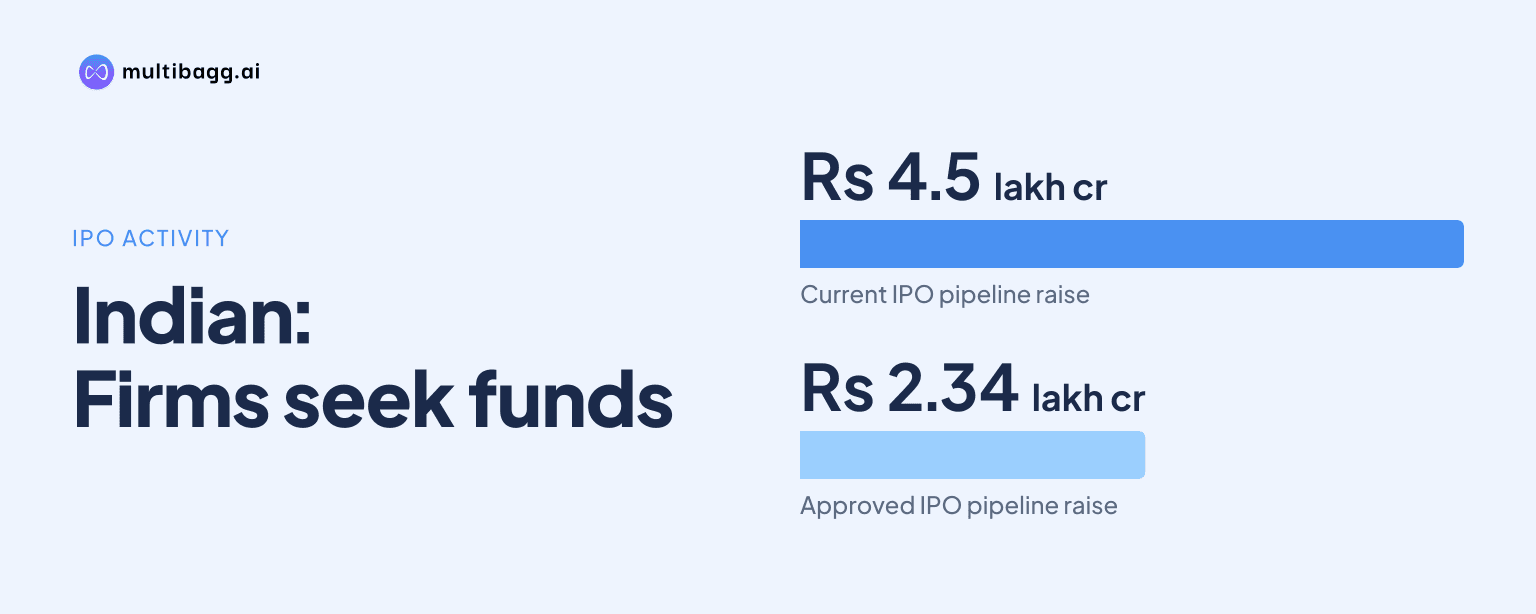
The Indian initial public offering pipeline has 252 companies proposing to raise around ₹4.5 lakh crore in 2026, according to Prime Database figures cited in market discussions, with 121 companies holding valid approvals and awaiting an opportunity to access the primary market. The queue points to a large supply of prospective issues beyond those already scheduled.
How large is the Indian IPO pipeline?
The Indian IPO pipeline is substantial, with 252 companies collectively proposing to raise about ₹4.5 lakh crore. The figure covers companies at different stages, from those with regulatory approvals to those that have filed draft documents or are still preparing to do so.
Market discussions also indicate that more than 20 IPOs could reach the market during the second half of November and December 2026. Separately, 121 companies with valid approvals are waiting to raise an estimated ₹2.34 lakh crore. These figures show that approval does not necessarily determine the date of a public issue, as companies still need to choose launch windows and announce price bands.
Which companies are waiting for regulatory or launch updates?
Several companies are awaiting either Securities and Exchange Board of India observations, regulatory clearance or final launch details. The Indian IPO pipeline list includes Swara Baby Products, JSW One Platforms Limited and B S Sponge Limited, alongside companies such as Gujarat Victory Forging, Milestone Gears, Avaada Electro, Integris Medtech and AGS Health.
Swara Baby Products, a contract manufacturer of baby diapers, adult diapers and feminine hygiene products backed by FirstCry, received Securities and Exchange Board of India approval for its proposed ₹1,000 crore IPO. Its proposed issue comprises a ₹500 crore fresh issue and a ₹500 crore offer for sale. JSW One Platforms Limited has filed for an issue totalling ₹3,054 crore, comprising a ₹1,300 crore fresh issue and a ₹1,754 crore offer for sale, while B S Sponge Limited has proposed a ₹1,000 crore issue.
What does filing a DRHP mean for the Indian IPO pipeline?
A draft red herring prospectus filing means a company has started the regulatory process, but it does not fix an IPO date. Once Securities and Exchange Board of India issues its observations, a company has 12 months to launch its issue, according to the pipeline information shared in the discussion.
The distinction matters because the pipeline contains businesses at very different stages. The reported list showed 16 companies filed or cleared but without dates. Around 110 companies were also said to be awaiting Securities and Exchange Board of India approval, while another 10 to 15 were expected to file draft red herring prospectuses in the coming weeks. In addition, 15 to 20 companies were reported to have either received approval or to be awaiting clearance through the confidential pre-filing route.
Got a follow-up? Ask IRIS
Which large consumer and technology listings are being discussed?
Large consumer, technology and financial-services names are part of the Indian IPO pipeline discussion, though their listing status varies. Razorpay reportedly secured approval for a proposed ₹5,000 crore to ₹6,000 crore IPO after using the confidential filing route in June. Atomberg also received approval for a proposed issue that may include a ₹450 crore fresh issue and an offer for sale of up to 7.65 crore shares.
Global beverage groups are at earlier and differing stages. Carlsberg has filed an updated draft red herring prospectus for its Indian business, Pernod Ricard is continuing preparatory work pending board approval, and The Coca-Cola Company is exploring a potential IPO of its Indian bottling operations. These are plans rather than announced subscription schedules, so investors need to distinguish preparatory disclosures from confirmed public issues.
Why are shareholder quotas part of the IPO discussion?
Shareholder quotas are receiving attention because investors applied for the Jio Platforms IPO through a quota reserved for eligible Reliance Industries shareholders. The discussion also identified Mahanadi Coalfields, South Eastern Coalfields, Indian Gas Exchange and Reliance Retail among potential future IPOs that may have a shareholder quota.
Eligibility, the record date and the exact allocation rules depend on each company’s final offer documents. A shareholder quota should therefore not be treated as automatic for every issue connected with a listed parent. Investors must wait for the red herring prospectus or final prospectus to confirm whether a quota exists and who qualifies.
Conclusion
The Indian IPO pipeline reflects a broad pool of prospective fundraising, led by 252 companies targeting around ₹4.5 lakh crore and a separate approved queue of about 121 companies seeking around ₹2.34 lakh crore. The 109 mainboard IPOs that had raised approximately ₹1.58 lakh crore in 2026 provide context for the pace already seen in the primary market.
The next points to watch are price-band announcements, subscription dates and Securities and Exchange Board of India observations for companies without fixed schedules. The reported expectation of more than 20 issues in the latter half of November and December, along with the planned draft filings and pending clearances, will determine how much of the pipeline reaches investors in the near term.