










Nippon India ETF Gold BeES Falls as Domestic Gold Retreats
Key highlights
- Gold BeES fell 1.16% to ₹115.51 on November 11.
- Gold BeES was down 4.80% over 30 days and about 22% below its ₹148.14 52-week high.
- MCX December 2026 gold futures fell ₹635 to ₹1,39,081 per 10 grams.
- Gold ETF assets under management rose to ₹1.91 lakh crore in October from ₹1.58 lakh crore in April.
powered by IRIS
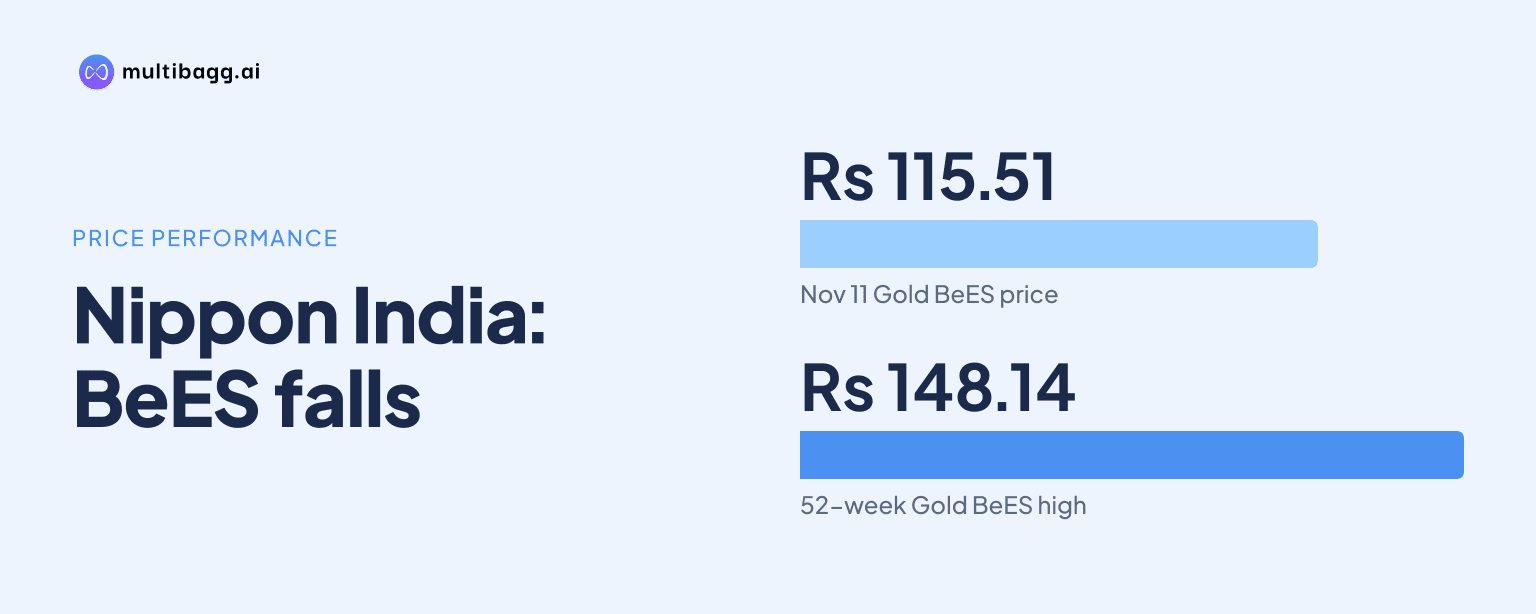
Nippon India ETF Gold BeES fell 1.16% to ₹115.51 on November 11 as domestic gold weakened, and it was about 22% below its ₹148.14 52-week high. The move reflects pressure on Indian gold prices from a stronger US dollar and rising expectations of a US Federal Reserve rate hike, rather than a break from the fund's stated objective of tracking domestic physical gold prices before expenses.
Why did Gold BeES fall?
Gold BeES fell because domestic gold prices declined alongside international bullion prices. On November 11, all 26 gold exchange-traded funds cited in the market update were lower. The broader weakness followed a stronger US dollar, which reached a 19-month high, and increased market expectations that the Federal Reserve could raise interest rates in the following month.
Higher rate expectations can weigh on gold sentiment because gold does not generate interest income. In the international market, spot gold was down 0.2% at $3,981.49 per ounce after reaching its lowest level since November 4. Stronger-than-expected US inflation data and hawkish comments from Federal Reserve officials were cited as the immediate triggers for the dollar's rise and the decline in bullion.
How does Gold BeES track physical gold prices?
Gold BeES aims to provide returns that, before expenses, closely correspond to returns from the domestic price of gold through physical gold. It is an exchange-traded fund holding physical gold, rather than a product whose value is set independently by company earnings or operating performance. One unit in Indian gold ETFs represents one gram of 99.5% pure physical bullion, according to the provided market context.
That structure means Gold BeES and Indian physical gold should generally move in the same direction. Gold ETFs give investors a route to gold exposure without buying physical metal. However, returns need not exactly match a quoted retail jewellery rate because jewellery prices include making charges and GST, while the ETF does not. Expense ratio and tracking error can also reduce returns relative to spot gold.
Why can Gold BeES differ from dollar gold?
Gold BeES can decline by less or more than international dollar gold because it tracks gold priced in rupees. The domestic price is affected both by global gold prices in US dollars and by the rupee-dollar exchange rate. A weaker rupee raises the rupee cost of each dollar of gold and can partly offset a fall in the international gold price for Indian investors.
The context illustrates this currency effect during the recent correction. Dollar gold was reported to have fallen roughly 26% from a January high near $5,600 to about $4,123 on October 7, while Gold BeES was down about 18% from its peak at that point. The rupee was cited as moving from close to 92 per dollar in late January to around 96.7 later, a depreciation of roughly 5% that cushioned domestic gold-linked returns.
Got a follow-up? Ask IRIS
What does the recent price trend show for Gold BeES?
Gold BeES has seen short-term weakness after a substantial correction from its January 2026 high. It was down 4.80% over 30 days in the November 11 update, while a separate October 30 closing figure put the ETF at ₹115.23. On November 6, it traded near ₹115.81 at 10:12 AM, down 1.96% from the previous close of ₹118.13 following a sharp bounce on November 4 and 5.
The decline has occurred after a strong longer-term period for gold-linked funds. Gold-backed ETFs were reported to have delivered more than 30% over the preceding 12 months, with Gold BeES recording a 30.7% return in that data set. Meanwhile, assets under management in gold ETF schemes rose to ₹1.91 lakh crore in October from ₹1.58 lakh crore in April, even as gold prices had declined 12% over six months.
What should investors compare before buying Gold BeES?
Investors should compare Gold BeES with domestic gold prices, the rupee-dollar rate, fund costs and the market price of the ETF. A daily fall in Gold BeES is consistent with its mandate when domestic gold declines. It does not by itself establish a change in the fund's ability to track its underlying gold exposure.
The relevant comparison also depends on the chosen alternative. Physical jewellery includes costs that do not apply to an ETF, whereas an ETF has expenses and may show tracking error against gold. Investors following the recent correction should distinguish between moves in global spot gold, MCX gold futures and retail physical-gold rates, since each can be quoted in different currencies, contracts or formats.
Conclusion
The decline in Gold BeES is aligned with a broader retreat in domestic and international gold prices. Its 1.16% fall to ₹115.51 on November 11 came as a stronger dollar and expectations of a Federal Reserve rate increase pressured bullion, while its position about 22% below the 52-week high shows the scale of the earlier correction.
The next factors to watch are US inflation signals, Federal Reserve rate expectations, the dollar and the rupee-dollar exchange rate. These variables can influence domestic gold prices and therefore Gold BeES, while the fund's expenses and tracking error remain relevant when comparing its return with physical gold.