










BSE Limited 4,000 Call Faces Heavy Resistance Before Expiry
Key highlights
- BSE's ₹4,000 call carried 10.28 lakh open interest for the 23 November 2026 expiry.
- Call volume at BSE's ₹4,000 strike was 36.61 lakh, the highest reported for the series.
- BSE's ₹3,900 put recorded 13.67 lakh volume, marking the main reported volume-based support.
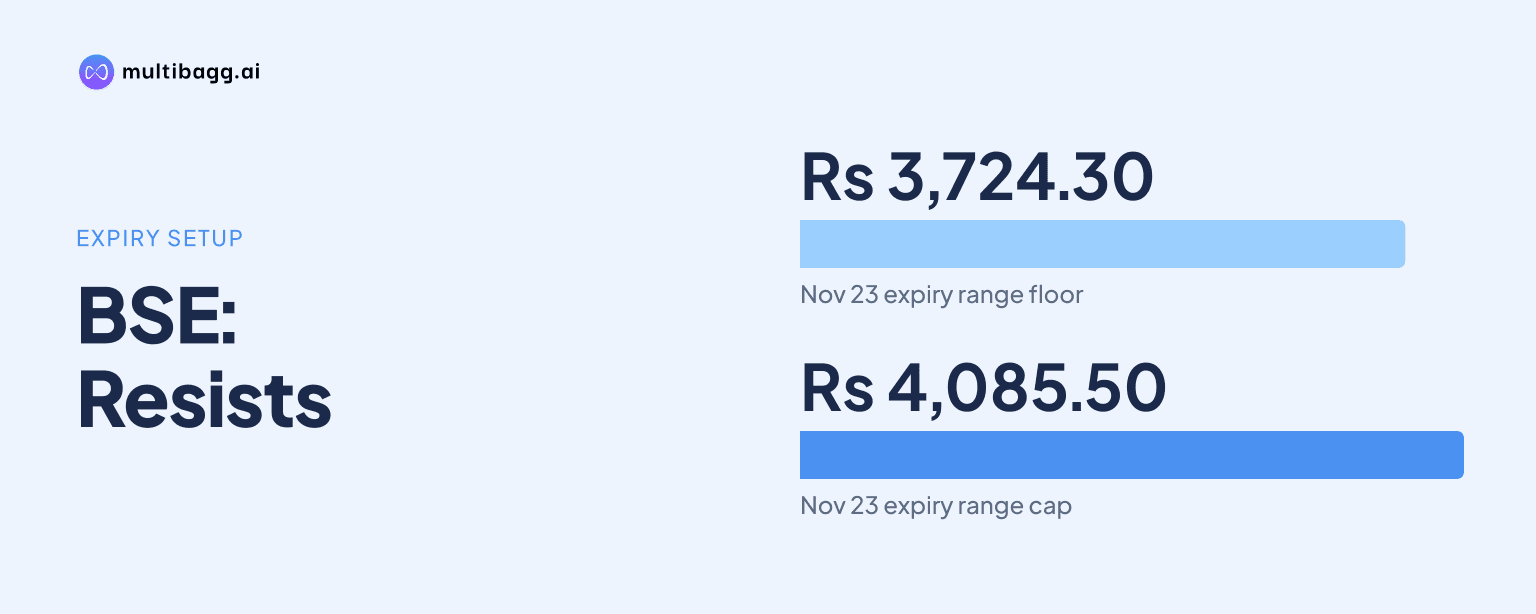
- The options-implied BSE range was ₹3,724.30 to ₹4,085.50, based on a ₹180.60 expected move.
powered by IRIS
For the 23 November 2026 expiry, BSE's 4,000 call faced heavy resistance, carrying 10.28 lakh call open interest at a strike just above the reported ₹3,904.90 spot price. The option chain allows for an upside move beyond 4,000, but the concentration at the strike does not by itself establish a breakout.
Why is BSE's 4,000 call the key expiry level?
BSE's 4,000 call is the key expiry level because it had the largest reported call open interest of 10.28 lakh and the highest reported call volume of 36.61 lakh for the 23 November series. With the underlying quoted at ₹3,904.90, the strike was just out of the money. That closeness makes the contract highly responsive to relatively small daily changes in BSE's share price.
A move above ₹4,000 would give the call intrinsic value at expiry, while a failure to cross or sustain that level would leave a long call exposed to time decay. The level is therefore important for both options traders and cash-market participants. It should not, however, be treated as a standalone directional signal because high call open interest can arise from call buying, call writing, hedges or spread strategies.
What does the BSE option chain show at 3,900 and 4,000?
The BSE option chain placed the main volume-based support at 3,900 and the main call resistance at 4,000. Put volume at the 3,900 strike stood at 13.67 lakh, compared with call volume of 36.61 lakh at 4,000. This created a narrow area that traders were watching as expiry approached.
The relationship between these two strikes matters more than either figure in isolation. Holding near or above ₹3,900 could keep attention on a test of ₹4,000. Conversely, an inability to maintain the support area may reduce the probability of the call becoming valuable through intrinsic value before expiry. Open interest must be read alongside changes in price, volume and implied volatility rather than as proof that market participants are uniformly bullish or bearish.
Can BSE move beyond 4,000 before 23 November?
The implied range allowed for BSE to move above ₹4,000 before 23 November, but it did not predict that outcome. Options were pricing an expected move of plus or minus ₹180.60, or 4.62%, from the stated spot price of ₹3,904.90. With 11 days remaining at the time of the data, this produced an implied range of ₹3,724.30 to ₹4,085.50.
The upper end of ₹4,085.50 sits above the 4,000 resistance strike, leaving room for the underlying to cross the level. Yet an implied range is derived from option premiums and reflects the scale of movement being priced, not a forecast of the direction. For a 4,000 call holder, a brief move through the strike and a sustained move can have different effects, particularly as time remaining falls.
Technical commentary in the supplied discussion also referred to a breakout from an inverse head-and-shoulders pattern and identified ₹3,470-₹3,450 as a crucial support and breakout area. One cited view placed a potential short- to medium-term resistance and target zone at ₹4,250-₹4,300, subject to BSE sustaining above that support. These technical observations sit alongside, rather than override, the nearer-term expiry dynamics at ₹4,000.
Got a follow-up? Ask IRIS
What should BSE call holders monitor into expiry?
BSE call holders should monitor whether the cash share price can hold the ₹3,900 volume-support area and absorb positioning at ₹4,000. A spot price above the strike is relevant to intrinsic value, but the option premium can also change with time decay and implied volatility. This is especially relevant for an out-of-the-money call approaching expiry.
The reported option data included different snapshots over time, including open interest of 8.716 lakh and a premium of ₹43.90 on 6 November for the same 4,000 call. Such figures can change during the series, so the latest option-chain position matters more than an earlier isolated reading. Investors tracking the contract can watch cash-market participation, fresh changes in open interest and changes in implied volatility to assess whether the derivatives activity is receiving confirmation from the underlying share.
It is also useful to separate a share-price view from an option-position view. The supplied analyst coverage showed 15 buy ratings, four hold ratings and two sell recommendations among 21 analysts, while the consensus target implied 8% upside from current levels. Those views concern BSE shares and do not remove the expiry-related risks specific to a short-dated 4,000 call.
Conclusion
BSE's 4,000 call had become the focal point for the 23 November expiry because of 10.28 lakh call open interest and 36.61 lakh call volume at a strike only ₹95.10 above the reported spot price. The ₹3,900 put-volume area offered the clearest nearby support reference, while the implied range showed that a move beyond 4,000 remained possible but was not assured.
The next issue is whether BSE holds ₹3,900 and trades decisively through the 4,000 call concentration before expiry. Traders can also watch the evolution of open interest, implied volatility and cash-market participation, while the cited technical framework identifies ₹3,470-₹3,450 as the wider support zone and ₹4,250-₹4,300 as a potential resistance area if the positive setup persists.