










Indian Oil Corporation: Buy Consensus Meets Margin Risks
Key highlights
- Indian Oil Corporation has a ₹157.42 average target from 31 analysts, implying 7.70% average one-year upside.
- IOCL's analyst target range runs from ₹105 to ₹217, implying outcomes from 28.17% downside to 48.46% upside.
- Motilal Oswal retained a Neutral rating and ₹135 target, valuing IOCL at about 6 times FY28E consolidated EPS.
- PL Research forecasts IOCL FY28E EBITDA of ₹567 billion and profit after tax of ₹273 billion.
powered by IRIS
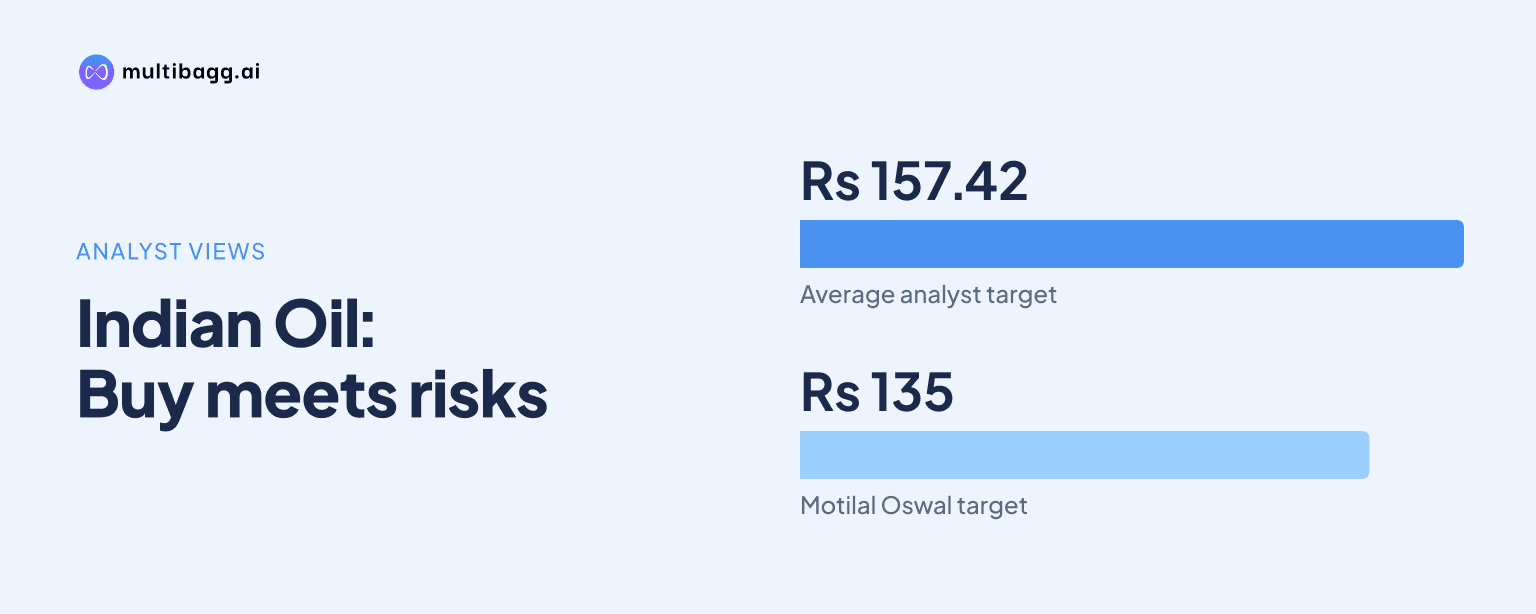
Indian Oil Corporation has a Buy consensus with a ₹157.42 average 12-month target, implying 7.70% upside from the reference price in the analyst poll. The outlook is tempered by fuel under-recoveries, uncertain refining margins and planned refinery shutdowns, even as expansion projects are targeted for December 2026.
What is the analyst view on IOCL stock?
IOCL has a Buy consensus among the 31 analysts polled by S&P Global, but individual estimates show a wide range of possible outcomes. The average target is ₹157.42, while the lowest target is ₹105 and the highest is ₹217. Those figures imply downside of 28.17% at the low end and upside of 48.46% at the high end from the reference market price used in the poll.
The range matters because it reflects differences in views on marketing profitability, refinery performance and the timing of earnings recovery. A consensus Buy rating indicates that the analyst group expects IOCL to outperform the market over the next 12 months, but it does not remove the operational risks identified by individual brokerages.
Why do some brokerages remain cautious on IOCL?
Brokerages remain cautious because near-term earnings can be affected by fuel under-recoveries, refinery shutdowns and uncertainty in gross refining margins. Motilal Oswal retained a Neutral rating and a ₹135 target in its November 1, 2026 update, despite describing IOCL as inexpensive on FY28 estimates.
Motilal Oswal valued the company at about 6 times FY28 estimated consolidated earnings per share of ₹21.9 and 0.7 times FY28 estimated price to book. Both measures were below IOCL's 10-year averages, according to the brokerage. Its caution was based on limited expected upside from its target and a weaker outlook for marketing margins.
PL Research retained an Accumulate rating but reduced its target to ₹145 from ₹163. It cut its FY27 EBITDA and EPS estimates by 30.4% and 45.9%, respectively, citing near-term weakness, while raising FY28 EBITDA and EPS estimates by 2.9% and 9.4%. This combination points to a view that the pressure may be concentrated in FY27 rather than permanent.
What do IOCL's recent earnings and forecasts indicate?
IOCL's reported and forecast numbers show strong recent profitability alongside expectations of a more difficult intervening period. The company reported Q4 FY26 net profit of ₹14,458 crore, up 77.98% year on year, while another data point in the social discussion stated that earnings grew 90% over the past year.
PL Research said standalone Q4 FY26 revenue was ₹2,078.8 billion, up 1.7% quarter on quarter and 6.6% year on year, though 5.4% below its estimate. The brokerage described the quarter's operating and earnings performance as strong, but expects Q1 FY27 to be challenging amid West Asia-related volatility, under-recoveries and planned shutdowns.
For FY27, PL Research forecasts consolidated revenue of ₹8,899 billion, EBITDA of ₹378 billion and profit after tax of ₹137 billion. Its FY28 estimates rise to ₹9,830 billion of revenue, ₹567 billion of EBITDA and ₹273 billion of profit after tax. Separately, a forecast cited in the discussion expects earnings to decline by an average 23.8% a year over the next three years and revenue to remain flat, highlighting how sharply expectations differ across sources.
Got a follow-up? Ask IRIS
How could refinery expansions affect IOCL's outlook?
IOCL's planned refinery expansions are a central part of the longer-term growth case because the Panipat, Gujarat and Barauni projects are targeted for completion in December 2026. Higher capacity after completion could support throughput and future earnings, which is why several valuation discussions focus more heavily on FY28 than on the near term.
The path to those benefits is not risk-free. Planned refinery shutdowns are expected to restrict FY27 throughput to about 75 million metric tonnes, according to PL Research. That operational constraint may weigh on volumes before new capacity is available, making execution and completion timelines important for investors tracking the expansion programme.
The social discussion also points to IOCL's activities across oil, gas, petrochemicals and alternative energy sources in India and internationally. Renewable energy and green hydrogen initiatives were identified as potential supports for future prospects, but no financial contribution or timeline was provided in the available material.
What is the near-term technical setup for IOCL shares?
IOCL shares have a constructive near-term technical setup, according to SMIFS, after breaking out of a prolonged consolidation range. SMIFS cited strong price and volume participation around the breakout area, supportive moving averages and improving momentum indicators.
The brokerage's stated trading framework places potential upside at ₹160 from a market price of ₹144.50, provided the bullish structure remains intact. It identified ₹137 on a closing basis as the level the stock needs to hold. This technical view is separate from fundamental target prices and can change quickly if the share price falls back below the breakout zone.
Conclusion
The available views present IOCL as a valuation-supported but operationally sensitive investment case. The Buy consensus and ₹157.42 average target suggest moderate expected upside, while Motilal Oswal's Neutral stance and PL Research's lower FY27 estimates show that fuel under-recoveries, margin pressure and shutdowns remain material concerns.
Investors will be watching marketing margins, gross refining margins, the effect of West Asia-related volatility and FY27 throughput during planned shutdowns. The December 2026 targets for the Panipat, Gujarat and Barauni refinery projects are the disclosed milestones that could shape the longer-term FY28 growth and valuation case.