










BSE Ltd Options Share Reaches 35% as Volumes Face Tests
Key highlights
- BSE reached around 35% of index-options premium turnover in H1 FY27, versus about 3% in FY24.
- BSE equity-options charges rose 53% to Rs 951.9 crore in Q2 FY27.
- BSE equity-options premium average daily turnover was around Rs 22,531 crore in Q2 FY27, down 24% sequentially.
- BSE premium turnover rose 61% to a record Rs 37,400 crore in October.
powered by IRIS
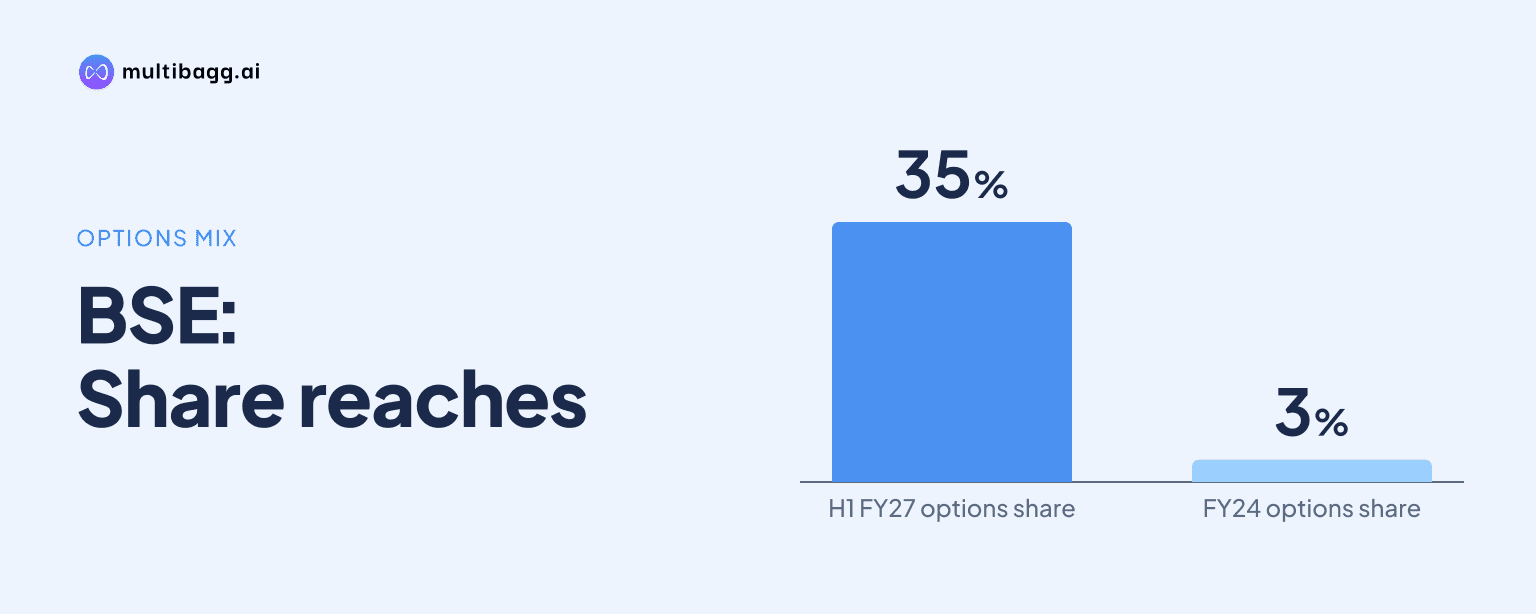
In H1 FY27, BSE Ltd reached about 35% of India’s index-options premium turnover, up from about 3% in FY24, but its Q2 equity-options turnover declined sequentially and faces pressure from low volatility, regulatory changes and a high comparison base.
How large is BSE’s gain in equity options?
BSE’s gain has been substantial, with Kotak estimating its index-options premium-turnover share at around 35% in H1 FY27 versus about 3% in FY24. The expansion has been linked to the growth of Sensex options and BSE’s efforts to add brokers and foreign portfolio investors to its derivatives platform.
The growth has also been visible in transaction charges. In Q2 FY27, total transaction charges rose 42% to Rs 1,127.8 crore, while charges from equity options increased 53% to Rs 951.9 crore. These figures show the importance of derivatives to BSE’s recent operating momentum, while also raising the question of how durable that momentum can be.
Why did BSE’s options volumes weaken in Q2 FY27?
BSE’s equity-options premium average daily turnover was around Rs 22,531 crore in Q2 FY27, up 50% year on year but down 24% sequentially. Social-media discussion around the results has focused on whether the sequential decline marks a temporary interruption or a more meaningful moderation after several quarters of strong derivatives growth.
Brokerage commentary cited the Closing Auction Session, introduced in early August, lower India VIX levels and tighter leverage norms as major headwinds. One assessment said BSE equity-options volumes fell about 21% quarter on quarter in Q2 FY27. During August 1-28, BSE’s options premium average daily turnover fell 22%, compared with a 14% decline at NSE, while BSE contracts traded dropped 30% against a 7% fall at NSE.
What does the wider options-market recovery indicate?
The October rebound indicates that market activity can recover quickly when volatility returns, although it does not by itself establish a sustained growth trend. Combined daily options premium turnover across NSE and BSE increased 43% from September to Rs 1,061 billion, and daily contracts rose 39% to 360 million.
BSE grew faster in that period, with premium turnover climbing 61% to a record Rs 37,400 crore. This followed a weaker prior quarter, when combined premium turnover fell more than 25% to Rs 70,300 crore from Rs 94,100 crore in April-June and daily contracts slipped nearly 20% to 257 million. The contrast underlines why investors are watching the quality and persistence of the recovery rather than a single month’s data.
Got a follow-up? Ask IRIS
Can BSE sustain its share gains against NSE?
BSE can continue to gain share through FY27, according to Bernstein, but the brokerage expects most of those gains to accrue by Q4 FY27. Thereafter, BSE’s revenue growth is expected to increasingly reflect overall market-volume growth, making the broad derivatives environment more important to its outlook.
NSE remains a formidable competitor because of its scale and margin advantage, as highlighted in the market discussion. BSE’s strategic test is therefore broader than adding options turnover: it must demonstrate that participation across brokers and investors can support a sustained derivatives franchise rather than one dependent on a single rapidly growing segment.
Which regulatory and market factors should investors track?
The market factors to track are India VIX, the effect of the Closing Auction Session and the response of derivatives volumes to regulatory changes. Bernstein expects equity-options growth of only 5% in FY27, after 31% year-on-year growth in Q1 FY27, citing subdued volatility, the Closing Auction Session, tighter leverage norms and a high base.
Motilal Oswal said the Securities and Exchange Board of India had partially reversed Closing Auction Session changes by restoring the last-30-minute volume-weighted average price settlement mechanism for index derivatives from December 7, 2026. The brokerage expects BSE average daily turnover to reach Rs 216 trillion in FY26-27, representing 16% year-on-year growth, while noting that healthy volumes after the volatility-led rebound remain essential.
Conclusion
BSE has materially changed its position in Indian index options, moving from about 3% share in FY24 to around 35% in H1 FY27 and reporting strong growth in equity-options charges. Yet the sequential Q2 decline and the sharper August contraction versus NSE show that market share gains do not remove sensitivity to volatility, regulatory design and trading conditions.
The next key marker is whether volumes remain resilient after the December 7, 2026 restoration of the last-30-minute volume-weighted average price settlement mechanism. Investors will also watch whether BSE’s recovery in premium turnover continues, as broker targets and earnings expectations rely on a sustained derivatives-volume improvement rather than a short-lived rebound.