








India Power Corporation Limited CIRP limited to separate assets
MAX Plan at ₹4,999/yr

Find your next multibaggerBe a Pro Investor
Research stocks and track your picks on the go. Download the app.
Key highlights
- IPCL’s CIRP admission of 15 May 2026 remains in force, but only its separate business and related income are under resolution-professional control.
- IPCL’s regulated core, non-core and other businesses must return to erstwhile management after 30 days from the tribunal’s order.
- IPCL identified separate-business assets including a 133 MW solar project, a 25 MW wind plant and a 50% Uniper SE joint-venture stake.
- The Section 7 application filed on 26 February 2020 was held timely under all three proposed default dates.
powered by IRIS
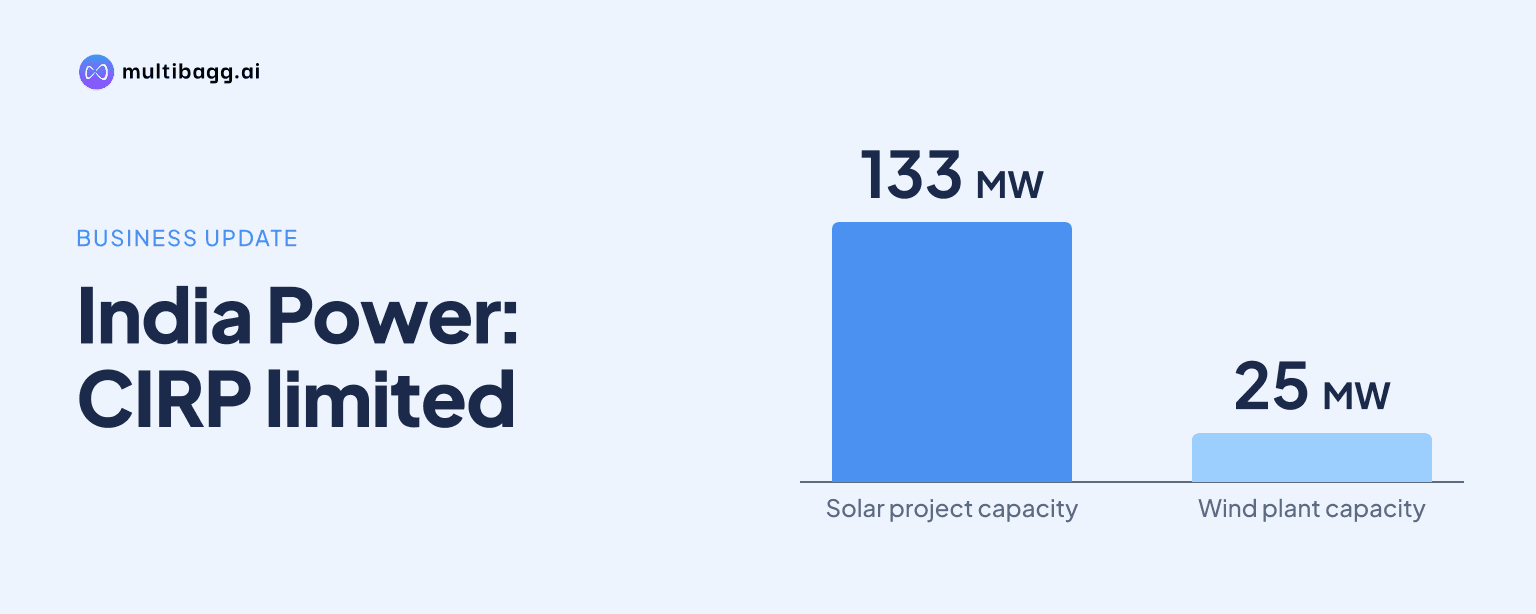
India Power Corporation Limited remains in the Corporate Insolvency Resolution Process (CIRP), but the National Company Law Appellate Tribunal limited the resolution professional’s control to its separate business, related assets and income. Its core, non-core and other regulated businesses must be returned to erstwhile management immediately after 30 days from the tribunal’s order.
Know India Power Corporation inside out
Results, valuation, peers and who's buying, in one view.
Why does IPCL remain in CIRP?
IPCL remains in CIRP because the tribunal held that its deed of guarantee dated 23 September 2016 was enforceable in respect of its separate business. That limited enforceability supported the adjudicating authority’s 15 May 2026 finding that financial debt and default existed for the purpose of the creditor’s application under Section 7 of the Insolvency and Bankruptcy Code (IBC).
The tribunal said the principal borrower, MEL, had defaulted on repayment and that this default was not disputed. It therefore declined to interfere with the order admitting IPCL to CIRP, while drawing a distinction between the separate business covered by the guarantee and IPCL’s core, non-core and other businesses governed by electricity regulations.
The tribunal also rejected the limitation challenge to State Bank of India’s Section 7 application. The application was filed on 26 February 2020 and was within time whether the relevant date of default was treated as 28 December 2017, 31 January 2020 or 15 February 2020.
It said that the absence of an expressly stated date of default in one part of the filing did not, by itself, establish that the application was time-barred. The tribunal noted that the filing record referred to the three possible dates, and held that each was within the applicable period when measured against the 26 February 2020 application date.
Which IPCL assets can the resolution professional manage?
The resolution professional may manage only IPCL’s separate-business assets and income from that business. The tribunal directed her to take charge of those assets and their income, including separate-business assets now held by IPCL Power Limited, IPCL’s wholly owned subsidiary formerly known as Parmeshi Energy Limited.
IPCL had identified five separate-business positions that, according to the tribunal, remain available to secure the debt under the partially enforceable guarantee. They include renewable-generation projects, a smart-metering project and a joint-venture holding, rather than the regulated electricity-distribution businesses.
The tribunal permitted the resolution professional to approach the adjudicating authority if she has material showing that IPCL omitted to transfer a specific separate-business asset. Any application on that issue must be decided only after IPCL is given an opportunity to be heard.
This direction preserves a route to test individual asset transfers without extending CIRP control to the company’s regulated operations. The tribunal specifically directed the resolution professional to take charge of the separate business and income from it, rather than leaving the scope of assets under her management to her judgment.
Why are IPCL’s regulated businesses outside CIRP control?
IPCL’s core, non-core and other businesses are outside the resolution professional’s direct control because the tribunal found that the guarantee could not safely be treated as enforceable against assets and income subject to electricity regulation. West Bengal Electricity Regulatory Commission (WBERC) Regulation 5.13.2 requires prior consent before a distribution licensee provides a guarantee.
The tribunal said Regulation 5.13.2 does not prohibit a guarantee in all circumstances, but requires prior regulatory consent. It considered there to be more than a strong prima facie case that the parties had attempted to sidestep this requirement through the drafting of the 23 September 2016 guarantee, including its treatment of non-regulated assets and surplus amounts.
The tribunal also held that Section 238 of the IBC did not resolve this issue in State Bank of India’s favour. It said the Electricity Act and the IBC operate in different spheres, and that the IBC’s overriding provision does not support conduct that evades a statutory procedure required to create a creditor-guarantor relationship.
For surplus income generated by IPCL’s regulated core, non-core and other businesses, the resolution professional must approach WBERC. The tribunal said WBERC retains control over profits from those businesses, while income from the separate business falls within the scope of the guarantee that it found enforceable.
Got a follow-up? Ask IRIS
When must IPCL’s regulated operations return to management?
IPCL’s core, non-core and other businesses must be handed over to erstwhile management immediately after 30 days from the tribunal’s order. Until that handover, the resolution professional must preserve the status quo, except for keeping IPCL as a going concern.
The handover direction applies to core, non-core and other businesses as defined under WBERC regulations. It does not end the CIRP because the resolution professional continues to administer the separate-business asset pool and income from that pool under the tribunal’s directions.
The tribunal also set aside anything the resolution professional may have undertaken to affect the regulated businesses under the earlier admission order. It said there was no justification for taking control of IPCL in its entirety when the guarantee was limited to the separate business and related income.
The 30-day period is therefore a transition period for the regulated operations, not a period in which those operations can be used to meet obligations under the guarantee. The tribunal required the status quo to be preserved during that period, subject to the need to keep IPCL operating as a going concern.
How did the ruling change State Bank of India’s recovery route?
State Bank of India can pursue recovery under IPCL’s guarantee only through the separate business, its assets and its income. The tribunal found the 23 September 2016 guarantee enforceable to that extent, but not across IPCL’s regulated core, non-core and other operations.
This produces a different result from a whole-company insolvency process. Before the appellate directions, the resolution professional had taken control of IPCL in its entirety; after them, control is limited to the separate-business perimeter while regulated operations are to return after 30 days.
The tribunal said State Bank of India had been alerted by IPCL that providing a guarantee might require compliance with Regulation 5.13.2. It also found that an indemnity deed dated 23 September 2016 did not assist State Bank of India because it was executed in favour of Rural Electrification Corporation Limited, not the bank.
Whether that indemnity could affect IPCL’s regulated core business was left open by the tribunal. The appeal was disposed of without costs, leaving State Bank of India with recourse to the separate-business assets and income but not an unrestricted claim on regulated operations.
Conclusion
The tribunal preserved IPCL’s CIRP admission because the 23 September 2016 guarantee remains enforceable for the separate business, while materially restricting the process from the company as a whole. The ruling separates renewable, smart-metering and joint-venture assets from regulated core, non-core and other businesses, whose assets and profits are subject to the electricity-regulation framework.
Next, the regulated businesses are due to return to erstwhile management after 30 days, while the resolution professional may seek WBERC’s direction on surplus income from regulated operations. The resolution professional may also apply to the adjudicating authority over any specific separate-business asset that IPCL may have omitted to transfer, subject to IPCL’s right to be heard.

