








Indian IPO grey market premiums fall as selling increases
MAX Plan at ₹4,999/yr

Find your next multibaggerBe a Pro Investor
Research stocks and track your picks on the go. Download the app.
Key highlights
- Indian IPO grey market premiums can fall when unofficial sellers outnumber buyers before listing.
- National Stock Exchange of India’s reported GMP declined nearly 32%, from Rs 218 to around Rs 148 between September 11 and September 17.
- National Stock Exchange of India reportedly listed at a 0.8% premium despite an earlier GMP of Rs 250-280.
- Lenskart Solutions reportedly opened at a 1.7% to 3% discount after its GMP fell from a Rs 55-120 range to zero.
powered by IRIS
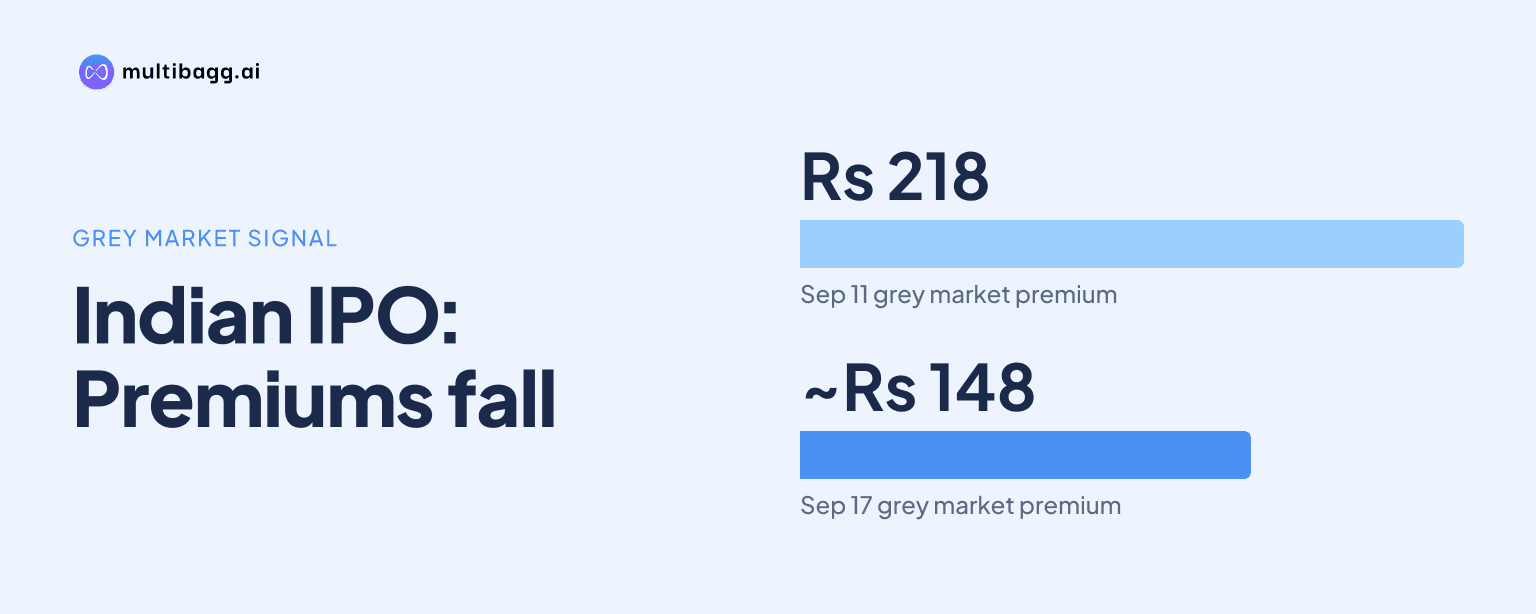
Indian IPO grey market premiums can fall when pre-listing sellers outnumber buyers, with broader market volatility, sector sentiment and expected listing-day selling also affecting quotes. National Stock Exchange of India’s reported premium declined nearly 32%, from Rs 218 on September 11 to around Rs 148 on September 17, illustrating how quickly sentiment can change.
Why do Indian IPO grey market premiums decline?
Indian IPO grey market premiums decline when the balance of unofficial demand shifts towards sellers. Buyers in this market pay an additional amount over an IPO’s issue price for a potential pre-listing transfer, while allotted investors may look to exit before the shares start exchange trading. When more such sellers emerge than buyers willing to pay the earlier premium, the quoted GMP falls.
The movement is not necessarily a verdict on the issuer’s business. It can instead reflect changing risk appetite between allotment and listing. A premium can rise if buyers are scarce and demand strengthens, but it can also fall sharply or turn negative when interest weakens. Because there is no regulated exchange order book behind these quotations, it is difficult to verify whether a quoted premium represents broad, genuine demand.
What market factors can compress GMPs before listing?
Broader market weakness can compress GMPs because a decline in the Nifty or Sensex raises the perceived risk of holding a newly listed share. Grey-market operators may lower bids in a falling market, even where no new company-specific development has emerged. This effect can be temporary if the wider market stabilises, but it can matter greatly close to the listing date.
Sector rotation can produce a similar result. An IPO in a sector that has fallen out of favour may see its GMP decline even when its underlying fundamentals are unchanged. Discussions also link muted premiums to weak post-listing performance, valuation concerns, continuous foreign investor selling, lower retail and high-net-worth investor enthusiasm, and trade tensions that have weighed on capital-market sentiment.
Does high NII subscription affect listing expectations?
High non-institutional investor, or NII, subscription can create concern about selling pressure on listing day. The context notes that some NII participation is funded with borrowing, which can make quick selling more likely after listing as applicants seek to repay loans. If NII subscription is extremely high, such as above 100 times, this expected supply can weigh on GMPs before the debut.
Anchor investors have a 30-day lock-in and cannot sell immediately, but informal market perceptions of institutional positioning can still influence grey-market sentiment. Any signals that investors are reducing exposure in related secondary-market shares may affect pricing discussions. These are sentiment-based influences rather than a transparent measure of executable IPO demand.
Got a follow-up? Ask IRIS
Why did National Stock Exchange of India’s GMP fall 32%?
National Stock Exchange of India’s reported GMP fell nearly 32% from Rs 218 on September 11 to around Rs 148 by 3 p.m. on September 17. The available context identifies the decline as a sign of softer pre-listing sentiment but does not give a specific reason for the move. It therefore cannot be attributed to a particular company event based on the information available.
The episode supports the broader point that IPO demand is uneven rather than uniformly weak. Commentary linked selective interest in some offerings to secondary-market volatility and a stronger quality and valuation filter among buyers. In the case of asset-management-related offerings, weakness in listed asset management company shares and mutual-fund redemption pressure were also cited as factors affecting interest.
Can a GMP accurately predict an IPO listing price?
A GMP cannot reliably predict an IPO listing price because it is an unregulated and unverified indicator rather than a formal price-discovery mechanism. The Securities and Exchange Board of India has cautioned investors against treating GMPs as indicators of likely listing prices or expected returns. It has also asked intermediaries and market participants to stop publishing or circulating GMPs for upcoming IPOs.
Recent examples show the possible gap between a grey-market quote and the eventual debut. National Stock Exchange of India’s premium reportedly fluctuated from Rs 250-280 at one stage before declining closer to listing, while the stock listed at a premium of just 0.8%. Lenskart Solutions reportedly saw its GMP range from Rs 55 to Rs 120 before dropping to zero, followed by an opening at a 1.7% to 3% discount.
Conclusion
Falling Indian IPO grey market premiums primarily indicate that unofficial pre-listing demand has weakened relative to selling interest. They may reflect wider market conditions, sector rotation, expected NII selling, valuation caution or adverse company news, but they do not by themselves establish the cause or forecast the listing price. The lack of oversight, settlement guarantees and investor protection makes GMP-linked transactions especially risky.
Investors should watch disclosed subscription data, valuations, financials, business models and conditions in the secondary market rather than rely on unofficial quotes. The unresolved question is whether Sebi’s push to curb GMP publication will reduce grey-market activity or move it into less visible channels, while market stability and actual listing-day demand will remain central to IPO outcomes.

