










IndiGrid sees ₹1.25 lakh crore in active grid and BESS bids
Key highlights
- IndiGrid identifies active transmission and BESS bids worth about ₹1,24,644 crore in Q2 FY27.
- Transmission opportunities total about ₹92,594 crore, including ₹70,958 crore with RFPs released.
- Five standalone BESS projects total about ₹32,050 crore, led by a 6,000 MWh project valued at ₹10,500 crore.
- Q2 FY27 peak power demand was 270.3 GW, up 17.7% from 229.7 GW in Q2 FY26.
powered by IRIS
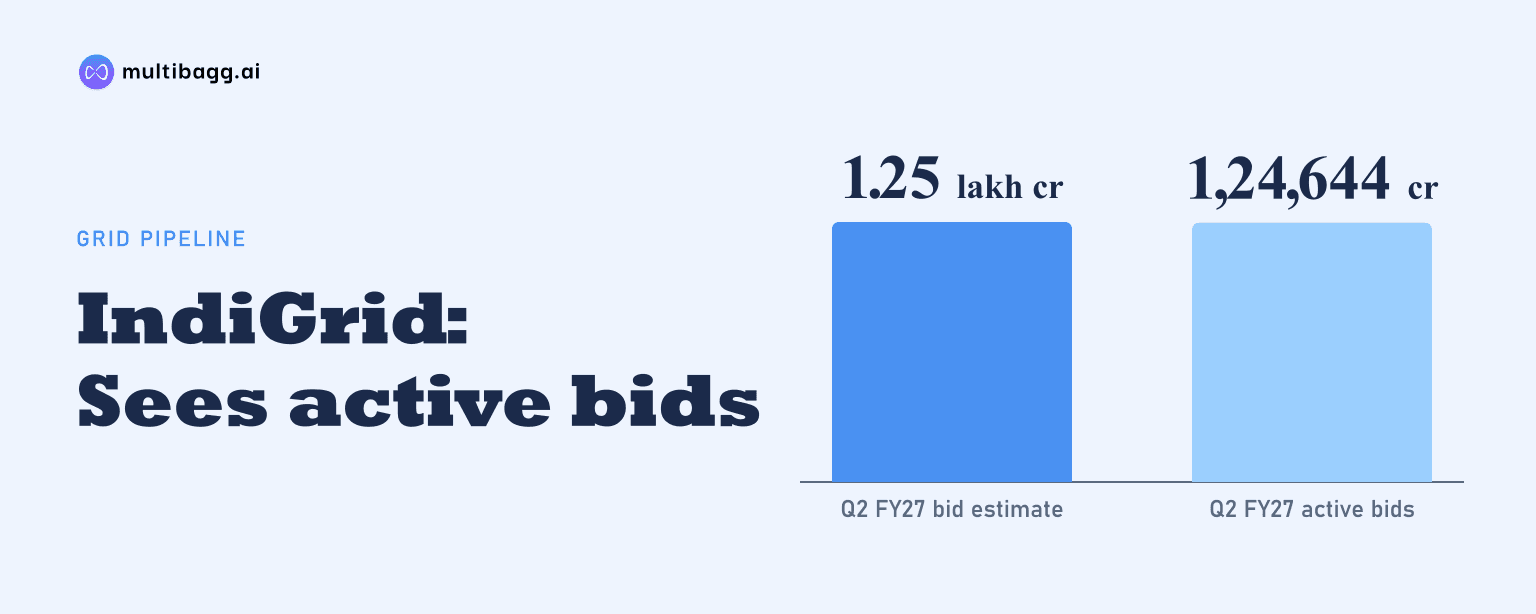
IndiGrid Infrastructure Trust identified active transmission and battery energy storage system, or BESS, bids worth about ₹1.25 lakh crore in Q2 FY27, comprising ₹92,594 crore of transmission projects and ₹32,050 crore of storage projects. The opportunity list coincided with quarterly peak power demand rising 17.7% year on year to 270.3 gigawatts.
Know IndiGrid Infrastructure Trust inside out
Results, valuation, peers and who's buying, in one view.
What makes up IndiGrid’s ₹1.25 lakh crore active bid pipeline?
IndiGrid’s active sector bid pipeline totals about ₹1,24,644 crore, made up of ₹92,594 crore in transmission projects and ₹32,050 crore in BESS projects. The presentation describes these as active bids across the transmission and BESS sectors, rather than as awards, contracted revenue or an IndiGrid order book.
Transmission projects with request for proposals, or RFPs, released account for ₹70,958 crore of the total transmission pipeline. A further ₹21,636 crore consists of projects under discussion in the National Committee on Transmission, or NCT, for which RFPs are awaited. The RFP-released category is therefore larger than the earlier-stage category by ₹49,322 crore.
The ₹32,050 crore BESS list covers five standalone projects, while the transmission list spans Northern, Southern, Eastern, Western and North Eastern regions. A released RFP denotes a formal procurement stage, whereas projects under NCT discussion remain subject to a subsequent RFP. That distinction is relevant to the ₹21,636 crore transmission component that has not yet reached the RFP stage.
Which transmission regions account for IndiGrid’s ₹92,594 crore pipeline?
IndiGrid’s largest RFP-released transmission opportunity is in the Northern region, estimated at ₹38,941 crore. The list includes Rajasthan projects at Bikaner Complex A, Pugal, Babai, Kankani, Rundh Gidawara, Bhojrajka and Dholpur, alongside projects in Haryana, Punjab, Uttar Pradesh, and Jammu and Kashmir.
The Western region contributes ₹14,460 crore of released-RFP projects, including schemes in Maharashtra, Madhya Pradesh and Daman. Southern projects in Tamil Nadu and Karnataka total ₹10,405 crore, and the Eastern-region entry in Bihar is estimated at ₹7,152 crore. These four regional categories sum to the ₹70,958 crore RFP-released transmission total.
The North Eastern region is the largest earlier-stage transmission category at ₹12,353 crore, represented by NERGS-II Dibang Basin in Assam and Arunachal Pradesh. Northern-region projects under discussion total ₹8,265 crore and include static or dynamic compensation in Jammu and Kashmir and Punjab, plus dynamic compensation, or synchronous condenser, projects in Rajasthan. The earlier-stage list also includes ₹632 crore for Chhattisgarh’s Dharamjaigarh augmentation and ₹386 crore for Tamil Nadu’s Krishnagiri substation augmentation.
Got a follow-up? Ask IRIS
How large are IndiGrid’s identified BESS bids?
IndiGrid identifies ₹32,050 crore of BESS projects, led by Rajasthan Rajya Vidyut Utpadan Nigam Limited’s 6,000 megawatt-hour, or MWh, standalone project at ₹10,500 crore. Andhra Pradesh Central Power Distribution Company Limited’s 5,000 MWh standalone project follows at ₹9,000 crore, making the two projects worth ₹19,500 crore together.
Gujarat Urja Vikas Nigam Limited’s 4,000 MWh standalone project is estimated at ₹7,250 crore. Maharashtra State Power Generation Company Limited’s 1,600 MWh project is valued at ₹3,500 crore, while Rajasthan Rajya Vidyut Utpadan Nigam Limited’s separate 1,000 MWh project is estimated at ₹1,800 crore. The five named tenders range from 1,000 MWh to 6,000 MWh.
The bid list is set against operational BESS capacity of 14.5 gigawatt-hours, or GWh, across 19 projects as of September 2026. IndiGrid also cites a total BESS pipeline, from operating projects through tendering, of about 198 GWh. The listed 17,600 MWh of standalone projects are part of this wider market pipeline rather than a stated portfolio of IndiGrid assets.
IndiGrid links storage demand to evening shortages of as much as 7.7 GW in September 2026. Its presentation says BESS can support renewable integration, peak management and use of transmission assets, but does not forecast the number of projects that will be awarded or IndiGrid’s participation in any named bid.
Why are transmission and storage procurement needs increasing?
India’s peak demand reached 270.2 GW in July 2026, close to the all-time high of 270.82 GW recorded in May 2026. Demand also set monthly records of 258.3 GW in August and 269.6 GW in September. On the quarterly measure, Q2 FY27 peak demand was 270.3 GW, compared with 229.7 GW in Q2 FY26 and 230.6 GW in Q2 FY25.
Electricity consumption rose about 12% year on year to about 502 billion units in Q2 FY27, while Indian Energy Exchange day-ahead prices increased 46% to ₹5.7 per unit. The presentation also reports coal stocks at power plants of 19 million tonnes at end-September, down 60% year on year, and says September day-ahead prices more than doubled from a year earlier.
Total installed capacity reached about 558.9 GW as of September 2026, including about 300 GW of non-fossil and renewable energy sources, or 53.5% of the total. Transmission additions were 6,108 circuit kilometres in H1 FY27, more than twice the H1 FY26 level. IndiGrid cites evacuation constraints and curtailment as reasons grid investment must keep pace with renewable additions.
The Central Electricity Authority’s draft technical standards propose co-located storage for new solar and wind plants from July 2027. The proposed minimum is storage equal to 10% of plant capacity for two hours, rising to four hours from July 2029. These are draft norms, not final requirements, but they are the policy proposal IndiGrid cites in discussing future storage procurement.
Conclusion
IndiGrid’s ₹1.25 lakh crore pipeline combines a ₹92,594 crore transmission opportunity with ₹32,050 crore of standalone BESS projects at RFP-released, under-discussion or RFP-awaited stages. The pipeline appears alongside Q2 FY27 peak demand growth of 17.7%, 300 GW of non-fossil capacity at September 2026, and September evening shortages of up to 7.7 GW.
The next developments to watch are whether the ₹21,636 crore of transmission projects awaiting RFPs move through the NCT process and whether the Central Electricity Authority finalises its proposed July 2027 storage requirement. Under the disclosed draft plan, the minimum co-located storage duration would increase from two hours to four hours in July 2029.