










Indo Borax completes 64.26% Kronox stake, appoints managing director
Key highlights
- Indo Borax completed the acquisition of a 64.26% stake in Kronox, making it a subsidiary.
- Indo Borax appointed Suresh Kalra as Managing Director and Chief Executive Officer of Kronox.
- H1FY27 consolidated operating income increased 16.0% to Rs 129.29 crore from Rs 111.42 crore.
- H1FY27 adjusted EBITDA increased 22.9% to Rs 28.09 crore, with a 21.7% adjusted EBITDA margin.
powered by IRIS
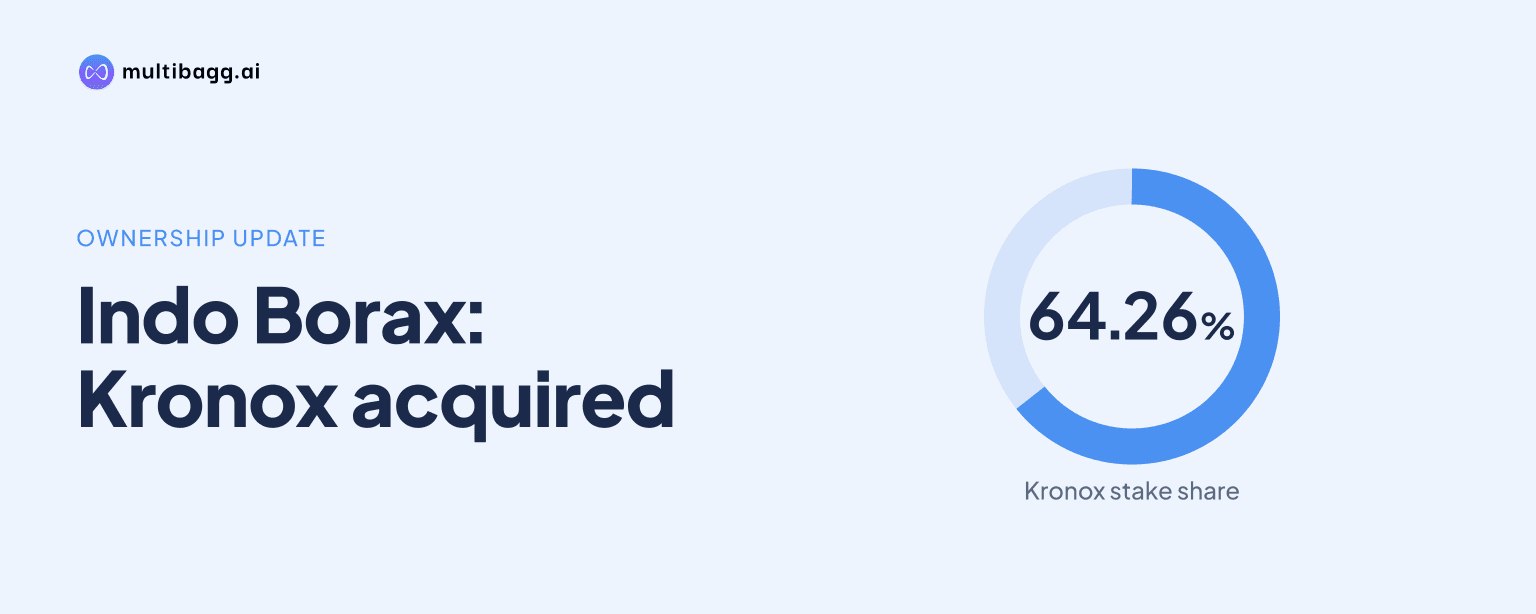
Indo Borax & Chemicals Ltd completed the acquisition of a 64.26% stake in Kronox Lab Sciences Ltd, making Kronox a subsidiary, and appointed Suresh Kalra as its Managing Director and Chief Executive Officer in its November 11, 2026 announcement. The update accompanied H1FY27 consolidated operating income of Rs 129.29 crore, up 16.0% year on year.
Know Indo Borax & Chemicals inside out
Results, valuation, peers and who's buying, in one view.
What did Indo Borax complete at Kronox?
Indo Borax completed the acquisition of a 64.26% stake in Kronox, which the November 11, 2026 release describes as a subsidiary acquisition. The disclosure confirms that Kronox has entered the Indo Borax consolidated group, but it does not state the transaction consideration, the acquisition closing date or the identity of holders of the remaining 35.74% stake.
Indo Borax also appointed Suresh Kalra as Managing Director and Chief Executive Officer of Kronox. The company disclosed the leadership appointment alongside the 64.26% stake acquisition, linking the ownership change with the installation of operating leadership at the subsidiary.
Management said the quarter saw strategic integration and stabilisation of synergies with the recently acquired business. It said future growth and margin strengthening would be supported by diversification, premiumisation and disciplined execution, although the release did not disclose a numerical synergy target, integration-cost estimate or timetable for these actions.
How did Indo Borax perform in H1FY27?
Indo Borax reported consolidated operating income of Rs 129.29 crore for H1FY27, compared with Rs 111.42 crore in H1FY26, an increase of 16.0%. Total income rose 15.5% to Rs 136.26 crore from Rs 118.01 crore over the same periods, showing that income growth continued through the first half of financial year 2027.
Profit after tax, or PAT, declined 20.7% to Rs 21.00 crore in H1FY27 from Rs 26.47 crore in H1FY26, despite the Rs 17.87 crore increase in operating income. Earnings before interest, tax, depreciation and amortisation, or EBITDA, also fell 6.3% to Rs 21.28 crore from Rs 22.71 crore.
Why did adjusted EBITDA rise while reported profit fell?
Indo Borax reported adjusted EBITDA of Rs 28.09 crore in H1FY27, up 22.9% from Rs 22.85 crore in H1FY26, while reported EBITDA declined to Rs 21.28 crore. The company defines adjusted EBITDA as EBITDA plus employee stock option plan, or ESOP, expense and foreign-exchange gain, so the adjusted measure is distinct from reported EBITDA.
The adjusted EBITDA margin was 21.7% in H1FY27, compared with 20.5% in H1FY26, according to the release. Reported EBITDA margin moved in the other direction, falling to 16.5% from 20.4%, while PAT margin fell to 15.4% from 24.0% over the same first-half periods.
For Q2FY27, Indo Borax reported PAT of Rs 4.75 crore, compared with Rs 16.26 crore in Q2FY26, a decline of 70.8%. The company said profitability in the quarter was under pressure from higher raw-material costs and geopolitical uncertainties in the Middle East, which affected the overall cost environment.
Got a follow-up? Ask IRIS
What did management say about demand and costs?
Indo Borax said demand remained steady across its key product segments during the quarter, despite the seasonal impact of the monsoon. The statement did not provide segment revenue or volume figures, but it placed the demand commentary alongside Q2FY27 PAT of Rs 4.75 crore and the higher raw-material-cost pressure cited by management.
Management said Indo Borax would focus on operational efficiencies and prudent cost management after H1FY27 operating income reached Rs 129.29 crore. The release did not provide a cost-reduction amount, raw-material price assumption or target date against which the execution of that plan can be measured.
The company also said diversification and premiumisation form part of its stated growth and margin approach following the Kronox acquisition. However, the November 2026 disclosure does not separate Kronox revenue, EBITDA, PAT or cash-flow contribution within the H1FY27 consolidated results.
What does Indo Borax plan to do with Indoborax Infrastructure?
Indo Borax received board approval to amalgamate its wholly owned subsidiary, Indoborax Infrastructure Private Ltd, with Indo Borax. The proposal was disclosed with the November 11, 2026 H1FY27 results and is separate from the completed acquisition of 64.26% of Kronox.
The amalgamation remains subject to approvals from the National Company Law Tribunal, or NCLT, and other regulatory authorities. Management said the proposed combination is intended to create a more integrated and efficient organisation, but did not disclose an expected approval date, completion date or financial effect.
The two corporate actions involve different parts of Indo Borax's structure. Kronox is a newly acquired subsidiary in which Indo Borax holds 64.26%, whereas Indoborax Infrastructure is already wholly owned; the release provides no combined financial target for the acquisition integration and proposed amalgamation.
Conclusion
Indo Borax has confirmed control of Kronox through its completed 64.26% stake acquisition and installed Suresh Kalra as the subsidiary's Managing Director and Chief Executive Officer. The corporate update came as H1FY27 operating income rose 16.0% to Rs 129.29 crore, while PAT declined 20.7% to Rs 21.00 crore amid reported cost pressure.
The next disclosed matters to watch are the integration and stabilisation of synergies at Kronox, for which management provided no numerical target, and the approval process for the Indoborax Infrastructure amalgamation. That proposal requires NCLT and other regulatory clearances before it can proceed.