










Influx says specialized formats can resist volume margin pressure
Key highlights
- Influx said reducing production changeovers could provide 5% to 7% growth.
- Management said Influx had operated at 85% to 90% capacity before delivering around 25% to 27% growth through new machinery.
- Influx said general lead times are 45 to 60 days, with an internal goal of approximately 30 days.
- Management said Influx has around 11 lines and introduced a 30 ml aseptic-grade pack.
powered by IRIS
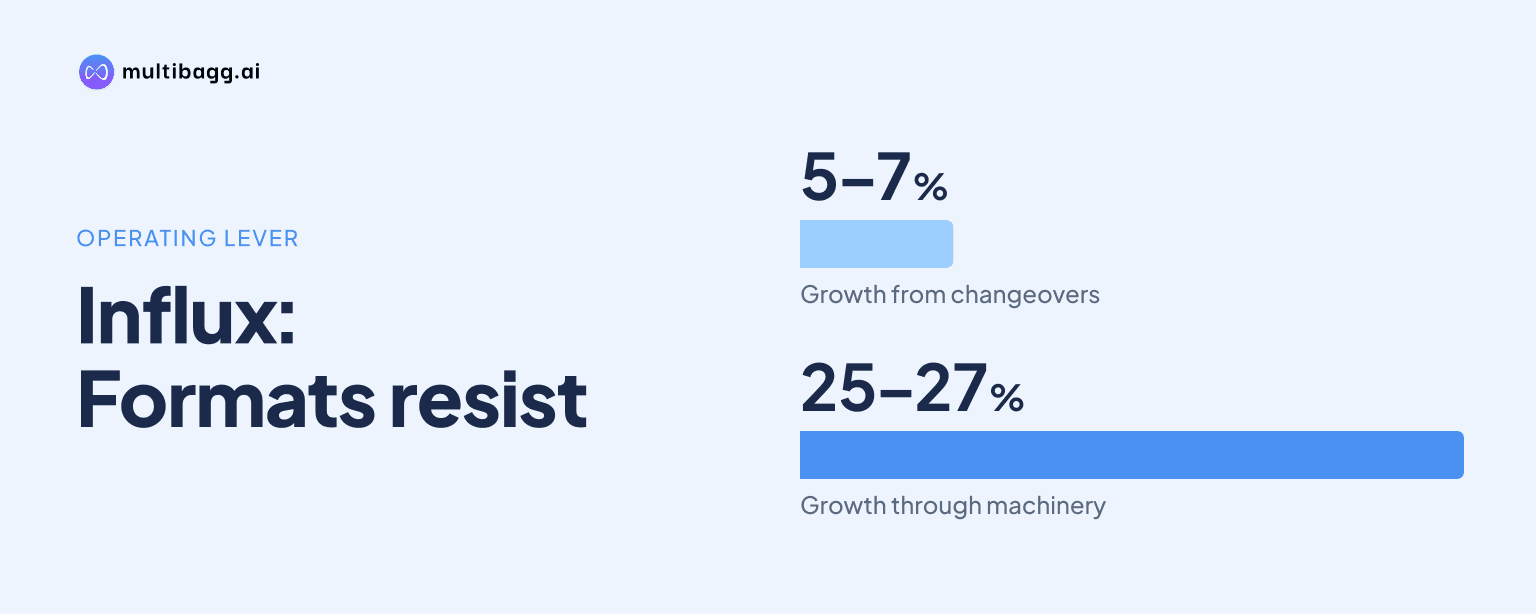
Influx says specialized formats such as liquid fill, B.O.V. and aseptic packs are intended to limit price pressure as it takes larger orders, while management estimates that reducing production changeovers could add 5% to 7% growth. It plans to preserve its customer mix by continuing to serve medium-scale clients alongside high-volume accounts.
Know Influx Healthtech inside out
Results, valuation, peers and who's buying, in one view.
How will Influx protect margins as batch sizes rise?
Influx’s answer is to combine differentiated formats with a balanced customer mix instead of relying only on higher production volumes. Management said its business-development team has started offering different batch sizes to new customers, while it does not intend to leave existing clients too early. Changeovers between products are the main operating issue, and management said reducing them could provide 5% to 7% growth.
Management acknowledged the concern that larger accounts can create pressure on realisations and operating margin as volumes rise. It said this risk is most visible in standardised products, where buyers can compare market rates. However, management said larger batches also improve production effectiveness, and it expects that efficiency to partly offset the pricing pressure associated with higher-volume orders.
The company did not provide a numerical margin target for this strategy. In a separate discussion of the first half, management said earnings before interest, taxes, depreciation and amortisation, or EBITDA, margin movement reflected product mix rather than raw-material costs. It said margins differ by client, product and brand, meaning a quarter’s manufacturing mix can change the reported result.
Which Influx formats are harder for customers to compare on price?
Influx identified liquid fill, B.O.V., aseptic formats and Boba cream as offerings where management sees less direct price comparison than in conventional contract manufacturing. Management also said it had introduced a 30 ml aseptic-grade pack, which it described as the first such pack in India. These formats are central to its stated effort to maintain pricing as larger customers account for bigger batch sizes.
Management contrasted these offerings with calcium tablets, where it said market rates are available and buyers can seek lower prices. It said customers using formats for which competitors lack comparable machinery or capacity have less basis for a like-for-like price negotiation. This was management’s commercial assessment; Influx did not disclose revenue, margin or customer concentration for liquid fill, B.O.V., aseptic packs or Boba cream.
Influx also said it had ordered machinery for Korean-style edible jelly products after its research and development work was successful. Management said internal approval for the machine had been obtained and that it expects the format to generate margin. The source does not disclose the machine’s cost, delivery date, customer order value or expected sales contribution.
Why will Influx retain medium-scale customers?
Influx says it will retain medium-scale customers because they can develop into major accounts over time. Management cited Carbamide Forte, saying it was once Influx’s sixth-largest customer and became its largest after four to five years. The company therefore does not see larger batches as a reason to discontinue relationships with clients that currently place smaller orders.
Management said large clients may seek to squeeze prices, but it intends to balance that pressure through product and customer mix. It said it would keep watch so that margins do not “break,” while continuing to work with medium-scale customers that have growth potential. Influx did not disclose the proportion of revenue from large, medium or small customers, and management declined to provide customer-level business data publicly.
The company also pointed to its breadth of formats. Management said Influx has around 11 lines and can offer nutraceutical and cosmetic products alongside other formats. It said its formulation development work allows it to manufacture customer-led projects as well as offer internally developed items, including Boba creams and edible jellies, although it gave no segment-by-segment margin data.
Got a follow-up? Ask IRIS
What has changed in Influx’s capacity and production efficiency?
Influx said it had previously been operating at 85% to 90% capacity but delivered growth of around 25% to 27% after putting new machinery into use. Management attributed the higher output to using equipment acquired for its initial public offering, or IPO, expansion, rather than solely to adding factory space. It said the existing plant can still raise output by replacing older machinery with higher-output equipment.
Management said some modern machines, including tablet-punching and capsule equipment, take less space than older machinery. It therefore sees room to increase output at the current facility, but said decisions must account for working conditions and safety hazards. While it said food-safety rules do not prescribe the internal factory layout, management noted that practical space limitations remain.
The new facility is intended to ease delivery pressure. Management said civil work was complete, machinery had reached its premises, and interior partitions were the main remaining item, while electrical work was nearly complete. It described the outstanding work as likely to take a couple of months, without confirming a commissioning date during the call.
Can faster deliveries improve Influx’s profitability?
Influx does not expect faster deliveries alone to materially increase EBITDA margin, but management expects them to improve efficiency, turnover and raw-material recovery. It said normal lead times are around 45 to 60 days and set an internal goal of approximately 30 days. Management said a 25-to-30-day production timeline would be desirable because it could allow customers to replenish products more frequently.
Management said customers including FAST&UP and Carbamide Forte are waiting to see how much Influx can supply, because their marketing activity is linked to its production capacity. This suggests that shorter lead times and higher output could support more customer orders. However, management explicitly said it does not expect margins to change substantially merely because it delivers the same products faster.
The company said first-half margin variation resulted from product mix rather than raw-material pressure. Management said the broad portfolio means the profitability of output can vary by product, brand and customer in any quarter. It said EBITDA margin should remain around the range currently being maintained, but did not disclose a numerical range or formal guidance.
Conclusion
Influx’s stated margin strategy is to pair larger batch sizes with formats that management says are less directly comparable on price. Standard products such as calcium tablets may face more price competition, but management expects lower changeover time, differentiated formats, around 11 product lines and continued medium-customer development to balance that pressure. Its reported 25% to 27% growth after deploying new machinery, despite prior 85% to 90% capacity use, is the operating progress management cited.
The next issue to watch is completion of the new facility’s remaining interior partitions and electrical work, which management said could take a couple of months. Subsequent disclosures can show whether lead times move from 45 to 60 days toward the internal 30-day goal, whether differentiated formats gain a larger role in output, and whether the stated effort to maintain margins is reflected in reported results.