










Info Edge targets 100% Job Hai billing growth, may break even in two years
Key highlights
- Job Hai recorded billings close to Rs 15 crore last year, and Info Edge is targeting 100% billing growth this year.
- Job Hai currently burns about Rs 45 crore annually, reducing Naukri’s overall margin by roughly 2-3 percentage points.
- Management estimates Job Hai could reach break-even at annual topline of Rs 100-125 crore, or possibly Rs 120-130 crore under a later estimate.
- Info Edge expects the broader high-volume jobs market to become significant over a five-to-10-year period as more employment activity moves online.
powered by IRIS
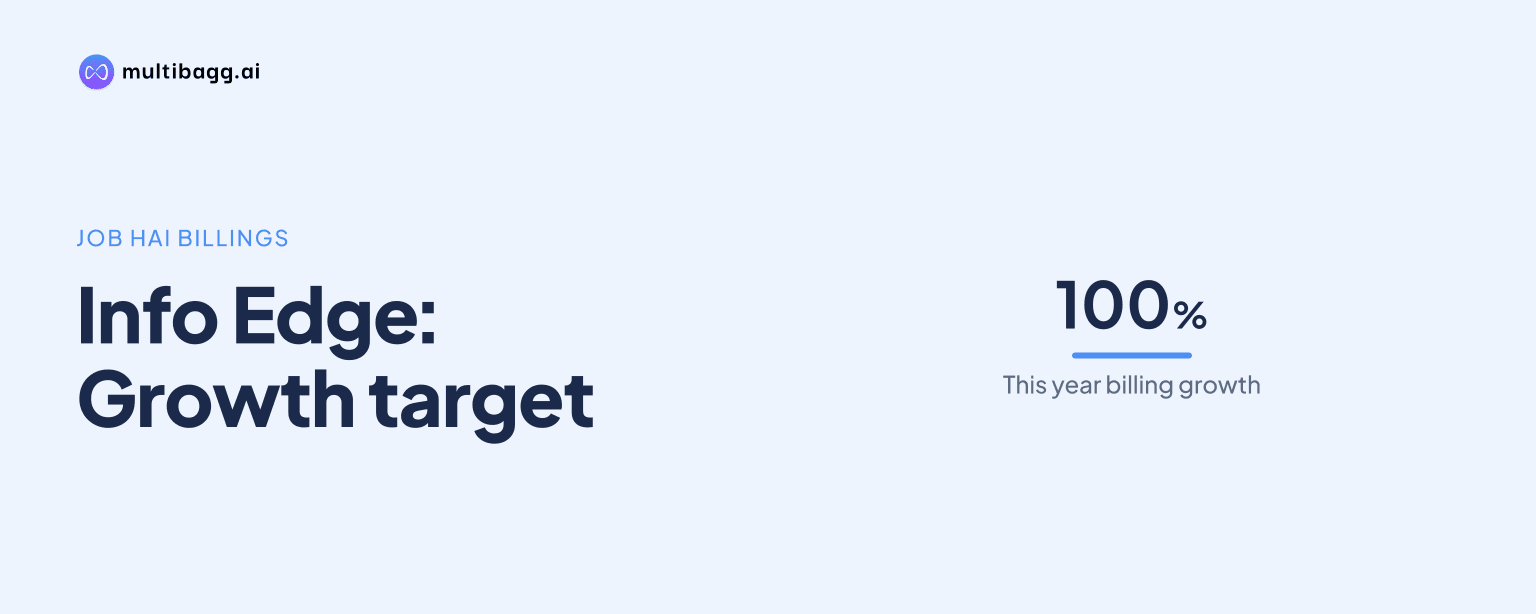
Info Edge is targeting 100% growth in Job Hai billings this year after the small-job platform recorded billings close to Rs 15 crore last year. Management said Job Hai currently burns about Rs 45 crore annually and may need a couple of years to reach break-even, which internal calculations place at Rs 100-125 crore of topline.
Know Info Edge (India) inside out
Results, valuation, peers and who's buying, in one view.
What billing growth is Info Edge targeting for Job Hai?
Info Edge is targeting 100% growth in Job Hai billings this year, implying a doubling from last year’s base of close to Rs 15 crore. Management did not provide a precise rupee billing target or commit to a final outcome, saying only that it would see where the business ends up.
Job Hai is distinct from the established Naukri recruitment business because it remains in an investment phase. While Naukri has a large customer base and monetisation model, Job Hai is pursuing a high-volume employment market that management said is gradually moving online. The disclosed 100% growth objective is therefore a management target rather than formal financial guidance.
The gap between last year’s close-to-Rs-15-crore billing base and the Rs 100-125 crore internal break-even range indicates the amount of scaling still required. Info Edge did not disclose Job Hai’s current revenue, employer count, jobseeker base or a year-by-year bridge from billings to the topline level required for break-even.
How much does Job Hai affect Info Edge margins?
Job Hai burns around Rs 45 crore annually and reduces Naukri’s overall margin by about 2-3 percentage points, according to management. That figure differs from an analyst’s suggestion that Job Hai could be reducing recruitment margins by Rs 15-20 crore a quarter.
Info Edge did not endorse the analyst’s calculation or the suggestion that a Job Hai break-even could lift recruitment margins from 59% to 62% or more. Instead, management quantified the annual burn at about Rs 45 crore and described the margin effect as 2-3 percentage points at Naukri’s overall level.
Management said it does not expect the burn to rise if Job Hai’s revenue ramps up as expected. This is conditional on revenue growth and is not a commitment that costs will remain unchanged. It nevertheless indicates that Info Edge expects the route to break-even to come from scaling revenue without a matching expansion in the platform’s investment base.
The current burn also puts the platform’s time horizon in context. Management said Job Hai is unlikely to become a big market in the next three or four years, even though it sees a potential break-even point within a couple of years if the revenue ramp proceeds as planned.
When could Job Hai reach break-even?
Info Edge said Job Hai may take a couple of years to break even, subject to revenues rising as management expects. Its first stated threshold was Rs 100-125 crore of topline, based on internal calculations, compared with billings close to Rs 15 crore last year.
Management later gave a slightly different threshold when discussing the platform’s longer-term potential. It said break-even should be possible at Rs 120-130 crore of annual topline, after which Job Hai could have operating leverage. The transcript does not explain why this later range is higher than the earlier Rs 100-125 crore calculation.
The distinction matters because Info Edge has not set a fixed financial year for profitability. “A couple of years” was presented as a possibility, not a scheduled deadline, and depends on the pace of revenue growth and management’s expectation that the Rs 45 crore annual burn will not increase.
Info Edge also did not disclose ultimate Job Hai margins. Management said it did not know what those margins would be, despite its expectation of operating leverage after the platform reaches the stated annual topline range.
Got a follow-up? Ask IRIS
Why is Job Hai strategic to Info Edge?
Info Edge views Job Hai as strategic because it sees a large market in employment volume that is still shifting online. Management said the market is not very large today and is unlikely to be large over the next three or four years, but could become significant over a five-to-10-year period.
This longer market-development view differs from the nearer-term break-even calculation of Rs 100-125 crore, or later Rs 120-130 crore, in annual topline. The first is an operating threshold; the second is management’s view of how long digitisation of the relevant jobs market could take to create a much larger opportunity.
Management said internet businesses can take eight to 10 years to reach meaningful scale and argued that early entry is necessary because competitors can otherwise take the market. That rationale explains why Info Edge is maintaining a business with an annual burn of about Rs 45 crore despite its view that the category will take years to mature.
Info Edge referred to China’s Kanzhun as an illustrative example, while cautioning that China is too large for a direct comparison. Management said reaching even 20% or 30% of Kanzhun’s size over the next five to 10 years would be a substantial achievement, but disclosed no revenue, user or market-share target for Job Hai based on that comparison.
What will determine Job Hai’s profitability?
Job Hai’s profitability will depend on whether it can grow revenue beyond the Rs 100-125 crore or Rs 120-130 crore break-even ranges without a comparable increase in burn. Management’s stated mechanism is operating leverage, but it did not provide data on customer acquisition costs, retention, usage frequency or competitive market shares.
An analyst specifically asked about competitive intensity, employer and jobseeker usage, and the platform’s ability to achieve profitability similar to the core business. Info Edge’s response focused on market volume and online migration rather than providing metrics on repeat usage, employer renewal or the current size of the digital small-job market.
Naukri offers some context for Info Edge’s broader recruitment economics, although management did not say its customer model applies to Job Hai. At Naukri, the top 20% of customers contribute 80% of revenue, while management estimated the top 50-60% contribute 97-98%. It also said revamped e-commerce offerings reduced the number of purchasing customers somewhat while e-commerce revenue rose, after the offerings became more expensive.
Those Naukri figures show an established platform managing pricing and customer mix, whereas Job Hai’s case rests on scale-building. The principal disclosed measures for Job Hai remain its close-to-Rs-15-crore billing base last year, its 100% billing-growth target this year, its Rs 45 crore annual burn and management’s break-even topline ranges.
Conclusion
Info Edge has provided specific operating markers for Job Hai: billings close to Rs 15 crore last year, a target of 100% billing growth this year, an annual burn of about Rs 45 crore and potential break-even at annual topline of Rs 100-125 crore or, in a later response, Rs 120-130 crore. Together, these figures show a platform still being funded for scale rather than one that has reached mature profitability.
The next issue to watch is whether Job Hai’s billing growth supports management’s expectation that burn will not rise and narrows the gap to its break-even thresholds over the stated couple of years. Over the longer five-to-10-year plan, management identifies the unresolved factor as the pace at which the high-volume jobs market moves online and develops into a larger revenue pool.