










InfoEdge targets AI-Rex adoption before pricing upgrades
Key highlights
- InfoEdge is targeting AI-Rex adoption across at least 40,000 large Naukri clients over the next 24 months, compared with 2,000 accounts currently trying it.
- AI-first products and services generated about Rs 60 crore of revenue in Q2, which InfoEdge annualised to Rs 240 crore of ARR.
- AI-Rex is priced at Rs 3,500 per mandate for companies and Rs 2,500 per mandate for consultants, with scope for negotiated bundle pricing.
- InfoEdge said customers buying AI offerings paid 10% to 15% more on average than customers that did not buy them in the previous quarter.
powered by IRIS
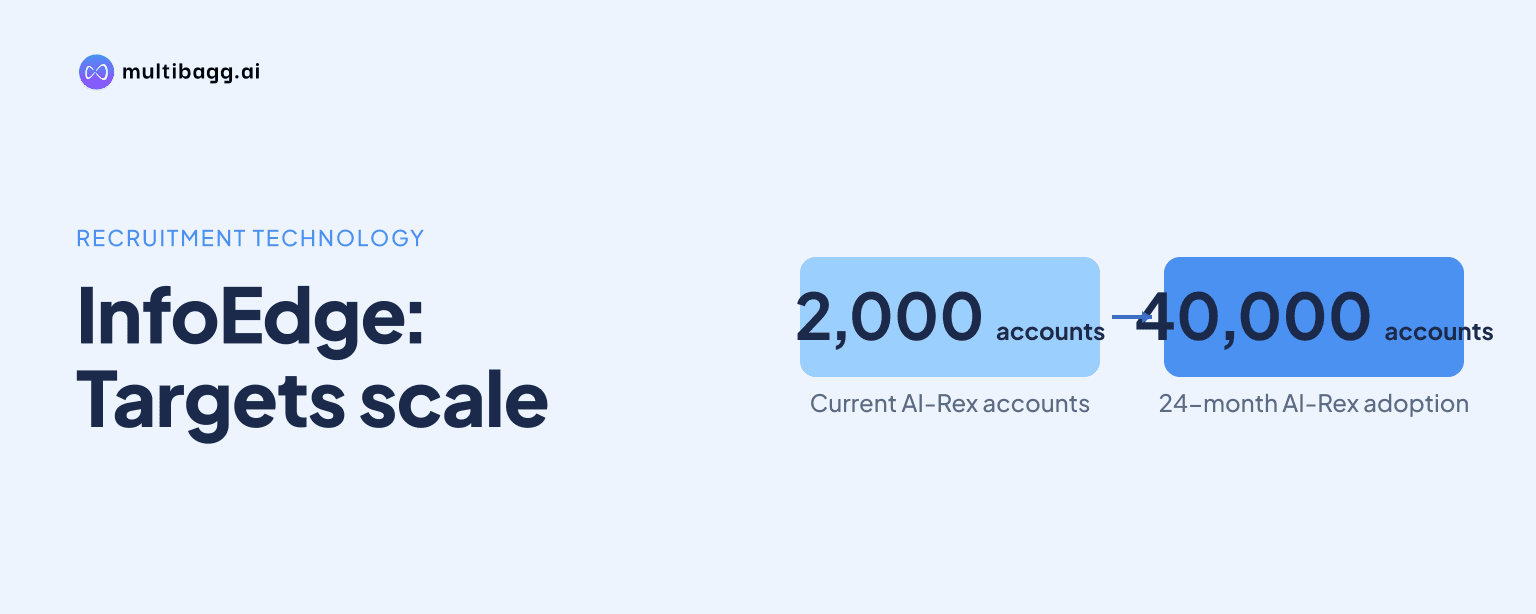
InfoEdge is putting AI-Rex adoption ahead of immediate margin maximisation, aiming over the next 24 months to expand trials, usage and renewals from 2,000 current accounts toward a pool of at least 40,000 large Naukri clients that renew annually. Management said this rollout follows the earlier Resdex playbook of low initial pricing followed by value-based upgrades.
Know Info Edge (India) inside out
Results, valuation, peers and who's buying, in one view.
What is InfoEdge's AI-Rex strategy?
InfoEdge's strategy is to make AI-Rex easy for clients to try, then seek renewals, upgrades and larger purchases once the product demonstrates hiring results. Management said the immediate goal for the next 24 months is penetration and adoption rather than margins, with an emphasis on getting as many clients as possible to use the product. The company expects customers that shift to AI-Rex to hire more people through Naukri, hire faster and improve recruiter productivity.
The product is part of InfoEdge's wider plan to monetise AI-first offerings, meaning products and services that management said could not have been launched without artificial intelligence. AI-Rex and Talent Pulse are aimed at recruiters, while the company also cited AI services for jobseekers. In Q2, revenue from AI-first products and services was about Rs 60 crore, which InfoEdge annualised into an annual recurring revenue, or ARR, figure of Rs 240 crore. Management said AI-Rex contributed only a little revenue in Q1 but scaled up substantially in Q2.
How much scope does InfoEdge see for AI-Rex adoption?
InfoEdge sees substantial scope because only 2,000 accounts are currently trying AI-Rex against at least 40,000 large Naukri clients that renew annually and buy significant products. These larger accounts are a subset of Naukri's 150,000 customers. Management said those 40,000 clients have high average revenue per user and that, in theory, AI-Rex could be sold to all of them.
The current rollout assumes clients will begin with small purchases rather than immediately adopt AI-Rex at scale. Management described a sequence of trial, satisfactory outcomes, renewal and then expanded buying. It also said clients that bought AI offerings paid on average at least 10% to 15% more than clients that did not buy AI offerings in the previous quarter, which it attributed to higher upgrades. That comparison supports management's expectation that initial adoption can later translate into higher client spending.
How is InfoEdge pricing AI-Rex today?
InfoEdge is currently pricing AI-Rex separately, although customers can negotiate it within a multi-product purchase. The stated rate card is Rs 3,500 per mandate for companies and Rs 2,500 per mandate for consultants. The company rolled out AI-Rex to consultants in Q2; it had not rolled it out for consultants in Q1, giving it an additional customer group within the recruiter market.
In practice, management said a client may buy Resdex, job listings, AmbitionBox, AI-Rex and Talent Pulse together, leading to a negotiated bundle. That does not mean AI-Rex lacks an individual price: InfoEdge said it retains a separate rate card for both AI-Rex and Talent Pulse. The arrangement lets the company measure the product as a distinct offering while retaining flexibility in a broader sales negotiation involving several recruitment products.
Management did not give a steady-state margin target for AI-Rex or the recruitment segment. It said the AI offerings have high gross margins and that, once technology is developed and capital expenditure is complete, incremental costs are limited. However, management explicitly said margin was not its present focus, which is expanding sales, client numbers and product adoption while keeping sales growth above 10% year on year.
Got a follow-up? Ask IRIS
How does AI-Rex compare with the Resdex rollout?
InfoEdge is explicitly modelling AI-Rex and Talent Pulse on the long-term Resdex rollout. Management said it launched Resdex about 25 years ago by initially giving it away free, then charging half price and continuing to offer substantial discounts. As customers used the product for more hiring, management said the company was able to realise more value and now perhaps charges five to 10 times what it charged in the early period.
Resdex's current contribution is the main evidence management offered for that approach: it said 70% to 80% of Naukri revenue now comes from Resdex. The comparison does not establish that AI-Rex will reach the same scale, and management made no revenue forecast for AI-Rex. It does, however, explain why InfoEdge is prepared to accept low initial monetisation in exchange for trials and repeat usage before pressing for larger renewals.
What could determine whether AI-Rex generates more revenue?
InfoEdge says the key variable is whether AI-Rex raises Naukri's share of hiring, not a preset margin level. Management illustrated this by asking what could happen if Naukri's share of all hires moved from 40% to 60% over time, while stressing that it did not know where margins would ultimately settle. Its stated logic is that greater hiring through Naukri should result in more customer revenue and higher growth.
The company also has a parallel jobseeker AI opportunity, where paid-product penetration rose from about 1.5% to 2.6%-2.7% of Naukri monthly active users over the past five or six quarters. Management said AI has enabled lower-priced offerings and new products such as interview preparation and the jobseeker agent Neo. It said more products are under development on both the jobseeker and recruiter sides, but did not disclose a timetable or revenue target for that product pipeline.
Conclusion
InfoEdge's AI-Rex plan is to use separate rate-card pricing while prioritising broad client trials and renewals before seeking fuller value through upgrades. The 2,000 accounts currently trying the product are small relative to at least 40,000 large annual Naukri clients, while the Resdex example explains why management believes extended adoption can create a larger revenue pool over time.
The next measure to watch is progress during management's stated 24-month penetration push. Growth in AI-Rex users, renewal behaviour and upgrades will indicate whether the Resdex-style model is taking hold, while AI-first revenue, at Rs 60 crore in Q2, will show whether the wider product pipeline is scaling alongside management's aim for sales growth above 10% year on year.