










Innovision Limited Q2 FY27 Revenue Rises 38.8% to ₹356.7 Crore
Key highlights
- Innovision reported Q2 FY27 consolidated revenue of ₹356.7 crore, up 38.8% year on year.
- Consolidated profit after tax was ₹5.15 crore, compared with ₹7.64 crore in Q2 FY26.
- A toll-fee expense estimate change lifted Q2 FY27 profit before tax by ₹23.76 crore.
- H1 FY27 consolidated operating cash flow was negative ₹89.24 crore.
powered by IRIS
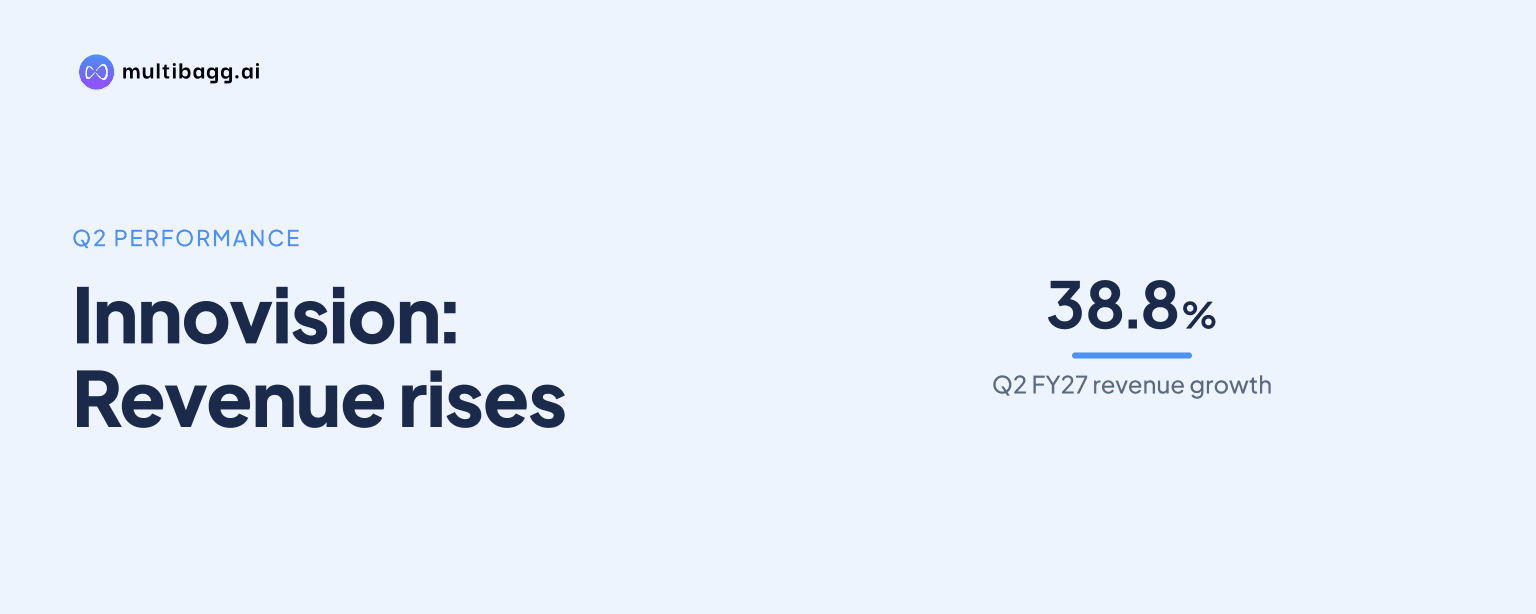
Innovision Limited reported consolidated revenue of ₹356.7 crore for Q2 FY27, a 38.8% year-on-year increase, while consolidated net profit was ₹5.15 crore for the quarter ended September 30, 2026. The result followed a loss in the preceding quarter, although profit remained below the ₹7.64 crore reported in Q2 FY26.
Know Innovision inside out
Results, valuation, peers and who's buying, in one view.
What did Innovision report for Q2 FY27?
Innovision reported consolidated revenue from operations of ₹356.7 crore in the July-September 2026 quarter, compared with growth of 35.2% over the preceding quarter and 38.8% from a year earlier. Consolidated EBITDA was ₹4.91 crore, translating to an EBITDA margin of about 1.4% based on reported revenue.
The company recorded consolidated profit after tax of ₹5.15 crore in Q2 FY27. This compares with a consolidated loss in Q1 FY27 and a profit of ₹7.64 crore in Q2 FY26. Separately, its standalone financial results showed quarterly profit after tax of ₹5.66 crore, illustrating the difference between the parent-company and consolidated performance.
No exceptional items were reported in the quarter. The disclosed operating-margin estimate of approximately 0.3% was lower than the EBITDA margin calculated using reported EBITDA and revenue, indicating that the two measures were presented on different bases in the available disclosures.
What changed in Innovision's toll-fee accounting estimate?
Innovision made a prospective change in the estimate used for toll-fee expenses during Q2 FY27. The change reduced toll-fee expense for the quarter and increased profit before tax by ₹23.76 crore, making it a material factor in the reported quarterly result.
A prospective estimate change affects the current and future reporting periods rather than restating earlier financial statements. The disclosure therefore identifies the profit effect in Q2 FY27 but does not alter previously reported numbers. Investors assessing the quarter need to separate this accounting-estimate impact from underlying operating performance.
The company did not report exceptional items, but the toll-fee estimate change had a significant effect on pre-tax profit relative to the ₹5.15 crore consolidated profit after tax. The available filing does not provide a separate adjusted profit figure excluding the change.
How did the Board and auditors handle the quarterly results?
Innovision's Board of Directors approved the unaudited standalone and consolidated financial results on November 13, 2026. The meeting began at 4:37 p.m. and concluded at 5:00 p.m., and the company submitted the results to BSE Limited and the National Stock Exchange of India Limited.
The results cover the quarter and six months ended September 30, 2026. They were prepared under Indian Accounting Standards and the SEBI Listing Obligations and Disclosure Requirements Regulations, 2015. Statutory auditor SRGA & Co. issued limited-review conclusions on the financial statements.
The limited-review conclusion was unmodified. For the standalone interim financial statement, the auditors said nothing had come to their attention to indicate that the statement was not prepared in accordance with applicable standards or contained a material misstatement. The consolidated review also noted that financial information for three subsidiaries had not been reviewed by the auditors.
Got a follow-up? Ask IRIS
What do the balance sheet and cash flow figures show?
Innovision's consolidated total assets stood at ₹483.13 crore as of September 30, 2026, up from ₹473.82 crore on March 31, 2026. The increase of about ₹9.31 crore shows a modest expansion in the consolidated asset base during the first half of FY27.
Cash flow from operating activities was negative ₹89.24 crore for the six months ended September 30, 2026. Investing activities contributed ₹55.66 crore, while financing activities resulted in a net cash outflow of ₹0.61 crore. These cash flow figures differ from accounting profit and are relevant for evaluating the cash conversion of the business.
What risks remain relevant for Innovision investors?
Innovision disclosed that an Enforcement Directorate investigation remains ongoing. The company said the outcome and financial impact of the investigation cannot currently be estimated. The disclosure does not provide a quantified provision or specify a possible financial effect.
The investigation is an important uncertainty alongside the quarterly financial results, particularly because the company cannot assess its eventual impact. The unmodified limited-review conclusion does not resolve this uncertainty; it addresses the auditors' review of the interim financial statements under the applicable review framework.
For investors, the Q2 result combines strong revenue growth, a return to quarterly profitability after Q1 FY27, and a significant accounting-estimate benefit to pre-tax profit. The negative operating cash flow in the first half and the continuing investigation are separate factors that remain relevant when interpreting the reported figures.
Conclusion
Innovision's Q2 FY27 performance showed consolidated revenue growth of 38.8% year on year to ₹356.7 crore and a return to consolidated profit of ₹5.15 crore after the previous quarter's loss. However, the ₹23.76 crore benefit from the prospective toll-fee expense estimate change was a major contributor to pre-tax profit, while first-half operating cash flow remained negative.
Investors will watch subsequent disclosures for revenue and margin trends, cash-flow movement, and any update on the Enforcement Directorate investigation, whose outcome and financial impact remain unquantified. Future filings may also provide further clarity on the effect of the toll-fee expense estimate change on later periods.