










Inox Wind prioritises cash flow over FY27 revenue guidance
Key highlights
- Inox Wind’s equipment-supply share was about 61% of its third-party order book in October 2026, against a medium-term target of about 75%.
- Inox Wind reported Q2 FY27 consolidated revenue of Rs 1,378 crore, up 58% quarter on quarter.
- Inox Wind’s order book was about 3.8 GW in October 2026, providing more than 24 months of execution visibility.
- Inox Wind targets FY28 revenue of about Rs 7,500 crore, subject to a review toward the end of Q4.
powered by IRIS
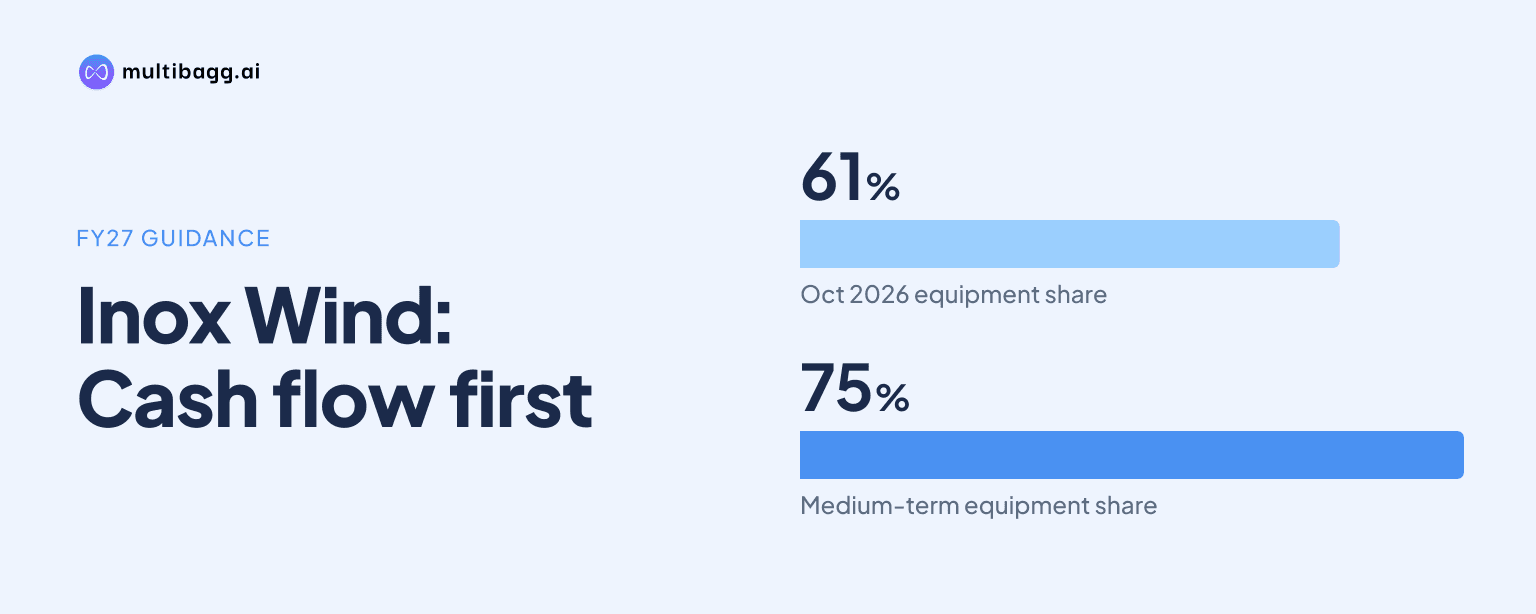
Inox Wind Limited withheld specific guidance for financial year 2027, or FY27, after shifting its third-party order book toward equipment supply, which was 61% in October 2026 and has a medium-term target of about 75%. Management said the trade-off is lower near-term growth and forgone orders for reduced working-capital intensity, better collections and cash generation.
Know Inox Green Energy Services inside out
Results, valuation, peers and who's buying, in one view.
Why did Inox Wind withhold FY27 revenue guidance?
Inox Wind withheld FY27 revenue guidance because management is prioritising business quality, balance-sheet strength and free cash flow over maximum revenue or backlog growth. On the November 13, 2026 earnings call, management said the strategic realignment undertaken over the previous couple of quarters had required it to forego certain business opportunities and recalibrate its short-term growth trajectory.
Management said it expects Q2 FY27 momentum to continue through the second half of FY27, or H2 FY27, and into FY28, but would not state a FY27 revenue figure. It said it would review and reaffirm its FY28 revenue target of about Rs 7,500 crore toward the end of the fourth quarter, or Q4, while retaining a long-term earnings before interest, tax, depreciation and amortisation, or EBITDA, margin objective of about 20%.
The decision follows Q2 FY27 consolidated revenue of Rs 1,378 crore, up 58% quarter on quarter, while adjusted EBITDA was flat quarter on quarter at Rs 238 crore. Management attributed the margin pressure to commodity and raw-material inflation linked to the West Asia war, and said incremental contracts and fresh bids were being priced dynamically for the higher-cost environment.
How is Inox Wind changing its order-book mix?
Inox Wind is reducing its proportion of turnkey projects and increasing equipment supply, which represented about 61% of its third-party order book as of October 2026. The remaining 39% was turnkey work, and management’s medium-term goal is to raise equipment supply to about 75% because it expects that mix to improve earnings quality and lower working-capital demands.
The realignment reduced the reported order book because Inox Wind discontinued certain orders that did not fit its revised approach. The order book stood at about 3.8 gigawatt, or GW, in October 2026, providing more than 24 months of execution visibility, and management said quality and executability mattered more than restoring the absolute backlog size.
Order inflows were about 350 megawatt, or MW, in Q2 FY27, taking first-half FY27, or H1 FY27, inflows to about 1.85 GW. Repeat orders came from NLC India Limited, Terra Clean Energy, a wholly owned subsidiary of Indian Oil Corporation, and an independent power producer, while management identified around 5 GW of potential tenders over the following four to five months.
What does the reset mean for working capital and collections?
Inox Wind expects a greater equipment-supply share and more selective turnkey orders to reduce working-capital intensity, although H1 FY27 working-capital days remained elevated. Debtor levels were broadly stable compared with March 2026 despite H1 revenue growth, which management said meant collections had broadly matched sales during the six-month period.
Management cited two reasons why the H1 FY27 position did not represent its expected full-year outcome. About 70% of annual revenue is normally generated in H2, increasing the full-year sales base and expected collections, while inventory rose in Q2 FY27 to prepare for higher H2 deliveries and is expected to moderate by March 2027 as those deliveries are completed.
The payment terms attached to remaining turnkey projects are also central to the strategy. Management said a significant portion of turnkey orders was from public-sector undertakings and Inox Clean Energy, with terms aligned to Inox Wind’s credit policy; it expects that customer selection to help address receivables over coming quarters.
Management set a further balance-sheet objective of reducing debtor days below 150 by the end of FY28. It said the changed emphasis on equipment supply and strategic turnkey projects had put debtor days on a downward trajectory, but did not disclose the starting number of debtor days on the November 13 call.
Got a follow-up? Ask IRIS
What did Q2 FY27 performance show about the transition?
Inox Wind’s Q2 FY27 revenue increased faster than profit because the higher commodity-cost environment affected margins. Consolidated profit before tax rose 8% quarter on quarter to Rs 103 crore, profit after tax rose 8% to Rs 69 crore, and cash profit rose 8% to Rs 165 crore, compared with revenue growth of 58% to Rs 1,378 crore.
Management also said Q2 FY27 EBITDA margins did not include income from the Wind World operations and maintenance, or O&M, business. The income had been actualised and was to be routed through the balance sheet before consolidation, and management said the consolidated EBITDA margin would have been about 20% had that income been recognised in the profit and loss account.
Line-by-line consolidation of the Wind World O&M portfolio in Inox Green was scheduled to begin in Q3 FY27. Management cautioned that margins should be assessed annually rather than quarterly because the sales mix changes among equipment supply, blades, towers, nacelles, turnkey engineering, procurement and construction projects, and O&M services.
Which execution milestones matter for Inox Wind next?
Inox Wind’s next test is delivery execution in H2 FY27, alongside progress on its 4.X wind-turbine platform. The 4.X prototype had been installed by the November 13 call and was expected to be commissioned shortly, while management targeted commercial launch by the end of financial year 2027.
The Rohika facility in Gujarat is geared to produce blades for the 4.X platform. Inox Renewable Solutions Limited has also enhanced transformer capacity for the platform and plans to make medium-sized transformers of 8 to 20 megavolt-amperes, or MVA, larger transformers, inverters, unit substations and electronic control systems.
The wider market provides an execution backdrop but not a replacement for FY27 guidance. India commissioned 1.8 GW of wind capacity in Q2 FY27 and 3.2 GW in H1 FY27, compared with 6.05 GW in all of FY26; management cited the Ministry of New and Renewable Energy expectation for 7.5 GW to 8 GW of wind additions in FY27.
Conclusion
Inox Wind’s reset shifts the measure of progress from a stated FY27 growth number to contract mix, collections and cash generation. The evidence disclosed so far is a 61% equipment-supply share in the third-party order book, a 3.8 GW backlog with more than 24 months of visibility, stable debtor levels versus March 2026 and Q2 FY27 revenue of Rs 1,378 crore.
The next indicators are H2 FY27 deliveries, the expected inventory moderation by March 2027 and progress toward debtor days below 150 by the end of FY28. Management is also due to review its approximately Rs 7,500 crore FY28 revenue target toward the end of Q4, while the 4.X platform’s commissioning and commercial launch timing remain operational milestones to watch.