










Intelligent Supply Chain Infrastructure Trust SPV distributes 74.7%
Key highlights
- The SPV distributed Rs 297.37 crore, or 74.73%, of Rs 397.93 crore H1 FY27 net distributable cash flow.
- SPV net distributable cash flow rose Rs 87.73 crore year on year, while actual distribution stayed at Rs 297.37 crore.
- The Trust distributed 100% of its Rs 169.08 crore H1 FY27 distributable cash flow to unitholders.
- The SPV deducted Rs 147.20 crore of capital expenditure in computing H1 FY27 distributable cash flow.
powered by IRIS
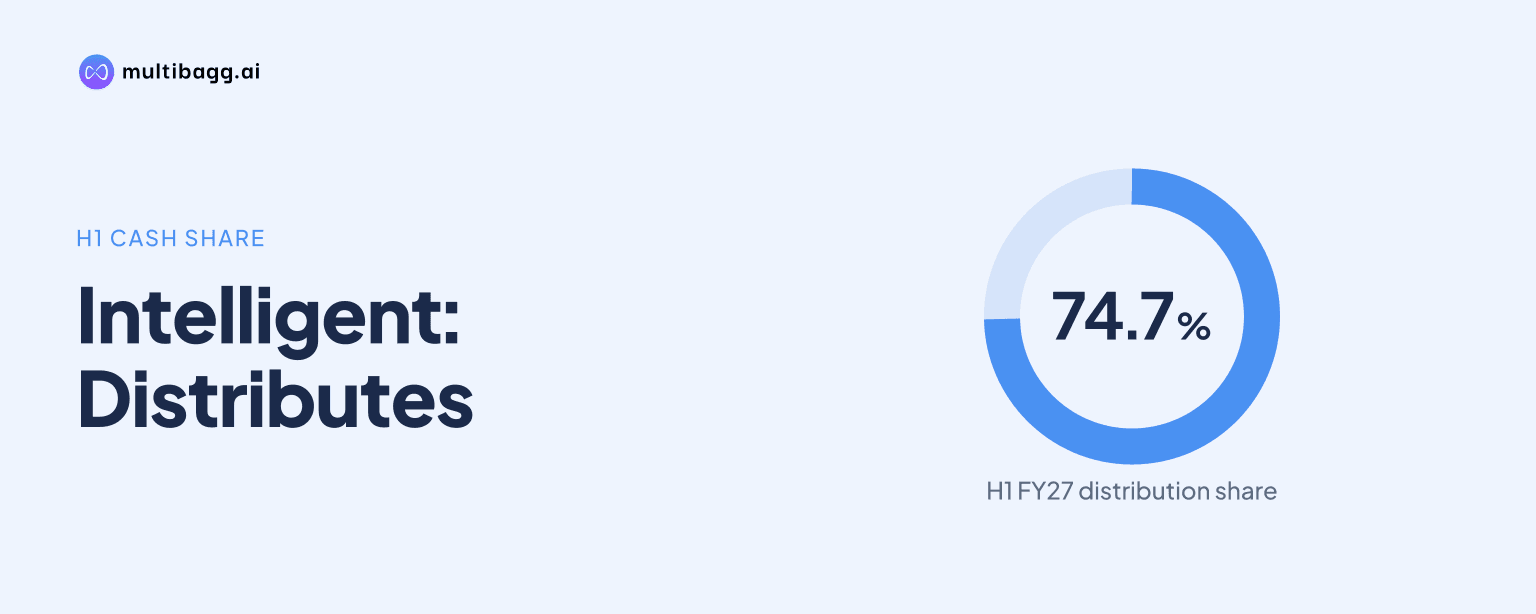
Intelligent Supply Chain Infrastructure Trust’s special purpose vehicle, or SPV, distributed Rs 297.37 crore in the half year ended September 30, 2026, equal to 74.73% of its Rs 397.93 crore net distributable cash flow. The Trust itself distributed all Rs 169.08 crore of cash available at its level after receiving SPV cash and deducting finance costs.
Know Intelligent Supply Chain Infrastructure Trust inside out
Results, valuation, peers and who's buying, in one view.
Why did the Trust’s SPV distribute 74.73% of cash flow?
The Trust’s SPV distributed Rs 297.37 crore against total net distributable cash flows of Rs 397.93 crore for the half year ended September 30, 2026, leaving Rs 100.56 crore undistributed at the SPV level. The disclosure records the distribution as interest on borrowings. It does not state a specific use, reserve or reinvestment plan for the undistributed amount.
The SPV’s Rs 397.93 crore total was unchanged from its calculated net distributable cash flow because it did not use opening cash, bank balances or investments for the H1 distribution. Its calculation began with Rs 540.85 crore of operating cash flow and added Rs 4.28 crore of treasury or investing income, before deducting Rs 147.20 crore of capital expenditure on existing assets not funded through debt, equity or earlier reserves.
The distinction matters because the SPV-level distribution rate measures the cash paid onward from the operating entity, while the Trust-level rate is based on the cash that reaches the listed InvIT after the SPV payment and the Trust’s own deductions. The Trust owns 100% of Intelligent Supply Chain Infrastructure Management Private Limited, the entity identified in the filing as the SPV.
How did the SPV cash flow change from last year?
The SPV’s net distributable cash flow increased by Rs 87.73 crore from Rs 310.20 crore in the half year ended September 30, 2025 to Rs 397.93 crore in the corresponding 2026 period. Actual distribution was unchanged at Rs 297.37 crore, so the distribution rate fell by 21.13 percentage points, from 95.86% to 74.73%.
Operating cash flow was the principal contributor to the increase. The SPV reported Rs 540.85 crore of operating cash flow in H1 FY27, Rs 57.41 crore above the Rs 483.44 crore reported a year earlier. Treasury and investing income declined to Rs 4.28 crore from Rs 5.38 crore, while the capital-expenditure deduction fell to Rs 147.20 crore from Rs 178.62 crore.
The quarter-by-quarter pattern also shows a variation in payments. In the quarter ended June 30, 2026, the SPV used Rs 25.81 crore of opening cash, bank and investment balances alongside Rs 122.06 crore of net distributable cash flow to distribute Rs 147.87 crore, or 100%. In the September quarter, it generated Rs 275.87 crore of distributable cash flow but paid Rs 149.50 crore, or 54.19%.
The filing separately notes that a Rs 6.97 crore security deposit paid from initial funding was included in operating cash flow under the cash-flow statement but adjusted out in computing net distributable cash flow. This adjustment is part of the disclosed methodology and helps explain why the distributable-cash measure is not simply the same as reported operating cash flow.
How did the Trust pass cash to unitholders?
The Trust distributed Rs 169.08 crore, or 100% of its total distributable cash flows, for the half year ended September 30, 2026. This cash distribution was presented as return on capital, whereas the SPV’s Rs 297.37 crore payment to the Trust was disclosed as interest on borrowings.
At the Trust level, Rs 297.37 crore received from SPVs or investment entities was offset principally by Rs 127.67 crore of finance costs and Rs 0.88 crore of negative operating cash flows. That produced Rs 168.82 crore of net distributable cash flow; the Trust then used Rs 0.26 crore of opening cash balance, taking total distributable cash flows to Rs 169.08 crore.
The Trust’s H1 distribution was Rs 0.18 crore lower than the prior-year amount of Rs 169.26 crore. The change followed a decline in opening cash used for distribution to Rs 0.26 crore from Rs 0.89 crore and a smaller operating cash-flow outflow of Rs 0.88 crore compared with Rs 1.33 crore. The Trust’s cash receipt from the SPV and finance costs were unchanged year on year.
Got a follow-up? Ask IRIS
What do the disclosures say about distribution requirements?
The Trust states that Securities and Exchange Board of India, or SEBI, InvIT regulations require it to distribute at least 90% of its net distributable cash flows to unitholders in each financial year. For the half year ended September 30, 2026, its Trust-level distribution rate was 100%, based on Rs 169.08 crore distributed from Rs 169.08 crore available.
That regulatory statement applies to the Trust’s net distributable cash flows, not necessarily to the SPV’s standalone payout ratio in the table. The SPV’s H1 rate was 74.73%, while the Trust used all cash calculated as available after its own finance cost and operating-cash adjustments. The filing gives both disclosures separately, allowing readers to distinguish cash generation, inter-entity payment and the final unitholder distribution.
The Trust’s consolidated cash-flow statement reports Rs 169.08 crore of distributions to unitholders, classified as return on capital, during H1 FY27. It also reports Rs 127.67 crore of finance costs and Rs 139.94 crore of lease-liability payments in financing activities. These reported cash-flow lines are broader than the distributable-cash calculations, which use the specified SEBI disclosure format.
What operating and capital items affected distributable cash flow?
Capital expenditure was the largest stated deduction in the SPV’s distributable-cash calculation, at Rs 147.20 crore in H1 FY27. This was Rs 31.42 crore lower than the Rs 178.62 crore deducted in H1 FY26, helping lift SPV net distributable cash flow despite the actual distribution remaining flat at Rs 297.37 crore.
No deductions were reported for finance costs on borrowings, debt repayment or reserves required under loan, debt-security, external-commercial-borrowing or asset agreements in the SPV’s disclosed H1 calculation. The table also showed no proceeds from infrastructure-asset or SPV-share sales, either for current distribution or for amounts previously held for reinvestment.
The Trust reported capital commitments of Rs 6.17 crore as of September 30, 2026, down from Rs 16.97 crore at March 31, 2026 and Rs 27.22 crore a year earlier. These commitments are disclosed separately from the SPV’s Rs 147.20 crore H1 capital-expenditure deduction, so the filing does not establish that the undistributed Rs 100.56 crore has been allocated to those commitments.
Conclusion
The combined disclosures show two different cash-distribution outcomes in H1 FY27. The SPV generated Rs 397.93 crore of net distributable cash flow and paid Rs 297.37 crore, producing a 74.73% payout rate, while the Trust distributed 100% of its Rs 169.08 crore of available cash to unitholders after finance costs and other Trust-level adjustments.
The next disclosure to watch is whether the SPV’s Rs 100.56 crore of undistributed H1 cash is paid in a later period or applied to a stated purpose. Readers can also track the next capital-expenditure deduction, following the Rs 147.20 crore recorded in H1 FY27, and the Trust’s continuing adherence to its stated requirement to distribute at least 90% of annual net distributable cash flows.