










Inter State Oil Carrier funds capex with Rs 10.7465 crore debt
Key highlights
- Inter State Oil Carrier increased borrowings by Rs 10.7465 crore in the half year ended September 30, 2026.
- Inter State Oil Carrier spent Rs 8.4011 crore on property, plant and equipment, compared with Rs 3.7197 crore a year earlier.
- Net operating cash outflow was Rs 88.86 lakh, compared with Rs 83.70 lakh in the corresponding 2025 half year.
- Total borrowings reached Rs 39.469 crore at September 30, 2026, up from Rs 28.7225 crore at March 31, 2026.
powered by IRIS
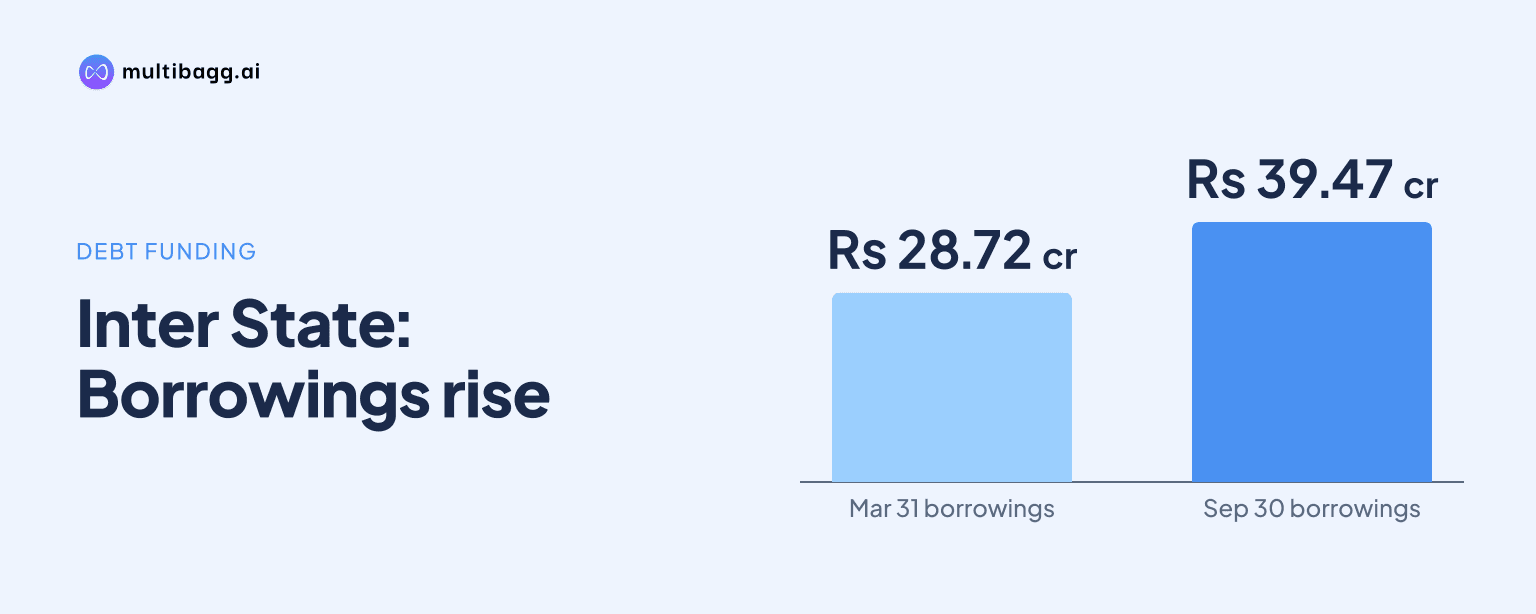
Inter State Oil Carrier Limited funded the half-year cash deficit to September 30, 2026 with a Rs 10.7465 crore increase in borrowings, after Rs 8.4011 crore of property, plant and equipment purchases and Rs 88.86 lakh of operating cash outflow. First-half net profit nevertheless rose to Rs 1.3024 crore.
Know Inter State Oil Carrier inside out
Results, valuation, peers and who's buying, in one view.
Why did Inter State Oil Carrier increase borrowings?
Inter State Oil Carrier increased borrowings because operating and investing activities together used more cash than they generated in the half year ended September 30, 2026. Net operating cash outflow was Rs 88.86 lakh and net investing cash outflow was Rs 8.3963 crore, making the combined cash use Rs 9.2849 crore before financing. Borrowings increased by Rs 10.7465 crore, while interest paid was Rs 1.4073 crore, resulting in net financing cash inflow of Rs 9.3392 crore.
Inter State Oil Carrier closed the period with cash and cash equivalents of Rs 8.64 lakh, compared with Rs 3.21 lakh at March 31, 2026. The Rs 5.43 lakh increase contrasts with a Rs 48.34 lakh fall in the corresponding half year ended September 30, 2025. Financing cash inflow rose from Rs 4.0112 crore a year earlier, while the investing outflow increased from Rs 3.6576 crore.
How much did Inter State Oil Carrier spend on capital expenditure?
Inter State Oil Carrier spent Rs 8.4011 crore on purchases of property, plant and equipment in the half year ended September 30, 2026, compared with Rs 3.7197 crore in the corresponding 2025 period. It received Rs 3,000 from sales of property, plant and equipment, versus Rs 6.86 lakh a year earlier. Net investing cash outflow was therefore Rs 8.3963 crore, compared with Rs 3.6576 crore.
Property, plant and equipment on the balance sheet stood at Rs 35.2564 crore at September 30, 2026, up from Rs 29.5164 crore at March 31, 2026. The Rs 5.74 crore increase in that balance occurred alongside the Rs 8.4011 crore cash purchase figure and Rs 2.6735 crore of depreciation and amortisation expense reported for the six months. Inter State Oil Carrier has one reportable segment under Indian Accounting Standards, so the filing does not provide a segment-level allocation of the spending.
Why was Inter State Oil Carrier's operating cash flow negative?
Inter State Oil Carrier's operating cash flow was negative because working-capital changes exceeded its Rs 5.5323 crore operating profit before working-capital adjustment. Trade receivables increased by Rs 6.8332 crore and other current assets increased by Rs 6.3026 crore during the six months. These outflows were partly offset by a Rs 3.1901 crore increase in trade payables and a Rs 2.6921 crore decrease in current tax assets.
Cash generated from operations was negative Rs 74.81 lakh before tax payments, compared with negative Rs 72.04 lakh in the prior-year half year. After Rs 14.05 lakh of tax payments, net operating cash outflow was Rs 88.86 lakh, compared with Rs 83.70 lakh a year earlier. The filing does not explain the working-capital movements, but it records trade receivables of Rs 25.5888 crore at September 30, 2026, against Rs 18.676 crore at March 31, 2026.
Got a follow-up? Ask IRIS
Did higher profit reduce Inter State Oil Carrier's financing need?
Inter State Oil Carrier's higher reported profit did not remove its financing need because profit did not convert into positive operating cash flow during the six-month period. Net profit rose to Rs 1.3024 crore for the half year ended September 30, 2026 from Rs 50.40 lakh a year earlier, while revenue from operations rose to Rs 66.0607 crore from Rs 50.7236 crore. Net cash used in operating activities remained Rs 88.86 lakh.
Finance costs increased to Rs 1.4073 crore from Rs 1.0256 crore in the corresponding 2025 half year, an increase of Rs 38.17 lakh. Profit before tax rose to Rs 1.559 crore from Rs 84.44 lakh, while depreciation and amortisation increased to Rs 2.6735 crore from Rs 2.3004 crore. Those adjustments lifted operating profit before working-capital changes, but did not cover the reported increases in receivables and other current assets.
How did Inter State Oil Carrier's balance sheet change?
Inter State Oil Carrier's combined current and non-current borrowings rose to Rs 39.469 crore at September 30, 2026 from Rs 28.7225 crore at March 31, 2026. Non-current borrowings increased to Rs 17.3325 crore from Rs 13.1326 crore, while current borrowings rose to Rs 22.1365 crore from Rs 15.5899 crore. The Rs 10.7465 crore balance-sheet movement matches the increase in borrowings reported in financing cash flow.
Total assets increased to Rs 74.8705 crore from Rs 58.551 crore over the six months. Besides the Rs 5.74 crore increase in property, plant and equipment, other current assets rose to Rs 9.786 crore from Rs 3.4834 crore and trade payables increased to Rs 7.7396 crore from Rs 4.5495 crore. Other equity increased to Rs 17.4519 crore from Rs 16.1495 crore, while equity share capital remained Rs 4.9923 crore.
Conclusion
Inter State Oil Carrier's September 2026 half-year figures show that higher revenue and profit coincided with heavier investment and working-capital cash use. Revenue increased by Rs 15.3371 crore year on year, but the combination of Rs 8.3963 crore of net investing outflow and Rs 88.86 lakh of operating outflow was met by Rs 9.3392 crore of net financing inflow.
The next results will show whether the Rs 6.8332 crore rise in receivables and Rs 6.3026 crore increase in other current assets translate into operating cash. The November 13, 2026 filing provides no capital-expenditure target, borrowing repayment plan or explanation for those working-capital movements, leaving future cash generation and debt changes unresolved.