










Antala sells packaging at every stage of bag production
Key highlights
- Antala sells five packaging products, including BOPP bags, printed BOPP rolls, BOPP lamination rolls, PP woven bags and PP woven lamination rolls.
- FY26 capacity utilisation reached 76.05% for printing, 76.67% for lamination and 71.43% for cutting and stitching.
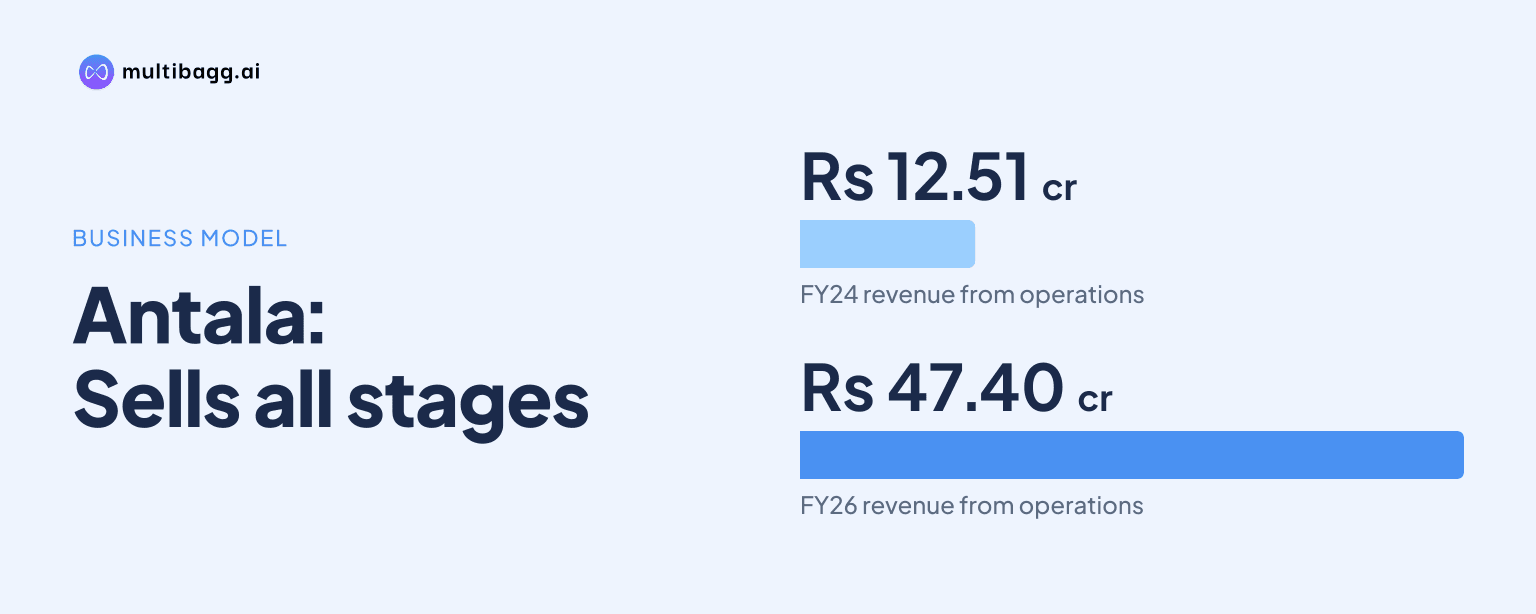
- Antala’s revenue from operations increased from Rs 12.5125 crore in FY24 to Rs 47.4047 crore in FY26.
- EBITDA rose from Rs 1.3617 crore in FY24 to Rs 6.1489 crore in FY26, while EBITDA margin increased to 12.97% from 10.88%.
powered by IRIS
Antala Industries Limited can sell packaging as printed biaxially oriented polypropylene film, laminated rolls or finished woven bags. Antala’s Rajkot facility performs printing, extrusion lamination, cutting and stitching in-house, and lamination capacity utilisation rose to 76.67% in FY26 from 51.68% in FY25.
How does Antala sell packaging at every stage of bag production?
Antala sells intermediate materials and completed packaging because its manufacturing sequence produces saleable outputs before the final bag-conversion stage. Its five listed products are BOPP bags, BOPP printing rolls, BOPP lamination rolls, polypropylene, or PP, woven bags, and PP woven lamination rolls. BOPP means biaxially oriented polypropylene, a film stretched in two directions to improve strength, clarity and dimensional stability.
The BOPP production chain starts with customer-specific rotogravure printing on BOPP film. Antala prints brand logos, product details, handling instructions and other graphics, and can supply the printed BOPP film roll directly to customers that have their own manufacturing operations. If processed further at Antala, the printed film becomes an input for lamination and eventually for finished bags.
The next stage combines the printed BOPP film with PP woven fabric through extrusion lamination. A molten blend of PP granules, low-density polyethylene, or LDPE, granules and filler granules bonds the two materials, creating a BOPP lamination roll. Antala may sell that roll directly or cut, stitch, gusset and finish it into a BOPP bag, allowing the customer’s required degree of conversion to determine the product supplied.
What changes between Antala’s printed roll, laminated roll and finished bag?
Antala’s printed BOPP roll is a decorative intermediate layer, while its BOPP lamination roll combines the printed layer with woven fabric. The company prints on the reverse side of the BOPP film, a process designed to protect graphics after lamination from scratching, fading and handling wear. The printed roll is generally not a final product, but Antala states that it can be supplied to customers for their own conversion process.
A BOPP lamination roll is a later-stage material because it already contains the structural PP woven fabric and laminated BOPP surface. The roll is designed to provide moisture resistance, tear resistance, load-bearing capacity and a printable surface; cutting and stitching then form individual bags. Antala lists gusset bags and handloom bags within its BOPP bag portfolio for sectors including food processing, fertilisers, chemicals and seeds.
Antala also has a PP woven production route that does not use BOPP film. It laminates PP woven fabric to create a PP woven lamination roll, which can be sold directly or converted into a PP woven bag. Unlike a BOPP lamination roll, the PP woven lamination roll does not have the high-gloss finish and premium graphics associated with BOPP film, although it may be used for basic surface printing and product identification.
How does Antala’s order-led production model work?
Antala begins production with a customer purchase order, or PO, specifying the required product, quantity, dimensions, printing requirements and delivery schedule. The company assesses the order’s feasibility, production requirements and material availability. Available materials are allocated to production; where there is a shortage, Antala procures inputs after considering quality, price, availability and delivery timelines.
The order-led process relies on distinct materials at each manufacturing stage. PP woven fabric is the structural base for both PP woven bags and BOPP bags, while BOPP film provides the printable outer layer of BOPP products. PP, LDPE and filler granules form the bonding layer during extrusion lamination, and printing inks and stitching threads are secondary consumables used in printing, conversion, stitching and finishing.
The PP woven bag sequence can vary according to customer specifications. Antala may print a laminated fabric roll before cutting and stitching it, or may cut and stitch the fabric first and print the finished bag afterwards. In either sequence, finished bags undergo checks for dimensions, stitching quality, print quality where applicable, strength and appearance before bale pressing, packing and dispatch.
Got a follow-up? Ask IRIS
What operating evidence supports Antala’s integrated packaging model?
Antala operates one manufacturing facility at Shapar in Rajkot, Gujarat, with extrusion, coating and lamination, rotogravure printing, roll-to-roll multi-colour printing, stitching and finishing infrastructure. This single-location configuration allows the company to move printed film into lamination and laminated rolls into cutting and stitching within its stated manufacturing process. Antala holds ISO 9001:2015 quality-management certification valid until August 19, 2027, alongside three management-system certifications valid until July 13, 2029.
Capacity utilisation increased across the three measurable conversion stages between FY24 and FY26, although capacity bases changed after machinery additions. Printing utilisation rose from 20.07% in FY24 to 76.05% in FY26, and lamination utilisation increased from 20.23% to 76.67%. Cutting and stitching, for which FY24 capacity was not stated, reached 71.43% utilisation in FY26.
FY26 printing capacity was calculated for five months for roll-to-roll printing machinery and an auto-cutting machine purchased in October 2025. FY25 capacity reflected 6.5 months of machinery received through a business transfer agreement dated September 11, 2024. These partial-period capacity bases mean the utilisation percentages show higher use of the available machinery but are not calculated on identical capacity periods.
Antala’s company-wide revenue from operations increased from Rs 12.5125 crore in FY24 to Rs 31.8499 crore in FY25 and Rs 47.4047 crore in FY26. Earnings before interest, tax, depreciation and amortisation, or EBITDA, increased from Rs 1.3617 crore in FY24 to Rs 6.1489 crore in FY26, while EBITDA margin was 10.88% in FY24 and 12.97% in FY26. The disclosed financial statements do not separate revenue from printed rolls, laminated rolls and finished bags, so they do not identify the largest product stage by sales.
Conclusion
Antala’s model is not confined to finished PP woven sacks because its Rajkot facility can sell printed BOPP film and laminated rolls before the final bag-making stage. The model depends on customer purchase orders, availability of BOPP film, woven fabric and polymer inputs, and the ability to complete the printing, lamination, cutting and stitching sequence required for each order.
What to watch next is Antala’s disclosed plan to expand its portfolio with BOPP film, BOPP lamination rolls, PP and BOPP woven bags, and PP woven flexo printed rolls. The company also discloses planned rated-capacity additions of 87.88% for printing, 80.00% for lamination and 35.50% for cutting and stitching; the effect will depend on demand, raw-material procurement and use of the added machinery.