










BLS Polymers Limited disclosed audit trail and internal audit gaps
Key highlights
- BLS Polymers reported that its accounting-software audit trail had not operated throughout the year ended March 31, 2024 for all relevant transactions and had not been preserved as required.
- Auditors said BLS Polymers’ internal-audit system was not commensurate with its business for the years ended March 31, 2024, March 31, 2025 and March 31, 2026.
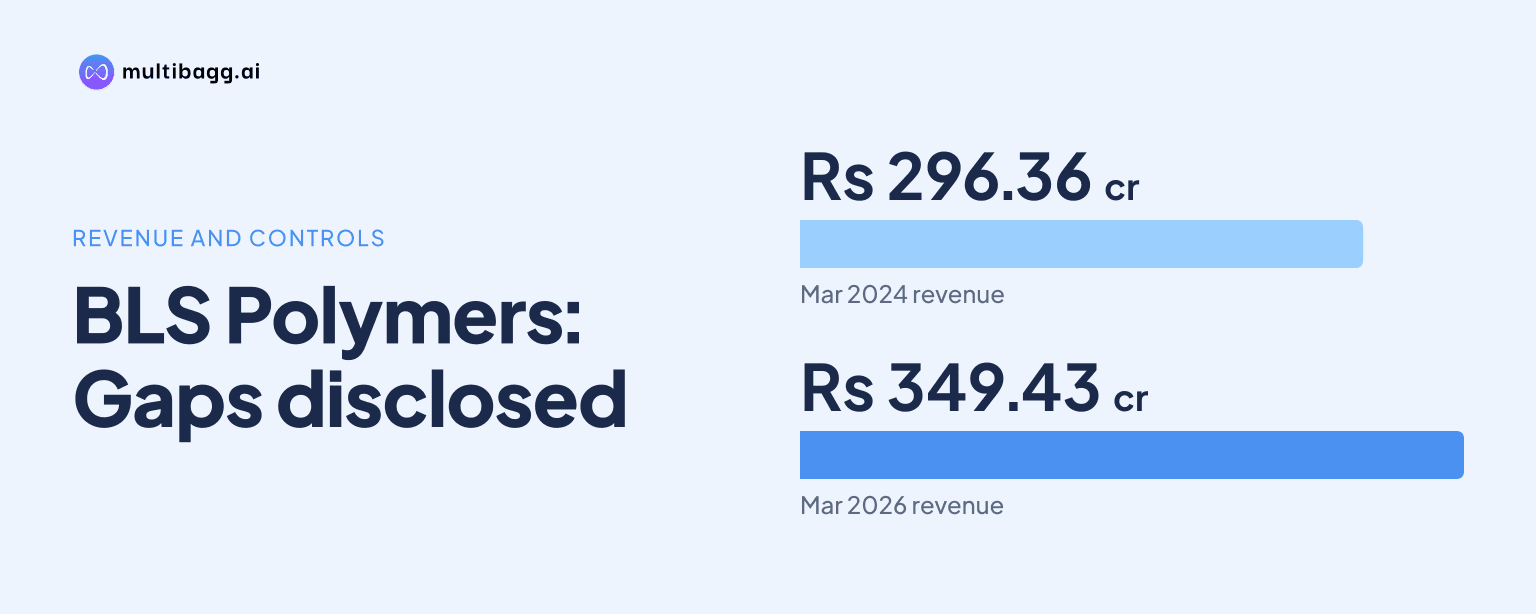
- Revenue from operations rose from Rs 296.36 crore in March 2024 to Rs 349.43 crore in March 2026 while the internal-audit finding persisted.
- The disclosed audit-control matters required no corrective restatement adjustment; the audit-qualification adjustment was nil, and March 2024 total comprehensive income remained Rs 7.57 crore.
powered by IRIS
BLS Polymers Limited disclosed that its accounting-software audit trail had not operated throughout the year ended March 31, 2024 for relevant transactions, preventing statutory preservation of the log. Separately, auditors said BLS Polymers’ internal-audit system was not commensurate with its business for each year from March 31, 2024 through March 31, 2026.
What were BLS Polymers’ audit-trail shortcomings?
BLS Polymers’ reported audit-trail issue concerned both the operation and preservation of the log in its accounting software. For the year ended March 31, 2024, the auditor said the software had an audit-trail, or edit-log, facility, but it had not operated throughout the year for all relevant transactions recorded in the system. The observation appears among other legal and regulatory matters that did not require an adjustment to the restated financial information.
An audit trail is a software-generated record of activities or changes made to accounting entries. The disclosure cites the proviso to Rule 3(1) of the Companies (Accounts) Rules, 2014, which addresses preservation of audit trails. Because the facility had not operated throughout the previous year, BLS Polymers had not preserved the audit trail in accordance with the statutory record-retention requirement described in that rule.
The issue was not presented as a quantified error in revenue, profit or equity for the year ended March 31, 2024. The supplied material does not identify the software provider, state how many transactions lacked an operating audit trail, or give the value of transactions affected. It also does not state a date on which the feature was enabled and shown to be operating for all relevant transactions.
Did the audit-trail disclosure continue after March 2024?
Yes, the disclosure issued for the year ended March 31, 2025 again identified a statutory audit-trail preservation issue, although its wording differs from the March 2024 disclosure. The March 2025 text states that BLS Polymers used software with an audit-trail facility for activities performed in the software, but its following paragraph says the feature was not available throughout the previous year and the audit trail had not been preserved as required under Rule 3(1).
The March 2024 wording says the audit-log facility had not operated throughout the year for all relevant transactions, while the March 2025 disclosure refers to the feature not being available throughout the previous year. Both statements connect the feature’s status to a failure to preserve the audit trail under the Companies (Accounts) Rules, 2014. The supplied material does not reconcile the differing descriptions or specify whether the March 2025 statement relates to a separate set of transactions.
The available disclosure therefore supports that audit-trail preservation was raised in the reporting material for the years ended March 31, 2024 and March 31, 2025. It does not support a calculation of missing logs, a conclusion about the completeness of particular account balances, or a claim that the same system failure continued for every transaction after March 31, 2024. Those details would require a later company or auditor update.
Why was BLS Polymers’ internal-audit system not commensurate?
BLS Polymers had implemented an internal-audit system, but auditors said the system was not commensurate with the size and nature of its business. That finding was disclosed for the years ended March 31, 2024, March 31, 2025 and March 31, 2026. The reports state that BLS Polymers is required to have an internal-audit system under Section 138 of the Companies Act, 2013.
“Commensurate” is the auditor’s comparison of the system against the company’s scale and operations; it does not mean BLS Polymers had no internal-audit system. The source does not disclose a numerical benchmark, staffing level, audit plan, testing coverage or budget that would show what system scale the auditor considered necessary. It does, however, report the same conclusion across three consecutive financial years.
The finding persisted as BLS Polymers’ reported revenue from operations increased from Rs 296.36 crore in the year ended March 31, 2024 to Rs 328.44 crore in the year ended March 31, 2025 and Rs 349.43 crore in the year ended March 31, 2026. That was an increase of Rs 53.07 crore between March 2024 and March 2026, while the internal-audit observation remained in the auditor-reported matters.
Got a follow-up? Ask IRIS
Did these audit-control matters change BLS Polymers’ restated figures?
No, the restated-adjustments statement says the other legal and regulatory matters described in the auditor’s reports did not require corrective adjustments to BLS Polymers’ restated financial information. In the reconciliation between audited financial statements and restated financial information, the audit-qualification adjustment is shown as nil for the periods displayed.
For the year ended March 31, 2024, total comprehensive income was reported as Rs 7.57 crore in both the audited-financial-statements line and the restated-financial-information line. This presentation means the disclosed audit-trail and internal-audit matters were not recorded as corrections to that reported total. It does not mean that the restated financial information involved no other accounting work.
The restated information separately describes reclassifications and changes made to align items with the Companies Act, 2013, Indian Accounting Standards, known as Ind AS, and Securities and Exchange Board of India requirements. For example, the company restated earnings per share for the years ended March 31, 2024 through March 31, 2026 after considering bonus shares issued after the respective year ends. The source distinguishes those accounting and presentation adjustments from the audit-control observations.
How large was BLS Polymers’ business during the internal-audit finding?
BLS Polymers operated with a substantial concentration in wire-and-cable products during the three years in which the internal-audit finding was reported. In the year ended March 31, 2026, wire and cable revenue was Rs 282.80 crore, or 80.93% of Rs 349.43 crore in total revenue from operations. Industrial pipelines generated the remaining Rs 66.63 crore, or 19.07%.
The product mix was similar in the two preceding years. Wire and cable accounted for 81.59% of revenue in the year ended March 31, 2025 and 80.49% in the year ended March 31, 2024, while industrial pipelines contributed 18.41% and 19.51%, respectively. The prospectus states that BLS Polymers manufactured six products in 127 grades as of the red herring prospectus date, but the revenue data identifies wire and cable as its principal sales category.
For the three months ended June 30, 2026, BLS Polymers reported Rs 107.03 crore of revenue from operations, of which wire and cable represented Rs 78.34 crore, or 73.20%, and pipelines represented Rs 28.68 crore, or 26.80%. The decline in the wire-and-cable share from 80.93% in the year ended March 31, 2026 shows a change in the interim sales mix, not a change in the auditor’s March 2026 internal-audit finding.
Conclusion
BLS Polymers disclosed two separate audit-control matters: an audit-trail operation and preservation issue in the reporting material for the years ended March 31, 2024 and March 31, 2025, and an internal-audit system judged not commensurate with the business for the three years through March 31, 2026. The restated-information reconciliation records nil audit-qualification adjustments, even as revenue from operations rose to Rs 349.43 crore in the year ended March 31, 2026.
The next disclosure to watch is whether BLS Polymers states that its audit-trail feature is enabled, operating throughout the relevant year and preserved in accordance with Rule 3(1), and whether auditors find the Section 138 internal-audit system commensurate with operations. The supplied material gives no dated remediation plan, so any confirmation would need to appear in a later company filing or auditor report.