










BLS Polymers Limited’s largest customer made 31.74% of FY26 revenue
Key highlights
- Customer 1 generated Rs 110.92 crore, or 31.74% of BLS Polymers’ Fiscal 2026 revenue from operations.
- BLS Polymers’ top 10 customers contributed 66.81% of Fiscal 2026 revenue, up from 50.52% in Fiscal 2024.
- BLS Polymers reported 190 customers in Fiscal 2026, including 172 domestic and 18 export customers.
- Pipeline products contributed 26.80% of sales in the three months ended June 30, 2026, compared with 19.07% in Fiscal 2026.
powered by IRIS
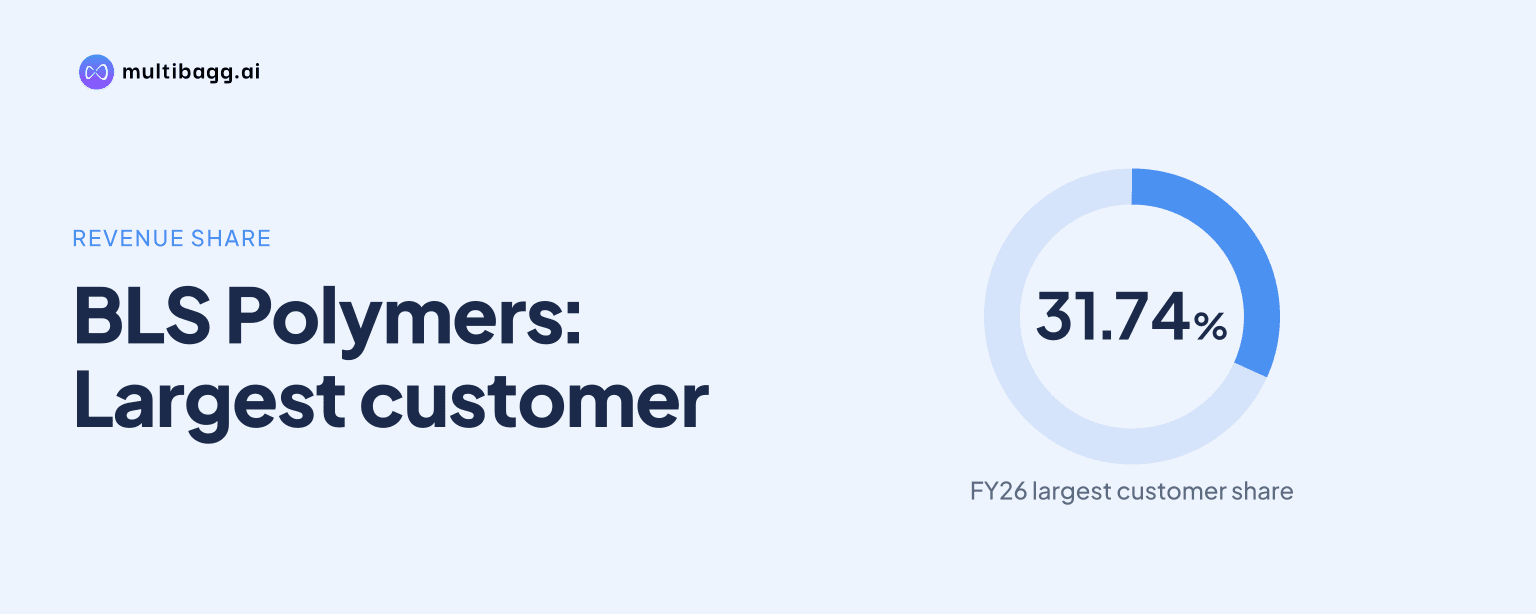
BLS Polymers Limited’s largest ranked customer generated Rs 110.92 crore, or 31.74% of revenue from operations, in Fiscal 2026, compared with Rs 27.57 crore and 9.30% in Fiscal 2024. The disclosure shows that concentration increased within the customer base despite BLS Polymers’ plans to diversify customers, products and regions.
How concentrated was BLS Polymers’ largest customer in Fiscal 2026?
BLS Polymers’ Customer 1 accounted for 31.74% of revenue from operations in Fiscal 2026, making it substantially larger than every other account in the disclosed top-10 table. Customer 1 generated Rs 110.92 crore in Fiscal 2026, while Customer 2 generated Rs 24.47 crore, or 7.00% of revenue from operations. The difference shows that the company’s top-customer exposure was concentrated in its largest ranked account rather than distributed evenly among the top 10.
Customer 1’s disclosed revenue rose in each of the three full fiscal periods shown, from Rs 27.57 crore in Fiscal 2024 to Rs 75.48 crore in Fiscal 2025 and Rs 110.92 crore in Fiscal 2026. Its share of revenue increased from 9.30% to 22.98% and then 31.74%, an increase of 22.44 percentage points between Fiscal 2024 and Fiscal 2026. BLS Polymers states that the top 10 customers may not necessarily be the same across periods, so the table measures the changing concentration of the largest ranked account and does not identify one continuing buyer across all three years.
The three months ended June 30, 2026 produced a lower 13.53% share for Customer 1, on revenue of Rs 14.48 crore. That partial-period figure does not establish a full-year change because BLS Polymers says customers place orders based on internal requirements, including pricing, capacity limitations, demand for end products and industry trends. Changes in order timing can therefore alter customer rankings and revenue shares between a three-month period and a fiscal year.
How dependent was BLS Polymers on its top 10 customers?
BLS Polymers derived 66.81% of Fiscal 2026 revenue from its top 10 customers, compared with 64.44% in Fiscal 2025 and 50.52% in Fiscal 2024. The top-10 group generated Rs 233.47 crore in Fiscal 2026, while the top five generated Rs 186.76 crore, or 53.45% of revenue. Customer 1 alone represented 31.74% of total revenue, leaving the other nine top-10 accounts to contribute the remaining 35.07 percentage points of the group’s share.
The top-10 concentration declined to 61.34% in the three months ended June 30, 2026, when those accounts generated Rs 65.65 crore. BLS Polymers identifies the loss of sales from any significant customer as a business risk, including where orders are reduced, delayed or cancelled, contracts are not renewed, or terms cannot be renegotiated. The company also says order volumes from top-10 customers declined during the preceding three fiscals, although it reports no loss of those customers during that period.
BLS Polymers reported 190 customers in Fiscal 2026, compared with 166 in Fiscal 2025 and 175 in Fiscal 2024. Domestic operations accounted for 172 customers, or 90.53% of the Fiscal 2026 total, while export operations accounted for 18 customers, or 9.47%. The increase of 24 customers from Fiscal 2025 did not prevent Customer 1’s share from rising by 8.76 percentage points to 31.74% in Fiscal 2026, showing that customer count and revenue concentration are different measures.
Got a follow-up? Ask IRIS
What could alter BLS Polymers’ largest-customer concentration?
BLS Polymers’ largest-customer concentration could fall if sales to other customers grow faster than sales to Customer 1, or rise further if the leading account maintains its Fiscal 2026 ordering while other revenue declines. The prospectus lists reduced demand, plant shutdowns, labour disruptions, financial stress, customer disputes and loss of market share at customers as possible causes of lower orders. For the 31.74% Fiscal 2026 share to persist, the largest ranked account would need to continue placing orders at a comparable level relative to total revenue.
BLS Polymers says customers may face barriers to changing suppliers because its products involve tailored solutions, switching costs, confidentiality and intellectual-property considerations. Those factors may affect retention, but the company says it cannot assure that it will retain key customers, maintain historical order volumes or keep customers within the top-10 group. The 13.53% Customer 1 share in the three months ended June 30, 2026 illustrates that the ranking and concentration level can change as customer requirements change.
The company’s end-market exposure also affects customer demand. Wire and cable polymer compounds contributed Rs 282.80 crore, or 80.93%, of Fiscal 2026 sales, while pipeline products contributed Rs 66.63 crore, or 19.07%. BLS Polymers says a reduction in demand from wire and cable industries could affect its revenue because polymer compounds are used for insulation, jacketing and sheathing of wires and cables.
Can BLS Polymers’ diversification plans reduce customer dependence?
BLS Polymers is pursuing product, customer and geographic diversification, but the disclosed figures do not establish that these plans have yet reduced its Fiscal 2026 largest-customer dependence. Pipeline revenue increased to Rs 28.68 crore, or 26.80% of sales, in the three months ended June 30, 2026, from 19.07% in Fiscal 2026. Wire and cable products correspondingly represented 73.20% of sales in the three-month period, compared with 80.93% in Fiscal 2026.
The product plan includes polyethylene pipe coating and adhesives for three-layer polyethylene, or 3LPE, applications. BLS Polymers also intends to deepen its presence in existing regions and establish distributors and customers in Tunisia, Algeria, Nigeria and Oman, including through sub-agents in selected international markets. The company notes that certain intended markets, including Nigeria and Algeria, have increased import tariffs on polymer-based materials or introduced local-content requirements, which could affect pricing, market entry, compliance requirements or the need for local partnerships.
Export customers increased from 11 of 166 customers in Fiscal 2025 to 18 of 190 customers in Fiscal 2026. However, BLS Polymers does not disclose export revenue or the identity and location of Customer 1. The available data therefore cannot show whether export expansion would directly diversify the 31.74% concentration in the largest ranked customer.
Conclusion
BLS Polymers’ customer data show that the largest ranked account increased from 9.30% of revenue in Fiscal 2024 to 31.74% in Fiscal 2026, while the top 10 customers’ combined share rose from 50.52% to 66.81%. Fiscal 2026 also brought the customer base to 190 accounts, but the figures show that having more customers does not by itself lower reliance on the accounts generating the most revenue.
The next disclosed indicators are whether BLS Polymers’ customer-diversification, 3LPE product and international distributor plans produce recurring sales outside its leading accounts. Pipeline products reached 26.80% of sales and Customer 1 represented 13.53% of revenue in the three months ended June 30, 2026, but neither partial-period figure establishes whether the Fiscal 2026 concentration pattern will continue.