










BLS Polymers sourced 64.73% from one supplier in June
Key highlights
- Supplier 1 accounted for Rs 52.98 crore, or 64.73% of BLS Polymers’ procurement cost, in the three months ended June 30, 2026.
- The top 10 suppliers represented 88.02% of BLS Polymers’ June 2026 procurement cost, despite the company reporting 108 suppliers.
- Raw-material consumption was Rs 82.01 crore, equal to 76.62% of revenue from operations, in the June 2026 quarter.
- Domestic purchases made up 90.34% of BLS Polymers’ June 2026 purchases, while imports accounted for 9.66%.
powered by IRIS
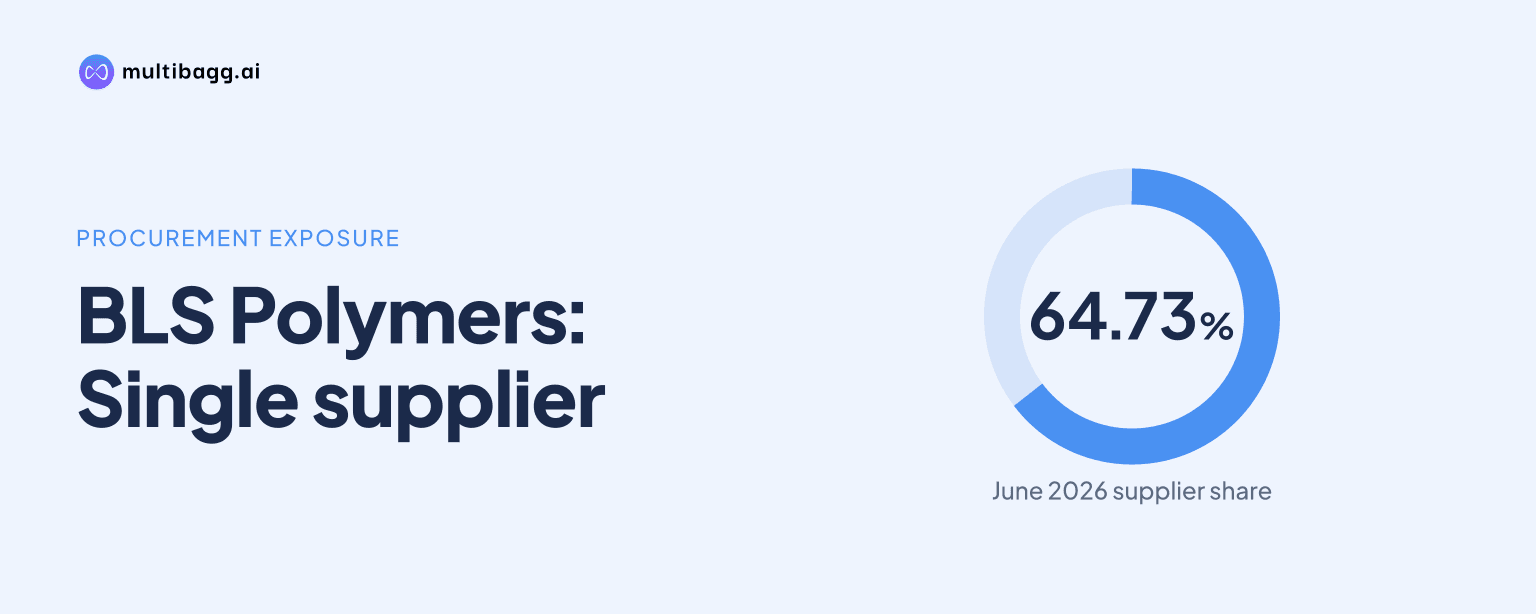
BLS Polymers sourced Rs 52.98 crore, representing 64.73% of total procurement cost, from Supplier 1 in the three months ended June 30, 2026. The concentration existed despite a reported supplier base of 108 entities, and BLS Polymers says it has no long-term contracts with a majority of its raw-material suppliers.
How concentrated was BLS Polymers’ raw-material procurement?
BLS Polymers’ raw-material procurement was concentrated in Supplier 1, which accounted for Rs 52.98 crore and 64.73% of total procurement cost in the three months ended June 30, 2026. Supplier 2 accounted for Rs 8.12 crore, or 9.92%, meaning Supplier 1’s share was more than six times that of the next-largest supplier. BLS Polymers identifies linear low-density polyethylene, or LLDPE, resin, high-density polyethylene, or HDPE, resin, and recycled HDPE as key inputs for its polymer compounds.
The top 10 suppliers accounted for Rs 72.04 crore, or 88.02%, of procurement cost in the June 2026 quarter. The remaining suppliers accounted for the balance of 11.98% based on the disclosed top-10 share. BLS Polymers names Haldia Petrochemicals Limited and Prime Polychem Private Limited as among the top 10 suppliers, but does not identify Supplier 1; it says the remaining supplier names were not disclosed because their consents were unavailable.
Has BLS Polymers’ supplier concentration changed over time?
BLS Polymers’ reliance on Supplier 1 increased over the reported annual periods before easing in the June 2026 quarter. Supplier 1 represented 38.32% of procurement cost in Fiscal 2024, 60.74% in Fiscal 2025, 71.68% in Fiscal 2026 and 64.73% in the three months ended June 30, 2026. Spending with Supplier 1 rose from Rs 96.14 crore in Fiscal 2024 to Rs 200.13 crore in Fiscal 2026.
The top-10 share also rose over the longer comparison, from 75.34% in Fiscal 2024 to 83.52% in Fiscal 2025 and 93.52% in Fiscal 2026, before declining to 88.02% in the June 2026 quarter. The June-quarter figure was 5.50 percentage points below Fiscal 2026 but 12.68 percentage points above Fiscal 2024. The comparison shows that the reported number of suppliers did not by itself determine how BLS Polymers distributed procurement spending.
Why does the 108-supplier count not remove procurement concentration?
BLS Polymers reported 108 suppliers in the three months ended June 30, 2026, comprising 107 domestic suppliers and one import supplier. Domestic suppliers represented 99.07% of the supplier count, compared with 145 of 163 suppliers, or 88.96%, in Fiscal 2024. Over that period, the supplier count declined by 55 while Supplier 1’s procurement share increased by 26.41 percentage points.
Raw-material purchases were also primarily domestic. Domestic purchases were Rs 75.95 crore, or 90.34% of purchases, in the June 2026 quarter, while import purchases were Rs 8.12 crore, or 9.66%. In Fiscal 2024, domestic purchases accounted for 71.94% and imports for 28.06%; in Fiscal 2026, the respective shares were 87.54% and 12.46%. The June-quarter import-purchase amount matches Supplier 2’s disclosed expenditure, but BLS Polymers does not state that Supplier 2 was the only import supplier.
Got a follow-up? Ask IRIS
What contractual protection does BLS Polymers have with suppliers?
BLS Polymers says it procures raw materials on an order basis from a maintained supplier list using internal demand projections, but has not entered into long-term contracts with a majority of suppliers. It has memoranda of understanding with leading domestic petrochemical manufacturers, while raw-material prices are normally based on supplier quotes. The disclosure does not describe those memoranda of understanding as long-term supply agreements.
Suppliers without formal arrangements are not contractually required to sell materials to BLS Polymers and may instead supply competitors. BLS Polymers says discontinued production, delayed deliveries, or failures in quality or quantity could disrupt its manufacturing schedule. The company also says shortages and supply delays have occurred in the past owing to the nature of the industry, although it does not quantify those events or identify the affected periods.
How exposed are BLS Polymers’ costs to raw-material availability and prices?
Raw-material consumption equalled Rs 82.01 crore, or 76.62% of BLS Polymers’ revenue from operations, in the three months ended June 30, 2026. The ratio was 78.13% in Fiscal 2026 and 89.30% in Fiscal 2025. The 12.68-percentage-point decline from Fiscal 2025 to the June 2026 quarter means raw-material consumption made up a lower proportion of revenue, while still accounting for more than three quarters of quarterly revenue.
The exposure would continue if BLS Polymers cannot obtain LLDPE resin, HDPE resin and recycled HDPE in sufficient quantities and on commercially acceptable terms. The company identifies government restrictions, supply-chain disruptions, market pressures and supplier capacity limitations as factors that could raise prices or reduce availability, and says it may not be able to pass increased costs to customers. International suppliers require advance payments when orders are placed; BLS Polymers says no failure to deliver adequate quantities meeting quality standards occurred in the June 2026 quarter or the preceding three fiscals.
Conclusion
BLS Polymers’ June-quarter procurement profile shows that a broad supplier list did not translate into dispersed purchasing. One unnamed supplier accounted for 64.73% of procurement cost and the top 10 accounted for 88.02%, while raw materials consumed represented 76.62% of June-quarter revenue from operations. Supply availability, delivery timing and quoted prices can therefore affect manufacturing volumes and margins.
The next point to watch is whether BLS Polymers reduces reliance on Supplier 1 while maintaining supplies on commercially acceptable terms. BLS Polymers’ disclosed approach is to procure against internal demand projections and use memoranda of understanding with leading domestic petrochemical manufacturers; the unresolved matter is that a majority of suppliers remain outside long-term contracts and are not contractually obliged to supply the company.