










BLS Polymers Limited disclosed missing records and open lapses
Key highlights
- BLS Polymers disclosed 21 categories of missing corporate records and regulatory filings spanning FY 1990-91 to FY 2023-24.
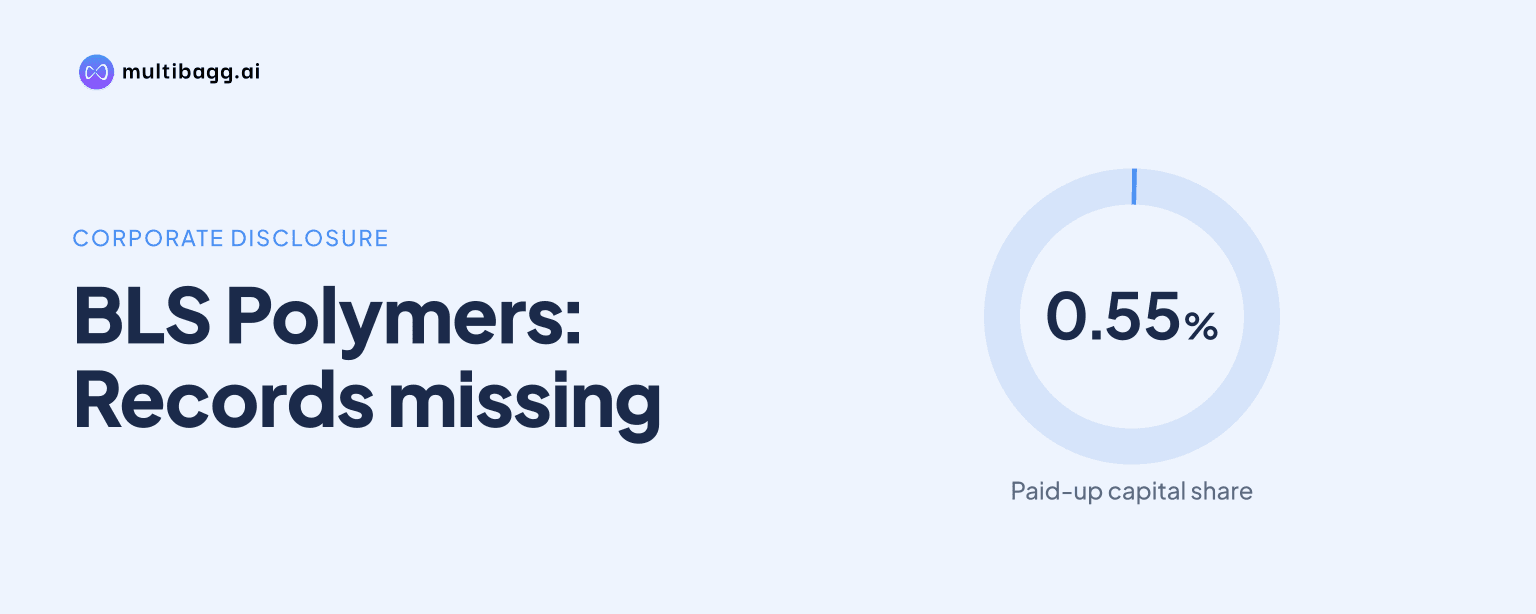
- The company cannot trace records for 2.52 lakh shares issued in 1991 and 1994, representing 0.55% of current paid-up share capital.
- BLS Polymers’ July 8, 2026 CSR application dismissal remains unresolved after the company re-filed an application on September 24, 2026.
- The company disclosed unregistered vehicle-loan charges of Rs 44 lakh in FY 2014-15 and Rs 89.54 lakh in FY 2022-23, although both loans were repaid.
powered by IRIS
BLS Polymers Limited disclosed that 21 categories of corporate records and regulatory filings are untraceable, including meeting records from incorporation through March 31, 2013 and audit-related filings beginning in FY 1990-91. BLS Polymers also has an unresolved corporate social responsibility, or CSR, compliance matter after its application was dismissed on July 8, 2026.
What corporate records has BLS Polymers been unable to trace?
BLS Polymers has been unable to trace governance, audit, annual-return, share-allotment and regulatory records covering periods from incorporation through FY 2023-24. The missing governance documents include notices, minutes and attendance sheets for board, committee and general meetings from incorporation to March 31, 2013. Director disqualification disclosures, interest notices and consents to act as director are also unavailable for that period.
The disclosed gaps also cover statutory registers maintained under specified corporate forms. BLS Polymers listed registers covering securities held by directors and key management personnel, loans, guarantees, securities and acquisitions, investments not held in its own name, and related-party contracts, all from incorporation to March 31, 2013. Key management personnel refers to executives designated by the company for corporate-governance purposes.
The longest missing financial-record period runs from FY 1990-91 to FY 2004-05. BLS Polymers cannot trace standalone audit reports and financial statements, balance-sheet filings in Form 23AC, or profit-and-loss filings in Form 23A for those 15 financial years. The company also listed unavailable compliance certificates for FY 1990-91 to FY 2010-11 and FY 2012-13 to FY 2013-14.
BLS Polymers also cannot trace Form 2 for two further share allotments: 2.48 lakh equity shares on December 28, 1991 and 3,600 equity shares on March 31, 1994. The combined 2.52 lakh shares represent 0.55% of BLS Polymers’ current paid-up share capital. Paid-up share capital is the amount received by a company for issued shares.
How has BLS Polymers dealt with the missing-record disclosures?
BLS Polymers informed the Registrar of Companies, or RoC, about the untraceable filings through a letter dated August 5, 2025. The company said disclosures made in the prospectus where records were unavailable relied on other supporting documents, including available board or shareholder resolutions and documents attached to filings sent to regulatory authorities.
BLS Polymers also relied on a search report dated August 5, 2025 from Himanshu S K Gupta & Associates, Practicing Company Secretaries. The report was based on inspection and independent verification of documents available with BLS Polymers, the Ministry of Corporate Affairs portal and the RoC. The company said the relevant reviewed certificate bore number 1943/2022.
Separately, BLS Polymers filed Form GNL-2, bearing service request number AB5855383, on August 5, 2025. The filing notified the RoC of discrepancies and inadvertent errors in statutory filings, as well as certain non-compliances under the Companies Act, 1956 and Companies Act, 2013. The company included that intimation among the material documents available for inspection.
The disclosed discrepancies include failures to register charges with the RoC for vehicle loans of Rs 44 lakh in FY 2014-15 and Rs 89.54 lakh in FY 2022-23. A charge is a registered security interest over company assets in favour of a lender. BLS Polymers said both vehicle loans had been repaid in full.
BLS Polymers also disclosed that its Form AOC-4 filings in eXtensible Business Reporting Language, or XBRL, for the years ended March 31, 2018 and March 31, 2019 omitted CSR contribution information in the attached files. Its FY 2015 board report incorrectly stated that no profits had been transferred to general reserve, although the company said its entire net profit for that year had been transferred to general reserve.
Got a follow-up? Ask IRIS
Which Companies Act lapse remains unresolved at BLS Polymers?
The principal unresolved BLS Polymers matter is a CSR spending and transfer lapse for FY 2021-22. Under Section 135(5) of the Companies Act, 2013, BLS Polymers said it did not spend the requisite amount on CSR activities and did not transfer the unspent amount to funds specified in Schedule VII by September 30, 2022. The company also said the board report did not disclose the matter because of an oversight.
BLS Polymers filed Form GNL-1 on August 3, 2025, bearing service request number AB5820008, seeking compounding under Section 441 read with Section 135(5). Compounding is a statutory process for resolving specified corporate offences through an authorised order. On July 8, 2026, the Regional Director dismissed the application, saying the matter fell under the adjudication mechanism in Section 454 rather than the compounding route in Section 441.
The July 8, 2026 order granted BLS Polymers liberty to file the appropriate application before the jurisdictional RoC. BLS Polymers subsequently re-filed an application under Section 441 on September 24, 2026, seeking reconsideration because it identified an interpretational issue over the applicability of Sections 441 and 454. The disclosed material does not report an outcome for the September 24, 2026 application.
A separate historic compliance lapse involved dematerialisation, the conversion of physical securities into electronic form. BLS Polymers said it did not facilitate dematerialisation as required by Rule 9A of the Companies (Prospectus and Allotment of Securities) Rules, 2014 from October 2, 2018 to July 14, 2024. The company said it subsequently complied, receiving International Securities Identification Number activation confirmation from Central Depository Services (India) Limited on July 15, 2024.
What regulatory exposure does BLS Polymers disclose?
BLS Polymers said no legal proceeding or regulatory action had been initiated against it, as of the prospectus date, regarding unavailable filings and the statutory lapses it identified. However, it said the amount of any future penalty or loss cannot be ascertained because it would depend on the circumstances of a potential regulatory action. The disclosure therefore identifies possible exposure rather than a reported current fine.
The company listed three share transfers approved through Form SH-4 that did not comply with Rule 9A. They involved 9 lakh equity shares in March 2021, 3.08 lakh shares in March 2022 and 60,000 shares in March 2022. The 60,000-share transaction had consideration of Rs 19.47 lakh.
BLS Polymers also disclosed that the explanatory statement for a preferential allotment dated August 2, 2006 did not contain all disclosures prescribed under the Unlisted Public Companies (Preferential Allotment) Rules, 2003. The required auditor certificate under Rule 7 of those rules is unavailable in the company’s records. A preferential allotment is an issue of shares to identified persons rather than through a public offer.
The continuing risk depends on the resolution of the CSR application and on BLS Polymers’ ability to detect and rectify future filing deficiencies. BLS Polymers said it monitors and evaluates internal controls for statutory compliance, but cannot assure that deficiencies will not arise or that all deficiencies can be detected and corrected. The company said recurring non-compliances could expose it, its promoters and directors to additional penalties.
Conclusion
BLS Polymers’ disclosures describe a historical record-retention and filing issue spanning 21 categories, rather than a single unavailable document. The gaps range from meeting documentation through March 31, 2013 to audit, annual-return and share-capital filings across specified years, while the company has notified the RoC and used supporting documents and an August 5, 2025 search report for its disclosures.
The next matter to watch is the outcome of BLS Polymers’ September 24, 2026 re-filed application on the FY 2021-22 CSR lapse. That application followed the July 8, 2026 dismissal in which the Regional Director said Section 454 adjudication, rather than Section 441 compounding, applied; the disclosed material records no later decision.