










BLS Polymers Limited vendor discounts made up 45% to 74% of PBT
Key highlights
- Vendor trade discounts were Rs 16.259 crore in Fiscal 2026, equal to 45.18% of PBT.
- Vendor discounts peaked at Rs 16.7574 crore in Fiscal 2025, when they represented 59.28% of PBT.
- Vendor discounts represented the highest share of PBT in Fiscal 2024 at 73.55%, despite amounting to Rs 7.1296 crore.
- The three months ended June 30, 2026 recorded Rs 3.8978 crore in discounts, equal to 28.49% of PBT.
powered by IRIS
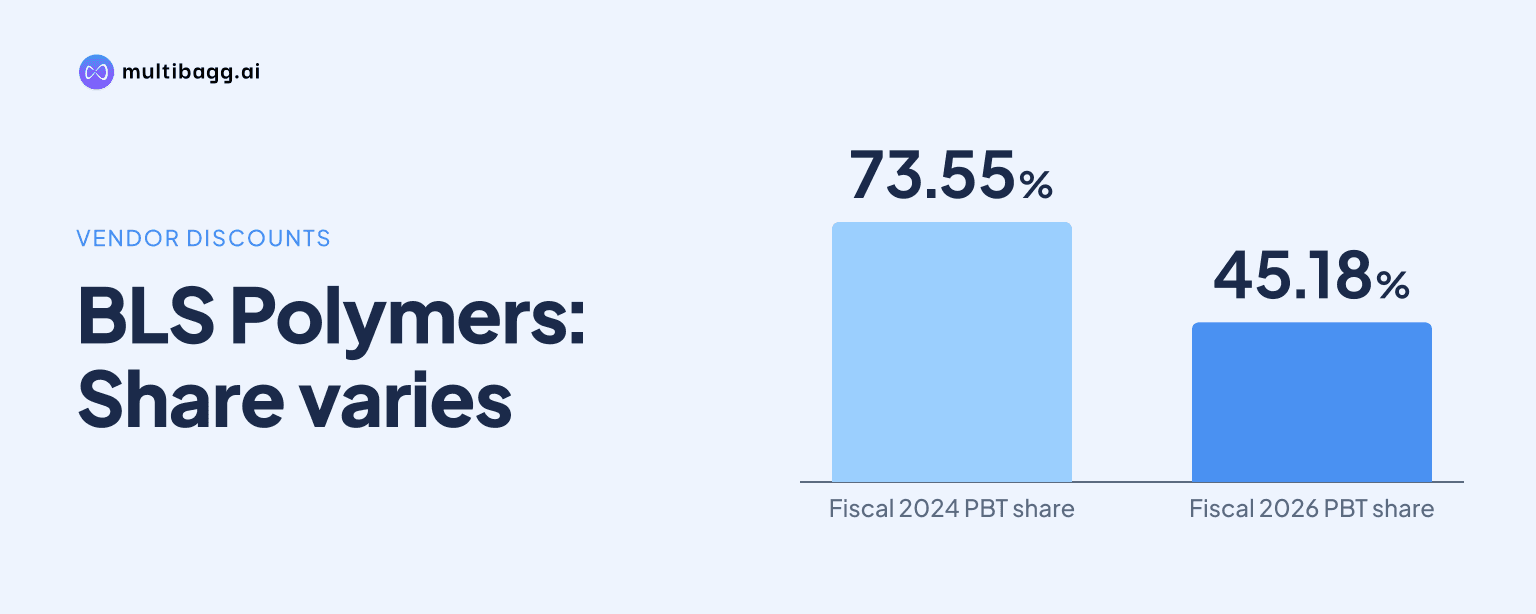
BLS Polymers Limited said discretionary vendor trade discounts accounted for 45.18% to 73.55% of profit before tax, or PBT, in Fiscal 2026, Fiscal 2025 and Fiscal 2024. The disclosed discounts reached Rs 16.7574 crore in Fiscal 2025, while their highest share of PBT was 73.55% in Fiscal 2024.
How much of BLS Polymers' pre-tax profit came from vendor discounts?
BLS Polymers' vendor discounts represented a material part of reported PBT in each of the three completed fiscal years disclosed. Trade discounts were Rs 16.259 crore in Fiscal 2026, equal to 45.18% of PBT; Rs 16.7574 crore in Fiscal 2025, equal to 59.28%; and Rs 7.1296 crore in Fiscal 2024, equal to 73.55%. PBT is profit before tax, which measures profit before the applicable tax charge.
The value of discounts peaked in Fiscal 2025 at Rs 16.7574 crore, Rs 0.4984 crore higher than in Fiscal 2026. The proportion of PBT was instead highest in Fiscal 2024 at 73.55%, falling by 14.27 percentage points in Fiscal 2025 and by a further 14.10 percentage points in Fiscal 2026. The three months ended June 30, 2026 recorded Rs 3.8978 crore of discounts, or 28.49% of PBT.
The comparison separates the amount of the discount from its relative contribution to reported profit. Fiscal 2024 had the lowest disclosed full-year discount amount, at Rs 7.1296 crore, but the highest share of PBT, at 73.55%. Fiscal 2025 had the highest discount amount, while Fiscal 2026 had the lowest full-year PBT share among the three fiscal years, at 45.18%.
Why are BLS Polymers' vendor discounts not assured to continue?
BLS Polymers says the discounts are discretionary and are not backed by long-term contractual commitments. The company procures supplies through short-term arrangements, typically memoranda of understanding with leading domestic petrochemical manufacturers or purchase orders, rather than arrangements that assure the same terms over multiple years.
The terms can be linked to specified purchase volumes or periodic negotiations, according to the disclosure. Comparable discounts therefore require vendors to continue offering them and BLS Polymers to renew or negotiate arrangements on similar terms. BLS Polymers specifically says it cannot assure investors that vendors will continue to provide such terms or that renewals will be available under similar conditions.
The risk factor identifies favourable procurement terms and discretionary vendor discounts, rather than broader market trends, as influencing recent financial performance. This distinction matters because a price benefit negotiated with a vendor can change when the relevant short-term memorandum of understanding or purchase order is renegotiated, even if BLS Polymers' sales activity does not change.
How do vendor discounts affect BLS Polymers' reported profitability?
Vendor discounts lower BLS Polymers' input expense by allowing procurement at values below prevailing market data and industry benchmarks, according to the filing. In Fiscal 2025, Rs 16.7574 crore of disclosed discounts equalled 59.28% of PBT, showing the scale at which a procurement term affected pre-tax profit in that year.
The mechanism is that lower raw-material and services costs contribute to profit when selling prices and other costs do not offset the benefit. BLS Polymers says it strategically sources key inputs from a select group of suppliers, using higher purchase volumes to negotiate more favourable rates and to ensure consistent input quality. The company describes these trade discounts as an integral part of its purchase and procurement process.
The disclosed proportions also show that the relationship between discount amounts and PBT varied over time. The Rs 7.1296 crore discount in Fiscal 2024 represented 73.55% of PBT, whereas the larger Rs 16.259 crore discount in Fiscal 2026 represented 45.18%. The filing does not provide a fixed formula for the relationship because it depends on procurement costs, selling prices and other expenses in each period.
Got a follow-up? Ask IRIS
What would happen if BLS Polymers lost these discounts?
BLS Polymers says operating costs would increase toward independent market rates if discounts were reduced or withdrawn, or if relationships with key suppliers ended. In Fiscal 2026, the Rs 16.259 crore discount represented 45.18% of PBT, making the disclosed benefit significant relative to that year's pre-tax profit.
The disclosure makes the effect conditional rather than forecasting a specific profit reduction. BLS Polymers says higher expenditure on raw materials and services would materially and adversely affect results of operations and financial condition if it were not mitigated by a corresponding increase in selling prices. The stated condition is important because the filing links the risk to the ability to pass increased input costs through to customers.
BLS Polymers also identifies supplier relationships as part of the mechanism. The company says that its sourcing strategy uses a select group of suppliers and higher purchase volumes to negotiate rates. If a supplier relationship ended, the relevant issue would be whether BLS Polymers could obtain replacement procurement terms that prevent costs from moving to independent market rates.
Does the June 2026 quarter show a change in the dependency?
The three months ended June 30, 2026 showed a lower disclosed discount share of PBT than each of the prior three full fiscal years. BLS Polymers recorded Rs 3.8978 crore of vendor trade discounts in that period, representing 28.49% of PBT, compared with 45.18% in Fiscal 2026, 59.28% in Fiscal 2025 and 73.55% in Fiscal 2024.
That comparison does not establish a full-year trend because the June 2026 figure covers three months, whereas Fiscal 2026, Fiscal 2025 and Fiscal 2024 cover full financial years. It does show that the proportion ranged from 28.49% to 73.55% across the disclosed periods. The filing attributes the availability of discounts to discretionary terms, purchase volumes and periodic negotiations rather than to a long-term commitment.
The quarterly figure should therefore be read as a separate partial-period disclosure, not as a direct annualised measure. For the June 2026 period, Rs 3.8978 crore in discounts was 28.49% of PBT; for Fiscal 2026, Rs 16.259 crore was 45.18%. Whether the lower quarterly proportion persists depends on the future terms offered by vendors and the outcome of procurement negotiations.
Conclusion
BLS Polymers' disclosure shows that vendor trade discounts were a significant component of historical pre-tax profitability, ranging from Rs 7.1296 crore to Rs 16.7574 crore in Fiscal 2024 through Fiscal 2026 and representing 45.18% to 73.55% of PBT. Reported profit was therefore affected by procurement terms negotiated with suppliers as well as by sales, production costs and other expenses.
The next item to watch is whether BLS Polymers can renew its short-term memoranda of understanding and purchase-order arrangements on comparable terms. The company has not disclosed long-term contractual commitments for the discounts and says that reduced discounts, terminated supplier relationships or higher market input rates could increase raw-material and services costs unless selling prices rise correspondingly.