










G&J industry US share falls to 18.4% as Middle East rises
Key highlights
- The US share of Indian gems and jewellery exports fell to 18.4% in FY26 from 32.2% in FY25.
- Middle East gems and jewellery exports rose 16.8% year on year to Rs 88,470 crore in FY26.
- The UAE, Hong Kong and the US together accounted for 71.2% of FY26 gems and jewellery exports.
- Cut and polished diamond exports declined 4.4% to Rs 1,07,460 crore in FY26.],
powered by IRIS
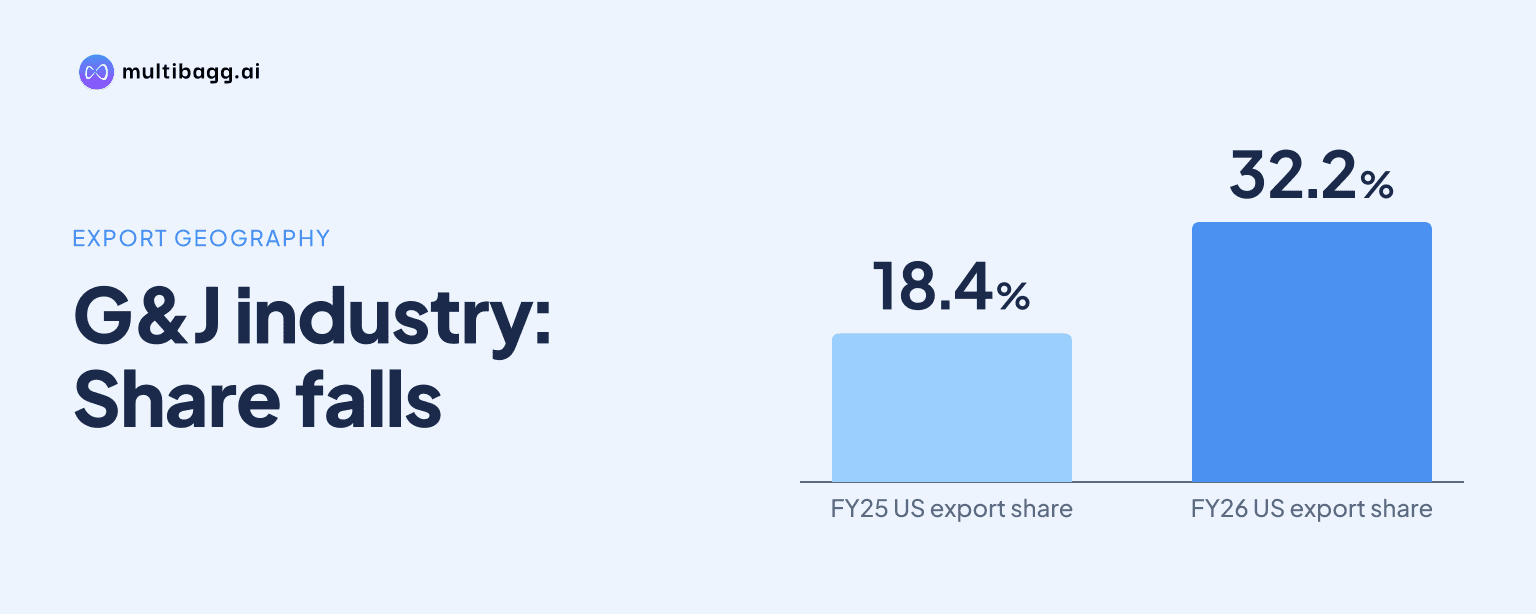
The Indian gems and jewellery industry reduced its relative reliance on the US in FY26, when the US share of exports fell to 18.4% from 32.2% in FY25. The change coincided with tariff measures imposed in August 2025 and a 16.8% rise in G&J industry exports to the Middle East, to Rs 88,470 crore.
Why did the G&J industry US share fall to 18.4%?
The G&J industry US share fell because tariff measures imposed in August 2025 reduced the price competitiveness of Indian exports, while discretionary demand weakened for diamonds and high-value jewellery. The US accounted for 18.4% of FY26 exports, down 13.8 percentage points from 32.2% in FY25 and 18.5 percentage points from the FY22 high of 36.9%.
The source also attributes the decline to weak US discretionary spending amid inflationary pressures. This was particularly relevant to diamonds and high-value jewellery: cut and polished diamonds represented about 44% of G&J industry exports in FY26, and their export value declined 4.4% to Rs 1,07,460 crore from Rs 1,12,410 crore in FY25. Weak demand in the US and China, alongside rising consumer preference for lab-grown diamonds, affected that product category.
The FY26 movement was larger than the preceding shifts in the US destination share, which was 25.8% in FY20, 34.1% in FY21, 33.0% in FY23 and 30.4% in FY24. The source does not provide a US-specific export value, shipment volume or standalone estimate of the tariff effect, so the 18.4% figure measures a change in the destination mix rather than the absolute fall in US shipments.
How concentrated were G&J industry exports in FY26?
G&J industry exports remained concentrated in three destinations, which jointly represented 71.2% of FY26 exports. The United Arab Emirates (UAE) accounted for 31.1%, Hong Kong for 21.7% and the US for 18.4%, making the UAE the largest individual export destination in FY26.
Total G&J industry exports were Rs 2.44 lakh crore in FY26 and were broadly stable from FY25, while gross imports increased 21.54% to Rs 2.02 lakh crore from Rs 1.67 lakh crore. Exports exceeded imports in FY26, extending the net-exporter position recorded in each of the six financial years from FY21 to FY26.
Markets outside the UAE, Hong Kong and the US represented 28.8% of FY26 exports. Belgium had a 5.1% share, the United Kingdom had 2.6%, and all other destinations combined accounted for 21.1%. Government export-promotion efforts include identifying new markets while consolidating existing markets and assisting exporters, particularly small and medium enterprises.
Got a follow-up? Ask IRIS
How much did G&J industry Middle East exports increase in FY26?
G&J industry exports to the Middle East increased 16.8% year on year to Rs 88,470 crore in FY26, taking the region's share to about 36.2% of total exports. The increase followed a 1.7% decline in FY25, when Middle East shipments were Rs 75,720 crore, and coincided with exporters diversifying towards alternative markets.
Middle East exports rose from Rs 31,920 crore in FY21 to Rs 88,470 crore in FY26, a compound annual growth rate of 22.61%. The series included an 81.3% recovery in FY22 to Rs 57,890 crore after the pandemic-affected FY21 level, followed by growth of 13.5% in FY23 and 17.2% in FY24 before the FY25 contraction.
The regional expansion remained heavily dependent on the UAE. The UAE accounted for 85.8% of G&J industry exports to the Middle East in FY26, while Saudi Arabia accounted for 2.4%, Bahrain for 2.0%, Kuwait for 1.9% and Qatar for 0.8%. Other Middle East destinations represented 7.1%, meaning that continued regional growth depends predominantly on demand in the UAE.
What supports and limits the G&J industry Middle East shift?
The India-UAE Comprehensive Economic Partnership Agreement, or CEPA, supports the G&J industry Middle East shift through preferential tariffs and streamlined customs procedures. CEPA took effect in 2022, and Middle East exports increased from Rs 57,890 crore in FY22 to Rs 88,470 crore in FY26. However, the source says the agreement's impact appears limited so far, noting FY26 growth of 16.83%.
Product mix affects the durability of the destination change. Cut and polished diamonds made up about 44% of FY26 exports, while plain and studded gold jewellery accounted for about 41%; coloured gemstones, gold medallions and coins made up the remaining 15%. Diamond demand remains exposed to weaker discretionary spending and lab-grown diamond preferences, so a recovery in that category would depend on demand in major markets including the US and China.
Gold jewellery provided a separate source of export value in FY26. Gold jewellery exports increased 4.2% in rupee terms to Rs 1,00,280 crore, although they were broadly flat in US dollar terms. The source attributes the difference to higher gold prices and currency movements, while affordability concerns and constrained gold availability limited export manufacturing volumes; higher-value studded and design-intensive jewellery supported realisations.
Conclusion
The G&J industry export map changed in FY26 as the US share fell to 18.4% and Middle East exports reached Rs 88,470 crore. Tariff measures, softer US discretionary demand and a move towards alternative markets explain the shift, but export concentration remains substantial because the UAE, Hong Kong and the US still accounted for 71.2% of total exports.
The next measure to watch is whether UAE-led Middle East growth continues after the FY26 increase of 16.8%, including through CEPA's preferential tariffs and streamlined customs procedures. An unresolved issue is demand for cut and polished diamonds, whose FY26 exports declined 4.4% amid weak US and Chinese demand and growing preference for lab-grown diamonds.