








India’s Adult Incontinence Market Is Set to Grow 16.6% Annually
MAX Plan at ₹4,999/yr

Find your next multibaggerBe a Pro Investor
Research stocks and track your picks on the go. Download the app.
Key highlights
- India’s adult incontinence market is projected to grow from Rs 1,710 crore in FY 2026 to Rs 3,170 crore in FY 2030 at a 16.6% CAGR.
- India’s adult incontinence penetration is about 3-5%, compared with about 50-80% across Japan, North America and Western Europe.
- Adult diapers represent 85.0% of FY 2026 market value, or Rs 1,460 crore.
- Pharmacies account for 45.0% of FY 2026 value and e-commerce plus quick commerce account for 30.3%.
powered by IRIS
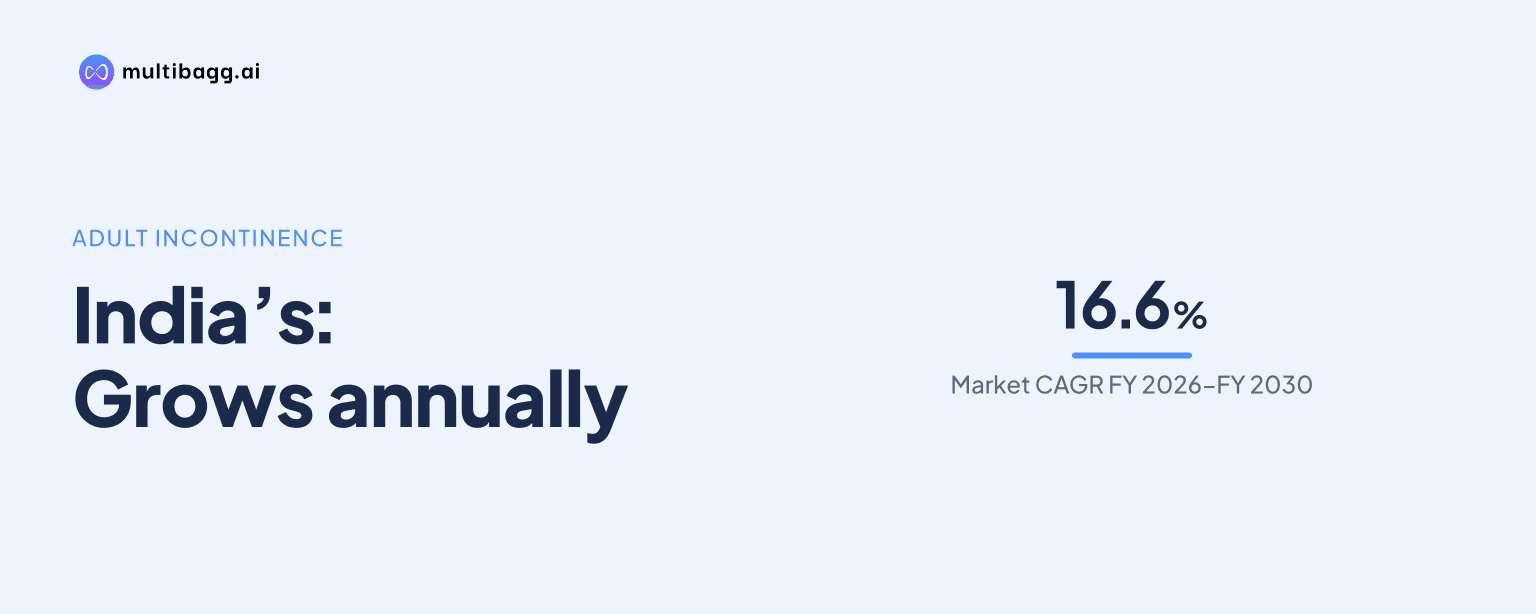
India’s adult incontinence market is projected to grow at a 16.6% compound annual growth rate (CAGR) from Rs 1,710 crore in FY 2026 to Rs 3,170 crore in FY 2030, supported by low 3-5% penetration, urban adoption, healthcare access and wider pharmacy and online availability. CAGR measures the average annual growth rate over a specified period.
Why is the adult incontinence market projected to grow 16.6% annually?
The adult incontinence market is projected to accelerate because its FY 2026-30 CAGR of 16.6% exceeds the 11.0% CAGR recorded between FY 2020 and FY 2025. Market value rose from Rs 900 crore in FY 2020 to Rs 1,510 crore in FY 2025, and was estimated at Rs 1,710 crore in FY 2026, a 13.5% year-on-year increase. The FY 2030 forecast implies Rs 1,460 crore of additional market value over four years.
The projection is linked to ageing, healthcare access and care settings that introduce products to patients and caregivers. India’s senior population is expected to increase from about 166.9 million in 2026 to 346.0 million by 2050. Hospitals, nursing homes, rehabilitation centres, assisted-living facilities and home healthcare providers can create first usage, while sustained growth requires subsequent replenishment in home-based care.
The adult incontinence market includes products for urinary and, in some cases, faecal incontinence among adult and elderly users. Demand is associated with age-related continence decline, post-surgical recovery, mobility impairment, extended bed rest and chronic conditions that affect bladder control. The source identifies rising diagnosis, greater healthcare expenditure, expanding pharmacies and e-commerce, and more organised brands with discreet product formats as the mechanisms behind the FY 2030 projection.
How low is adult incontinence market penetration in India?
The adult incontinence market reaches only about 3-5% of the relevant Indian population in CY 2025, compared with 50-80% in developed regions. Penetration was about 60-65% in North America, 50-55% in Western Europe and 75-80% in Japan in CY 2025. India accounted for roughly 1% of the global adult incontinence market in CY 2025, while North America and Western Europe together represented more than 60% of global demand.
This gap reflects low awareness, stigma, affordability constraints and reliance on informal alternatives such as cloth pads, cloth mats and plastic sheets. Adoption is concentrated in urban and semi-urban areas, where hospitals, pharmacies, elder-care facilities and online platforms offer more product access. The source characterises the category’s transition as moving from hospital- and caregiver-led usage toward organised retail and at-home consumption after 2015.
Urban areas accounted for an estimated 97-98% of adult incontinence market value in FY 2026, leaving rural areas at only 2-3%. Rural demand is constrained by lower awareness, social stigma and price sensitivity despite underlying needs associated with ageing and chronic conditions. The disclosed rural growth mechanisms are government-supported healthcare access, awareness campaigns, institutional reach and entry-level formats rather than premiumisation.
Which products drive the adult incontinence market?
Adult diapers drive the adult incontinence market, accounting for about 85.0% of value, or Rs 1,460 crore, in FY 2026. The adult diaper category is projected to grow at a 16.6% CAGR to Rs 2,690 crore by FY 2030. Tape-style diapers are used mainly for bedridden patients in care settings, while pant-style formats address mobile users seeking comfort and discreet use.
Underpads, also called bed protectors, represented 10.0% of market value, or Rs 170 crore, in FY 2026 and are projected to reach Rs 320 crore by FY 2030 at a 17.1% CAGR. They are used for light to moderate incontinence and can be an entry point into organised care, but informal substitutes continue to limit adoption in price-sensitive households. Their projected growth rate exceeds that of adult diapers by 0.5 percentage points.
Liners and guards made up the remaining 5.0% of FY 2026 value, or Rs 80 crore, and are projected to reach Rs 150 crore in FY 2030 at a 15.7% CAGR. These products are used for light or occasional incontinence, primarily by urban and mobile users, and inserts may supplement diapers in high-absorbency situations. The product mix is projected to remain broadly stable through FY 2030, with diapers at 85.0%, underpads at 10.2% and liners and guards at 4.8%.
Got a follow-up? Ask IRIS
Which channels will shape adult incontinence market growth?
Pharmacies are the largest adult incontinence market channel, accounting for 45.0% of FY 2026 value, while e-commerce and quick commerce accounted for 30.3%. Pharmacy includes standalone medical stores, organised chains and on-premise pharmacies in hospitals and nursing homes. These outlets matter because hospitalisation and assisted care can create the first trial, while pharmacists support product selection and repeat purchase.
E-commerce includes online marketplaces, direct-to-consumer websites, quick-commerce platforms and online pharmacies. Its share is projected to rise from 30.3% in FY 2026 to 31.5% in FY 2030, supported by privacy, delivery convenience and access to more stock-keeping units, or SKUs. E-commerce is projected to grow at a 15.4% CAGR between FY 2026 and FY 2030, compared with 11.4% for pharmacies, although pharmacy share is forecast to remain at 45.0%.
Modern trade held 11.9% of FY 2026 market value, general trade 9.9% and institutional channels 2.9%. Modern trade includes supermarkets, hypermarkets and large-format chains, while general trade covers non-pharmacy kirana stores and small retailers. Institutional demand includes elder-care and assisted-living facilities; private hospitals are expected to add more than 4,000 beds in FY 2026, supported by about Rs 11,500 crore of investment, potentially increasing exposure to first-time usage.
How do price segments affect adult incontinence market expansion?
Economy adult diapers are expected to lead price-segment growth, accounting for 45.2% of adult diaper value in FY 2026 and projected to reach 46.0% by FY 2030. Economy products are priced at Rs 13-25 per piece and are forecast to grow at a 17.1% CAGR during FY 2026-30. First-time users, caregiver budgets and bulk buying in high-frequency care situations support this segment.
Mid-premium adult diapers, priced at Rs 25-40 per piece, represented 35.1% of FY 2026 adult diaper value and are projected to grow at 16.8% annually to FY 2030. Premium products, priced above Rs 40 per piece, represented 19.7% and are projected to grow at 15.0%. The comparison shows that the market forecast is weighted more toward broad-based affordability-led adoption than toward premium product expansion.
Per-piece pricing varies with absorption level, fit, odour control, material quality, skin-related claims, package format and size. Larger sizes, including XL and XXL, use more material and typically offer greater absorption capacity than smaller sizes. The growth forecast therefore depends on more users entering the category and maintaining recurring use across economy, mid-premium and premium formats.
Conclusion
The adult incontinence market combines a projected rise from Rs 1,710 crore in FY 2026 to Rs 3,170 crore in FY 2030 with penetration of only 3-5% in CY 2025. Adult diapers account for 85.0% of FY 2026 value, urban areas contribute 97-98%, branded products represent 96-98%, and pharmacies plus e-commerce account for 75.3% of sales. The figures indicate that formal distribution, caregiver confidence and replacement of informal care methods are central to projected expansion.
What to watch next is whether the disclosed FY 2030 channel and product mix develops as forecast: e-commerce is projected to reach 31.5% of market value, economy adult diapers 46.0% of adult diaper value and underpads Rs 320 crore. The outlook also depends on the planned addition of more than 4,000 private-hospital beds in FY 2026, continued healthcare access and awareness efforts that reduce stigma in home-care and rural settings.

