








Indian hygiene-product manufacturers face BIS and import barriers
MAX Plan at ₹4,999/yr

Find your next multibaggerBe a Pro Investor
Research stocks and track your picks on the go. Download the app.
Key highlights
- Disposable sanitary napkins, baby diapers and adult incontinence diapers are covered by IS 5405:2019, IS 17509:2021 and IS 17508:2020, respectively.
- SAP, specialty non-wovens and breathable backsheet films remain partially import-dependent inputs for Indian hygiene-product manufacturers.
- The sanitary-napkin contract-manufacturing market was estimated at Rs 1,760 crore in FY 2026 and is projected to reach Rs 3,110 crore by FY 2030.
- In-house manufacturing represented 78.7% of the Rs 8,240 crore sanitary-napkin manufacturing market in FY 2026.
powered by IRIS
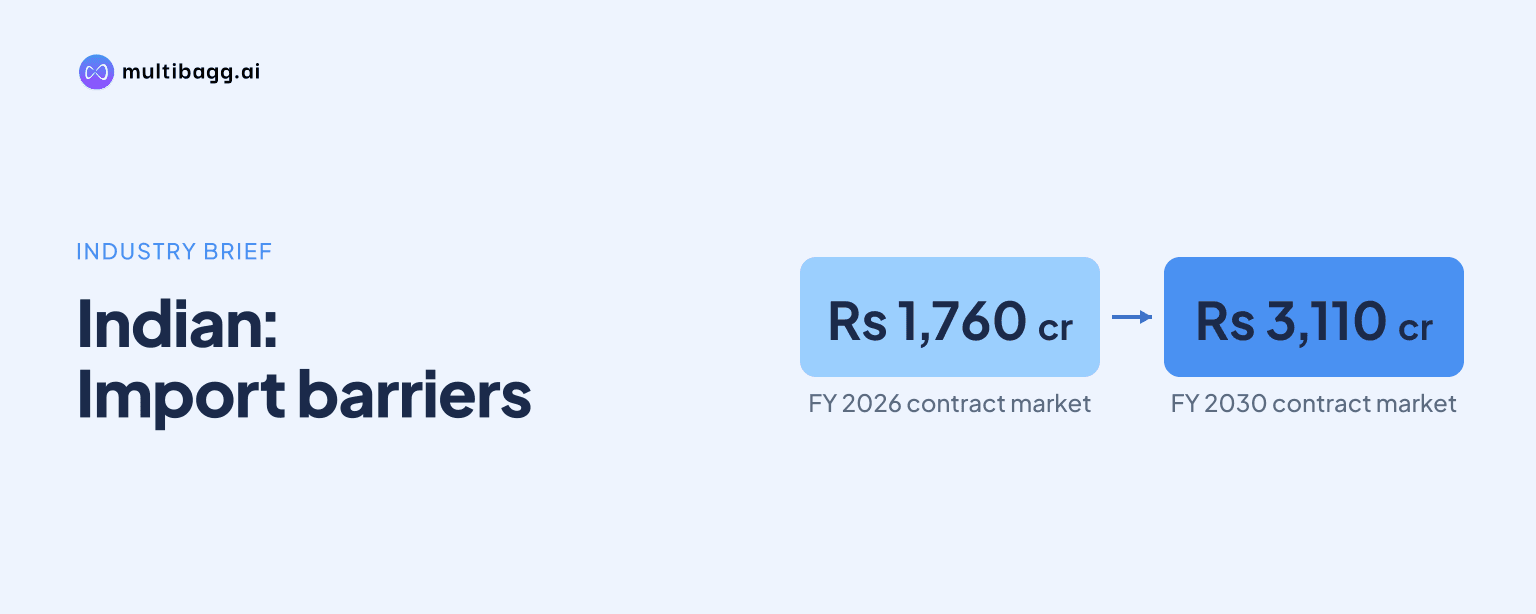
Indian hygiene-product manufacturers face higher entry barriers because they must meet Bureau of Indian Standards requirements and manage partially imported critical inputs; the sanitary-napkin contract-manufacturing market is projected to reach Rs 3,110 crore by FY 2030. Compliance with product standards, testing, pack marking and documentation combines with dependence on super absorbent polymer, specialty non-wovens and breathable backsheet films.
Why do BIS standards raise entry barriers for Indian hygiene-product manufacturers?
BIS standards raise entry barriers for hygiene-product manufacturers because they require controlled production, quality systems, regular testing, audits and documentation covering chemical composition, microbiological safety and product performance. The applicable Indian Standards are IS 5405:2019 for disposable sanitary napkins, IS 17509:2021 for disposable baby diapers and IS 17508:2020 for disposable adult incontinence diapers.
The Bureau of Indian Standards, or BIS, applies Scheme-I under the BIS (Conformity Assessment) Regulations, 2018, the ISI Mark Product Certification scheme, to the listed disposable hygiene products. IS 5405:2019 requires sanitary-napkin consumer packs to carry the Standard mark, BIS licence number and BIS website detail, while IS 17509:2021 requires the Standard mark on all baby-diaper packages. Compliance therefore extends from material selection and line controls to the finished pack.
Hygiene-product manufacturers also face requirements outside the product standard. The Legal Metrology (Packaged Commodities) Rules, 2011 require manufacturer, packer or importer details, generic product name, net quantity, packing or manufacturing month and year, maximum retail price inclusive of taxes, and consumer-care details. The Plastic Waste Management Rules, 2016 and Extended Producer Responsibility guidelines also govern plastic packaging and collection, recycling or end-of-life obligations for producers, importers and brand owners.
Which imported materials create risk for hygiene-product manufacturers?
Imported materials create risk because super absorbent polymer, or SAP, specialty non-woven fabrics and advanced breathable backsheet films remain partially import-dependent. SAP, generally sodium polyacrylate, absorbs and retains liquid in the core. Breathable backsheet film is typically a microporous polyethylene barrier that permits airflow while helping prevent leakage, making its specifications relevant to absorption, dryness and comfort.
The wider bill of materials is partly domestic. Pulp, adhesives, packaging and standard non-wovens are mainly sourced locally, according to the source. Diapers additionally use elastic leg-cuff and waist materials, fastening tapes or hook-and-loop components for tape formats, and pant-style waistbands; sanitary napkins use release paper or wrapper material to protect pressure-sensitive adhesive before use.
This mixed procurement structure transmits foreign-exchange movements, global price changes, shipping delays and international trade-rule changes into factory costs, inventory planning and working-capital cycles. The source says smaller manufacturers are more exposed when prices of fluff pulp, SAP, non-wovens, plastics and packaging fluctuate because they have limited buying power. Import dependence remains manageable only if procurement arrangements, inventories and incoming material quality remain stable.
Hygiene-product manufacturers use long-term sourcing, bulk purchases and inventory planning to manage input exposure. The source also identifies banana fibre, agro-based fibres and reduced-wood-pulp options as materials under exploration. However, changing to biodegradable materials or alternative fibres requires controlled trials, process validation and equipment or parameter changes before the new design can maintain conventional product performance.
Got a follow-up? Ask IRIS
How do manufacturing technology and product variety increase barriers?
Manufacturing technology increases barriers because diaper production uses mostly automated integrated converting lines that combine pulp defibration, SAP dosing, core formation, non-woven layering, elastic application, bonding, sealing, cutting and packing. Sanitary-napkin lines can be semi-automatic or fully automated, but also require absorbent-core formation, layer assembly, adhesive application, embossing, cutting and batch-level checks.
Diaper production is more automated and complex than sanitary-napkin production because it incorporates elastic leg cuffs, waist components and, depending on the format, fasteners or pant-style waistbands. Diapers generally contain more SAP and fluff pulp per unit than sanitary napkins. Consistent dosage, web handling and thermal or ultrasonic sealing must hold at production speed to maintain liquid retention, fit and leakage protection.
Stock-keeping unit, or SKU, proliferation adds operational complexity. Manufacturers may produce newborn, infant, toddler and adult diapers; tape-style and pant-style formats; and overnight, ultra-thin, winged, adolescent and postpartum sanitary-napkin variants. These combinations require machine-setting changes and sometimes modular tooling, while frequent changeovers can cause downtime, material waste and quality variation, especially for factories serving several contract clients.
The FY 2026 capacity comparison shows the scale of established organised suppliers. PAN Healthcare Pvt. Ltd. had installed annual capacity of 3,750.0 million units across baby diapers, adult diapers and sanitary napkins, compared with 3,543.0 million units for Swara Baby Products Ltd. and 667.2 million units for Uniclan Healthcare Pvt. Ltd. Capacity does not itself demonstrate certification, but it indicates the equipment base involved in large-scale conversion.
Can contract manufacturing lower the barrier for new hygiene brands?
Contract manufacturing can lower the capital barrier for a new brand, but it does not remove the compliance and sourcing burden held by the factory. Contract manufacturing means a third-party manufacturer produces goods to customer specifications under purchase orders or a supply agreement. This model allows direct-to-consumer, or D2C, and private-label brands to launch products without building their own production infrastructure.
The sanitary-napkin market demonstrates the distinction between brand entry and manufacturing entry. Contract manufacturing was estimated at Rs 1,760 crore in FY 2026, rising 15.8% year on year from Rs 1,520 crore in FY 2025, and is projected to reach Rs 3,110 crore in FY 2030 at a 15.4% compound annual growth rate. Yet in-house manufacturing represented 78.7% of the Rs 8,240 crore sanitary-napkin manufacturing market in FY 2026, compared with 21.3% for contract manufacturing.
Organised hygiene-product manufacturers can use documented processes, audit readiness, testing infrastructure and statutory approvals to qualify for institutional, private-label and large-volume contracts. The source identifies Swara Baby Products Ltd. as the first Indian manufacturer among selected peers to receive BIS certification for disposable baby diapers under IS 17509:2021. That differentiation must be maintained through continuing controls rather than a one-time certification event.
Factory location also affects the cost of managing imported inputs and bulky finished goods. Gujarat clusters including Halol, Biyala, Rajkot, Vapi and Ahmedabad benefit from proximity to ports and polymer hubs, while Pithampur and Mandideep in Madhya Pradesh offer central distribution positioning. Diapers are bulky, so warehouses near consumption centres and transport networks matter for freight and replenishment alongside port access for inbound SAP and specialty films.
Conclusion
The evidence shows that hygiene manufacturing requires more than low-cost conversion of disposable consumer products. Indian hygiene-product manufacturers must align materials, production equipment, quality testing, BIS marking, pack disclosures, factory permissions and plastic-waste obligations. Partial reliance on SAP, specialty non-wovens and breathable backsheet films adds foreign-exchange, shipping, inventory and supply-continuity exposure to that compliance workload.
The next issue to watch is whether domestic sourcing and alternative fibres can reduce import dependence without disrupting certified product performance. The source lists diapers and sanitary napkins in the HSN 9619 series as eligible Medical/Hygiene Textiles under the Production Linked Incentive Scheme for Textiles, while sanitary-napkin contract manufacturing is projected to reach Rs 3,110 crore by FY 2030. The expansion of organised capacity will depend on sustaining quality systems alongside supply continuity.

