










Our Company’s seasonal crushing limits factory operations
Key highlights
- Our Company’s factory operated for 102 days in FY 2024-25, compared with 146 days in FY 2023-24.
- Our Company’s jaggery-powder capacity utilisation reached 94.09% in FY 2025-26.
- Our Company’s khandsari sugar line used 620 metric tonnes, or 8.03%, of FY 2025-26 installed capacity.
- Our Company spent Rs 14.48 crore on harvesting and transportation in FY 2025-26.
powered by IRIS
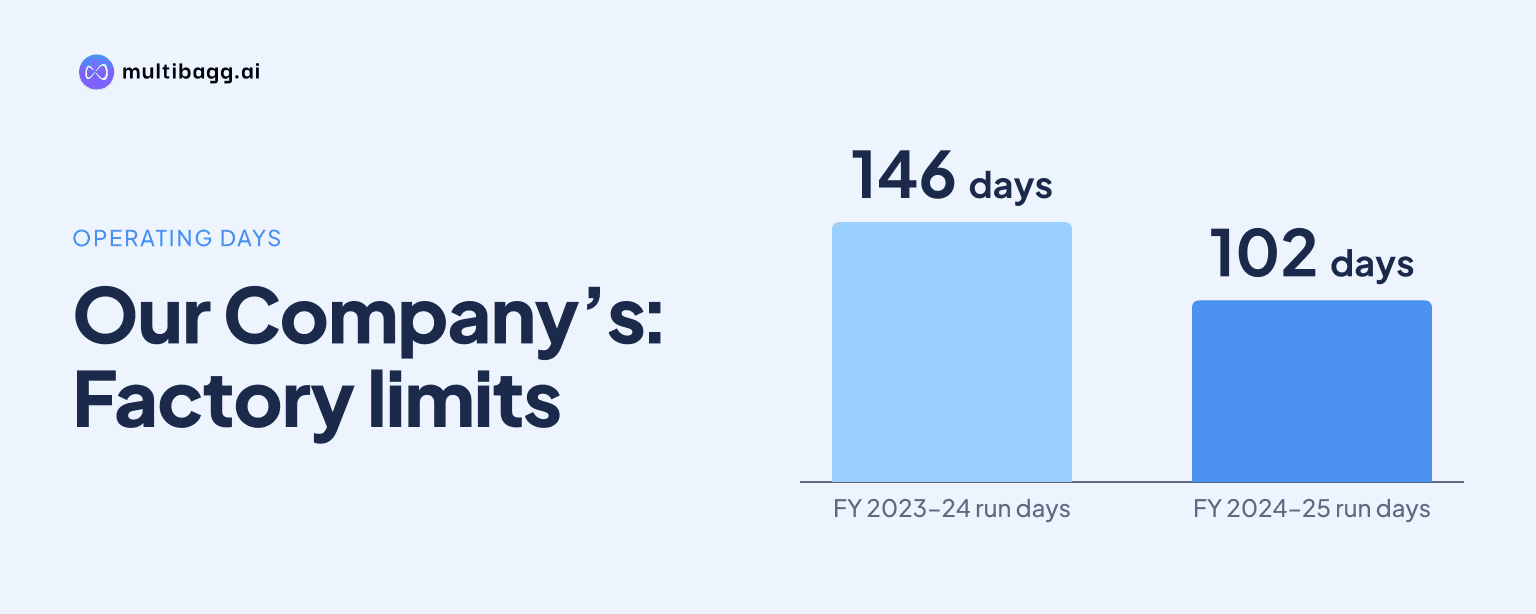
Our Company’s factory operated for only 102 to 146 days in FY 2023-24 through FY 2025-26 because sugarcane crushing is seasonal, while khandsari sugar used 8.03% of its 7,722 metric tonne installed capacity in FY 2025-26. The operating window, cane availability and procurement costs therefore affect production, working capital and cash flow.
Why is Our Company’s factory operation seasonal?
Our Company operates seasonally because manufacturing depends on fresh sugarcane during a crushing season that generally runs from October-November to April-May. The precise period depends on climatic conditions, rainfall, crop maturity and other agricultural factors rather than a fixed annual production schedule.
Our Company must process cane promptly after harvest because sugarcane begins losing sugar content shortly afterwards. Timely harvesting, transportation and factory intake therefore affect sugar recovery and conversion into jaggery, jaggery powder and khandsari sugar.
The disclosed operating records show material variation across three financial years. FY 2024-25’s 102-day period was 44 days shorter than FY 2023-24’s 146 days, while FY 2025-26 recovered by 18 days to 120 days but remained 26 days below FY 2023-24.
How did seasonal crushing affect Our Company’s capacity use?
Our Company’s jaggery and jaggery-powder plants recorded utilisation above 80% in each disclosed full year, although their installed capacity and production volumes changed with the operating schedule. In FY 2025-26, jaggery utilisation was 93.53% and jaggery-powder utilisation was 94.09%, compared with 83.84% and 87.15% in FY 2024-25.
Utilisation measures production against installed annual capacity and does not remove seasonal dependency. Jaggery installed capacity fell from 182,500 metric tonnes in FY 2023-24 to 127,500 metric tonnes in FY 2024-25, then rose to 150,000 metric tonnes in FY 2025-26; utilised capacity moved from 169,326.63 metric tonnes to 106,893.44 metric tonnes and then 140,298.62 metric tonnes.
Our Company’s khandsari sugar line presents a separate utilisation issue. It had 7,722 metric tonnes of installed capacity in FY 2025-26 but used 620 metric tonnes, or 8.03%; no capacity figures were reported for FY 2023-24 or FY 2024-25. Higher output would require production during the available crushing season, adequate cane procurement and product demand.
What could shorten Our Company’s crushing season?
Our Company identifies lower cane availability, a delayed start and a shorter harvesting window as direct risks to factory operating days. Adverse weather, inadequate rainfall, water scarcity, pest infestations, crop diseases and changed cropping patterns can affect both the quantity and quality of sugarcane available for processing.
Sugarcane is planted in spring, from February to April, and/or autumn, from September to October, and harvested after 10 to 18 months depending on variety and climatic conditions. Water availability, rainfall and temperature can therefore affect factory throughput as well as cane procurement prices during a crushing season.
In FY 2025-26, sugarcane purchases were Rs 36.89 crore, or 49.01% of revenue from operations, compared with Rs 26.71 crore, or 45.61%, in FY 2024-25. The FY 2023-24 ratio was 139.63%, but Our Company says it is not comparable because revenue was generated for only four to five months, versus 12 months in each following year.
Our Company has no long-term supply arrangements with suppliers or farmers, no formal hedging policy and does not use commodity-futures hedging. Continued production therefore depends on seasonal cane procurement at workable prices and the ability to pass higher input costs to customers.
Got a follow-up? Ask IRIS
Why do harvesting and transport matter to Our Company?
Our Company uses seasonal arrangements with harvesting and transportation contractors before each crushing season to move sugarcane from nearby farmers to its factory. Labour shortages, vehicle unavailability, contractor disputes, strikes, accidents, fuel shortages or weather disruptions could delay deliveries while cane quality is time-sensitive.
Harvesting and transportation expense was Rs 14.48 crore in FY 2025-26, equal to 19.23% of revenue from operations, up from Rs 8.68 crore, or 14.82%, in FY 2024-25. The FY 2023-24 expense was Rs 15.68 crore, or 43.24% of revenue, but that ratio is not comparable because that year’s revenue covered only four to five months.
Our Company states that a substantial portion of cane supply comes from rural and village areas where road, transport and communications infrastructure may be limited. Deterioration in connectivity can interrupt cane movement, lower sugar recovery, reduce production and delay fulfilment of manufacturing requirements.
How does seasonality affect Our Company’s cash flow and costs?
Our Company says revenue, profitability, production, working-capital requirements and cash flows can vary materially between reporting periods because substantial manufacturing occurs during the crushing season. Financial results for one period may therefore not be directly comparable with preceding, succeeding or corresponding periods.
Our Company may continue to incur employee, maintenance, administrative and other overhead costs outside the crushing season even as production declines. Fixed and operating expenses may not reduce proportionately with output during non-crushing months.
Cash-flow history illustrates the timing effect. Our Company generated Rs 5.04 crore of operating cash in FY 2025-26 and Rs 13.24 crore in FY 2024-25, after using Rs 17.79 crore in FY 2023-24. The Company attributes the FY 2023-24 outflow to working-capital deployment for raw materials and inventory while revenue was generated for only four to five months.
Conclusion
Our Company’s disclosed record shows a business tied to a short cane-crushing window of 102, 120 and 146 factory operating days in FY 2024-25, FY 2025-26 and FY 2023-24, respectively. High utilisation at jaggery and jaggery-powder facilities does not remove exposure to crop availability, contractor performance, raw-material pricing and off-season costs, while khandsari sugar utilisation was 8.03% in FY 2025-26.
The next disclosed operational milestone is the FY 2026-27 crushing and production cycle, which had not started as of 31 July 2026. The start date, duration, cane availability, khandsari sugar output beyond the FY 2025-26 level of 620 metric tonnes, and harvesting and transportation expense relative to revenue remain relevant measures to watch.